
Carrie Bradshaw of the Middle East
Breakups and Oslo Accords

Adapted meme based on a scene from Sex and the City (HBO), included here for cultural commentary.
I sat in the shower, rosemary shampoo in my hair, water falling on me, replaying my last exchange with New Guy. Since I started dating at fourteen, I’ve had more breakups than I care to admit. They’ve come with a reason– a clear reason X guy and I aren’t together. There was the possessive guy who couldn’t stand it when I made eye contact with another man, or the guy who left me for the petite girl who looked just like me minus thirty pounds. With New Guy, it felt frustratingly vague. Listening to Rosalia’s Lux album on repeat, hoping my imported Colombian shampoo would absorb into my scalp and fix all my problems, I was overcome by intense sympathy for Bill Clinton.
Okay, hear me out. I know I lost you there, and, really, that’s more about general lack of understanding of the Oslo Accords than my abrupt left turn into geopolitics. I’ll elaborate.
The year is 1993. Israel didn’t officially want to negotiate with the PLO (Palestine Liberation Organization), the effective government of the Palestinian people. The PLO wanted that maybe less. So, the Oslo Accords began in secret, in a secluded manor in the Norwegian countryside, giving both sides a chance to explore the relationship without the immediate pressure of public opinion or political backlash. Which is probably why I never met New Guy’s friends.
In August 1993, after eight months of heavy petting, Israeli Prime Minister Yitzhak Rabin and PLO Chairman Yasser Arafat were ready to define the relationship and make it public, which meant bringing in the world’s most powerful mediator: President of the United States, Bill Clinton.
The Scandinavian romance novel that were the Oslo Accords, the most significant breakthrough we’ve had to date in the Israeli/Palestinian conflict, happened without the United States in the room. Feeling pumped and excited to be a part of this blossoming new relationship, Bill put all of his personal and political capital into bringing both sides together for an engagement party. It was then that on US soil, Rabin and Arafat, two people who had spent their entire lives as enemies, shook hands.
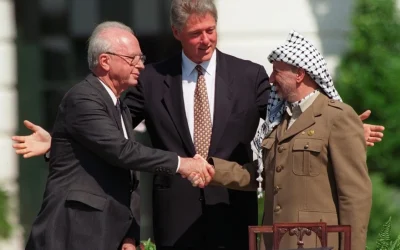
Imagine being Bill Clinton for a moment. No, not that part. Not the part you’re thinking of. Imagine being President Bill Clinton on September 13th, 1993, watching one of the world’s most controversial, oversimplified, misunderstood conflicts come to a tentative end on the South Lawn of the White House. After that, Bill would spend seven years trying to turn the engagement into a marriage. This could land him a Nobel Prize, or at least a Best Man speech. That night, Bill and I went to sleep laying on the chest of the man/geopolitical quagmire we were invested in and telling ourselves bedtime stories of what the future held.
Except, then someone left. They decided they didn’t want the future they had spent a couple of months/the better part of a decade negotiating toward. Yasser Arafat, for reasons people still argue about, I guess, was just not feeling it. Depending on who you ask, Arafat walked away from the best offer he’d ever get, or from bare minimum behavior. Either way, Bill woke up to an empty bed without the future he’d been imagining.
How do you make sense of someone leaving when the explanation doesn’t feel coherent to what you’ve experienced? That’s the question Bill, the world, and I have had to grapple with. At least my breakup didn’t define international affairs for the next three decades, though it’s too soon to tell.
Understanding is not a prerequisite for accepting someone’s decision. I was completely blindsided, but I accepted the simple truth that no is no. Bill did not. In his defense, there was much more at stake. When Arafat declined the proposed framework that had been negotiated for years, Bill tried to make it work, hoping Arafat would seize the opportunity or, at least, commit to working on the relationship. The talks collapsed in 2000, and within months, the Second Intifada broke out, igniting a larger wave of violence in the region, and, in Bill’s heart.
Relationships change you, no matter how short. If you come out of something completely unchanged, I don’t believe you let yourself open up to it at all. Likewise, the Oslo Accords set a framework, a temporary arrangement meant to create a sense of stability as negotiations moved forward. Imagine breaking up with someone but deciding to share the apartment. You get the kitchen for meal prep on Mondays, they get it on Tuesdays, and you share the living room to fold your laundry. That’s essentially what Oslo did. The breakup happened. The logistics didn’t. The West Bank was divided by the governing bodies into areas A, B, and C, which seemed like a good idea at the time. It was meant to last five years. With neither party at the table, the interim map became a practical reality.
That’s the irony of the breakup. Unprocessed, it led both sides to greater instability, giving us an emotional landscape too convoluted for any therapist to make sense of. New Guy was probably glad I never left anything at his place. The Oslo framework left millions of Palestinians and hundreds of thousands of Israelis living inside an arrangement that was never meant to become permanent. However abrupt New Guy’s ending was, at least it wasn’t that.
Bill still talks about that breakup to this day. I think he truly believed peace in the Middle East was a defining aspect of his legacy. Not the…other stuff. He thought both sides had the same long-term goals. I did, too.
I still don’t understand why New Guy left, no matter how much I remind myself that the reason doesn’t matter. The hardest part is realizing that the future you started to imagine won’t metabolize, which is probably how Bill felt as his dreams of world peace were shattered. Still, he got a presidential library out of it. Me? I got back on Hinge.
Related Topics