
Britain Has Finally Named the Threat. Now It Must Finish the Job.
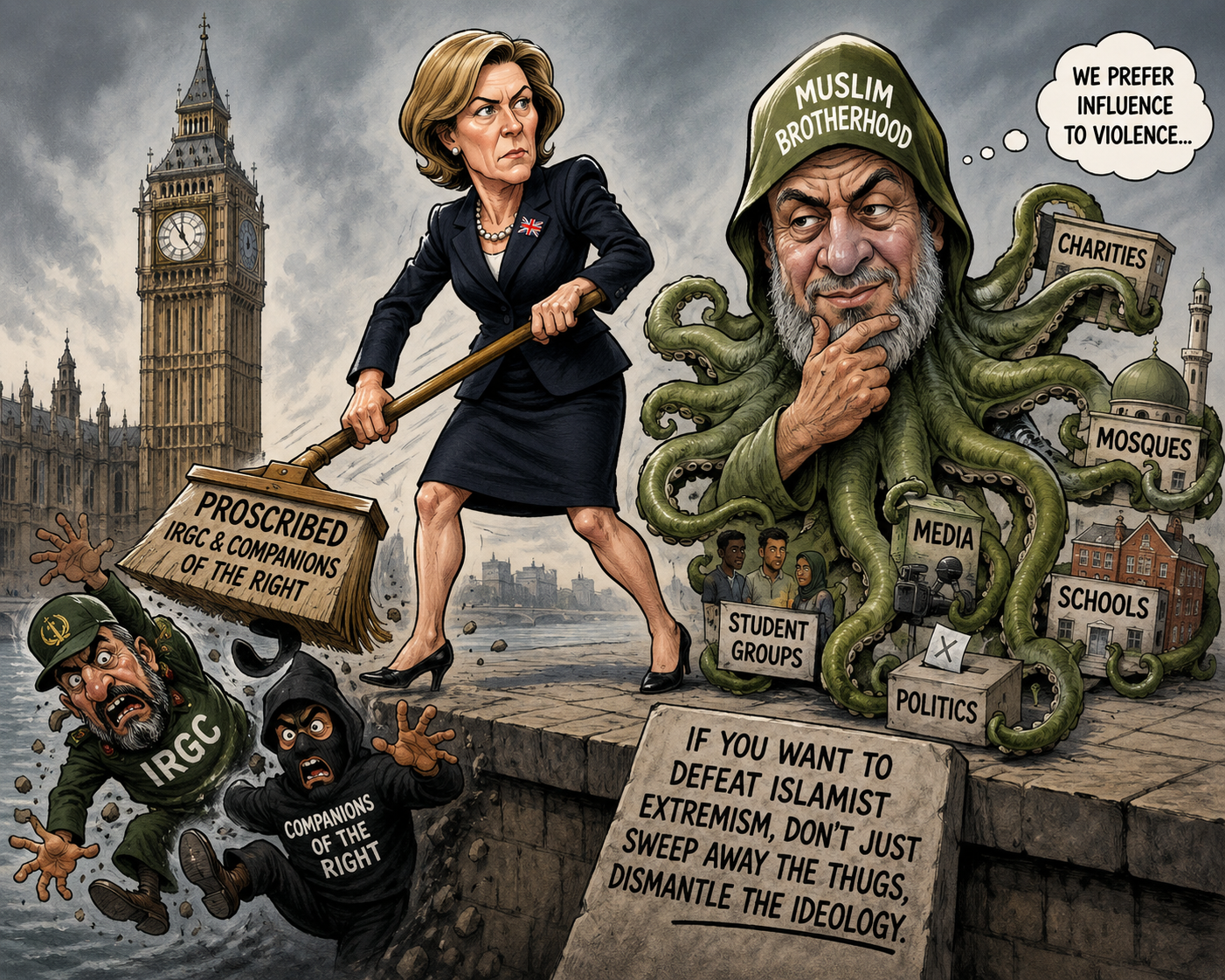
For years Britain has fought Islamist extremism like a doctor treating recurring fevers while refusing to diagnose the infection.
Every attack has been followed by another inquiry. Every plot by another review. Every warning by another promise that lessons had been learned. Yet the underlying problem has remained remarkably untouched.
The Government’s decision to proscribe the Islamic Revolutionary Guard Corps and Companions of the Right is therefore more than another national security announcement. It signals a long-overdue recognition that Britain is confronting something far more organised than isolated acts of terrorism. It is confronting an ideological ecosystem.
The IRGC was never simply another branch of the Iranian state. It is the regime’s praetorian guard, intelligence apparatus, economic empire and revolutionary export mechanism rolled into one. Wherever Tehran has projected influence, armed proxies or political intimidation, the fingerprints of the IRGC are rarely far behind. Its objective has never been confined to defending Iran. It exists to defend the Islamic Revolution wherever the regime believes its interests require it.
Companions of the Right illustrates just how far that doctrine has evolved.
Reports suggest the organisation was established as a contingency network, designed to carry out acts of violence across Western capitals should the Islamic Republic itself come under serious threat. That is not simply terrorism. It is deterrence by proxy. The message is unmistakable: challenge Tehran, and the consequences will not necessarily be confined to the Middle East.
Britain was right to respond.
The question now is whether ministers are prepared to follow their own logic.
For decades, British counter-terrorism policy has concentrated on the final act. We become appropriately determined once a bomb explodes, a knife is drawn or a vehicle is driven into a crowd. By then the ideological work has already been done. The recruitment has happened. The worldview has taken root. The moral barriers that once prevented violence have already been dismantled.
Extremism rarely begins with an explosive device.
It begins with an idea.
The belief that divine authority supersedes democratic law. That society should be organised according to religious ideology rather than civic equality. That loyalty belongs first to a movement, and only second, if at all, to the nation in which one lives.
Violence is often the final chapter, not the opening one.
That is why the conversation cannot end with the IRGC.
It must also include the Muslim Brotherhood.
The Brotherhood is not the IRGC. They differ in history, structure and method. One is the revolutionary arm of a state. The other is an international Islamist movement whose influence has spread through religious institutions, charities, educational networks and political activism. Confusing the two would be intellectually careless.
Ignoring the relationship between them would be equally careless.
For almost a century, the Brotherhood has advanced a political project rooted in the gradual Islamisation of society. It has generally preferred patient institutional influence over armed confrontation. That distinction matters. So does the ideology itself.
Ideas have consequences.
The history of modern Islamist extremism cannot be understood without recognising the Brotherhood’s intellectual influence. Organisations have emerged from it, broken away from it, rejected its methods or embraced violence more readily. Yet many have continued to draw upon the same ideological foundations: political Islam, the primacy of religious governance and the rejection of secular democratic authority as the ultimate source of legitimacy.
That should concern every liberal democracy.
The issue is not whether every member of the Brotherhood supports terrorism. It is whether Britain is prepared to examine movements according to the political culture they cultivate, rather than waiting until a tiny minority adopts violence.
Does an organisation promote equal citizenship regardless of faith?
Does it recognise the supremacy of Parliament over religious authority?
Does it encourage integration or separation?
Does it strengthen democratic institutions or gradually undermine confidence in them?
These are ordinary questions. They should be asked without hesitation.
There will be those who argue that proscribing the Brotherhood would be legally difficult, politically divisive or strategically unwise. Those objections deserve careful examination. Proscription is one of the most serious powers available to the state and should never be exercised lightly.
Neither should fear of controversy become an excuse for permanent inaction.
Britain has spent years studying the Brotherhood, acknowledging its influence and recognising the challenge posed by political Islam, while repeatedly stopping short of meaningful action. That ambiguity has served ideological movements far better than it has served British democracy.
The decision to proscribe the IRGC and Companions of the Right marks a welcome change of direction. It acknowledges that modern extremism is sustained not only by those who commit acts of violence but also by the structures that finance, legitimise and encourage it.
If Britain is serious about confronting Islamist extremism, then consistency matters.
It cannot dismantle one part of the architecture while leaving another untouched.
The Government has finally recognised the danger posed by Tehran’s revolutionary network.
Now it must show the same clarity when confronting the wider ideological movements that have spent decades preparing the ground on which extremism grows.