
Britain must not forget its latest terror attack
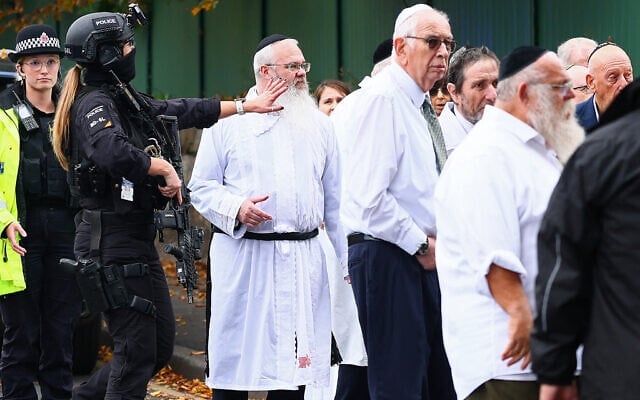
Britain has seen terror before. The IRA’s bombing campaigns in London, Dublin and Manchester; the Islamist terror attacks of 7/7; and yesterday in Manchester, when, as Jews marked Yom Kippur, the holiest single day in the entire 354 days of the Jewish calendar, two worshippers were murdered in cold blood.
The two men were killed, and three others grievously wounded, outside the Heaton Park Hebrew Congregation synagogue in northern Manchester on the 2nd October, when the terrorist tore into the grounds armed with a knife and a mock explosive belt. The assailant, later named in reports as Jihad al-Shamie, was shot dead by police at the scene; and an independent inquiry has already begun to probe all the circumstances. Unfortunately, the GMP has recently confirmed that one of the victims sustained a gunshot wound from a weapon fired by the police.
The moral clarity at play here is not difficult: the murderer bears the guilt. But political responsibility is miles wider than individual criminality. Terrorism does not simply arise in a vacuum; it feeds on public atmospherics, on political cues. And that is exactly why the posture of a prime minister matters. Kier Starmer, who has led Britain’s government since July 2024, set two very public precedents this year.
The first was the plan to recognise a Palestinian state in May earlier this year. And yet, we have heard these before: in 1974, the PLO was granted UN observer status just weeks after the Ma’alot massacre in Israel, in which 26 civilians, most of them children, were slaughtered. Symbolic gains in the wake of violence only harden the lesson for militants that by murdering civilians, the world will listen. That Starmer followed through with it in September is inconceivable: If Hamas applauds your decision, declaring ‘victory’ in response, surely then is the time to go on a rather long journey of reflection.
The second was the expansion of proscription powers against ‘extremist groups.’ Yes, this policy should, on paper, have strengthened security. In practice, though, it acted, if at all, to blur the lines between genuine incitement and protest movements. Islamist agitators, eager to claim victimhood, now had fresh grounds to argue repression.
Critics will argue that to link Manchester directly to Starmer’s decisions is crude. After all, terror networks are decades in the making. Al-Qaeda’s roots stretch back to the Afghan jihad of the 1980s; Hamas emerged in 1987 out of the Muslim Brotherhood; and yes, Britain’s own terrorists were already networked long before Labour’s latest manifesto. The Prime Minister neither pulled the trigger nor wielded the knife.
But politics is not about direct causality alone, but about signals. Tony Blair understood this when, following 7/7, he insisted that Britain ‘will not be divided.’ Every phrase, every symbol, every recognition or proscription sets the climate in which terrorists calculate their costs and benefits.
And so we return to Manchester: a terrorist stormed a synagogue with a knife. No symbolism of Starmer’s, no geopolitical calculation aimed to appease other European world leaders can erase the fact that terror thrives when politics loses its own sense of clarity.
Blood in the sanctuary is among history’s more chilling signals, and history shows that democracies are never safe when they equivocate. If Starmer truly wishes to break the cycle, he must not govern symbolically, but competently. Britain’s Jews should never again stand unprotected, and it is time for the realisation of that fact to become commonplace.