

Critiquing Ireland's "anti-Zionist" mindset
‘Build Bridges, Not Walls’ – Pope Francis
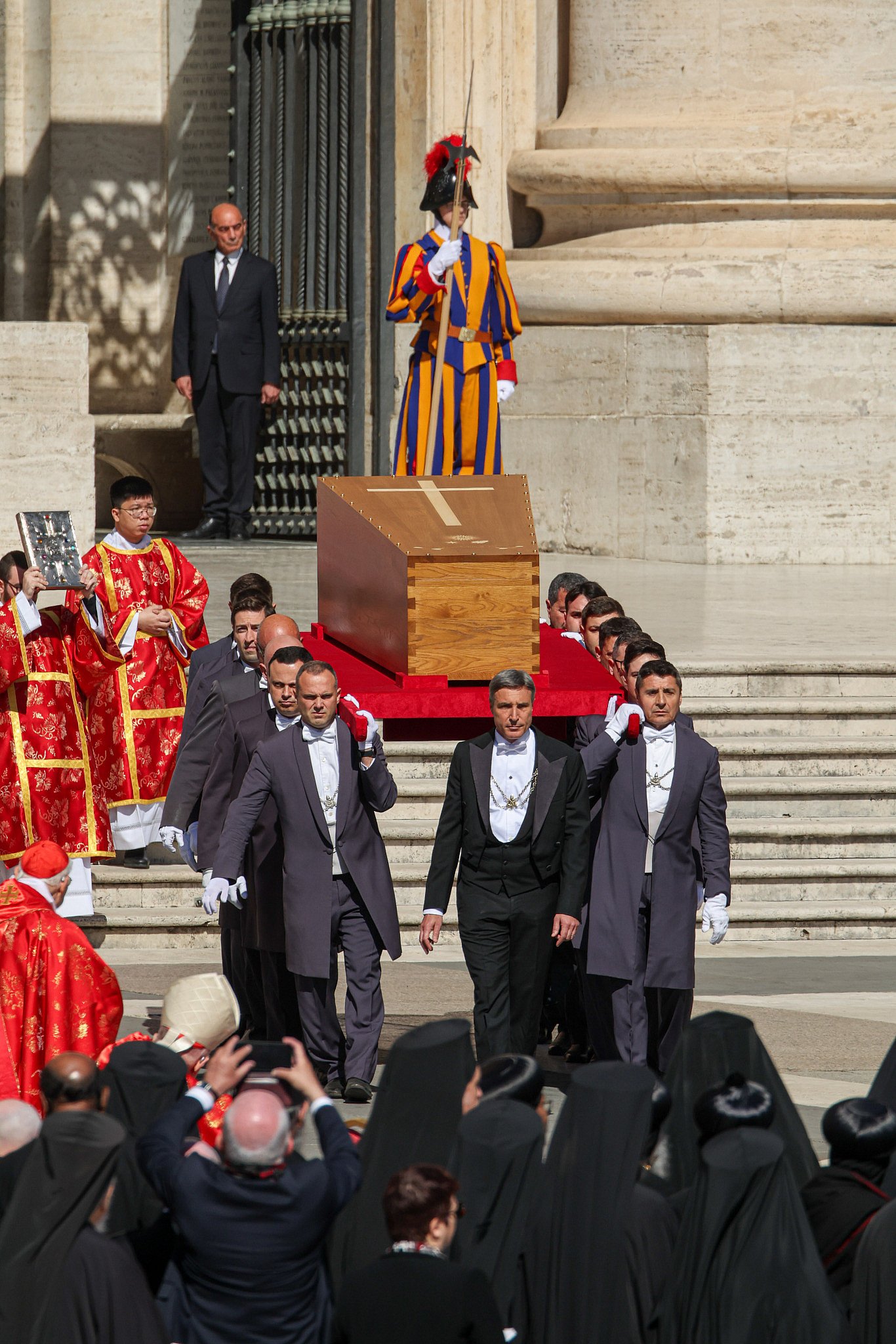
Funeral ceremony of Pope Francis in the Vatican City (credits: CC 4.0)
When Diplomacy Died in Rome: President Higgins’s Misjudged Moment
By any measure, the funeral of Pope Francis was not the stage for partisan politics. Heads of state, religious leaders, and ordinary pilgrims gathered in Rome to honour a pontiff whose legacy was one of dialogue, compassion, and bridge-building.
Yet amid the solemn ritual, Ireland’s President Michael D. Higgins chose to use his press conference to score political points — this time at Israel’s expense.
Asked about Pope Francis’s support for the people of Gaza, Higgins replied that it was “very significant, not only who is at the event today, but who is missing.” The barb was unmistakable: a jab at the absence of Israel’s Prime Minister, made sharper by its setting — a papal funeral meant to transcend politics.
His comments quickly expanded into a familiar tirade: denunciations of Israel’s conduct in Gaza, charges of starvation and blockade, and a defence of those who criticise Israel as being unfairly labelled antisemitic. The rhetoric was vintage Higgins — passionate, moralistic, and wholly undiplomatic.
A Consistent Crusade
No one should be surprised. For decades, Higgins has cast himself as the moral conscience of Irish public life. Whether addressing the UN or the Irish National Ploughing Championship, he speaks with the certainty of a prophet rather than the caution of a president. He sees global politics in stark moral contrasts: the oppressors and the oppressed, the powerful and the powerless. In this framework, Israel invariably occupies the darker role.
Ireland’s official foreign policy, by contrast, is careful and legalistic. It recognises Israel’s right to exist, supports a two-state solution, and condemns both Hamas terrorism and Israeli settlement expansion. It is cautious diplomacy, shaped by European consensus. Higgins’s version is something different — a lone-voice morality play in which nuance rarely survives.
The Optics of Outrage
There is an irony that should not be lost on anyone. In 2021, Higgins declined to attend an ecumenical service marking the centenary of Northern Ireland, saying the event had become “politicised” and therefore inappropriate for a head of state. Yet in Rome, at a deeply religious occasion, he himself injected politics of the most pointed kind. The inconsistency is glaring.
Worse still, his rhetorical flourish about “who is missing” ignored the many other absentees from the funeral: Egypt, Kuwait, Yemen, the Palestinian Authority, and even China — all nations with considerable moral or geopolitical weight.
To single out Israel alone, while two significant Jewish representatives — Rome’s Chief Rabbi Riccardo Di Segni and Israel’s ambassador to the Vatican — were in attendance, betrayed either poor briefing or deliberate selectivity. (1)
This is what makes the episode troubling. Higgins’s moral indignation routinely targets Israel, rarely Hamas. His language on Gaza is drenched in empathy; his references to terrorism, hostage-taking, or the cynical use of civilians as shields are fleeting, if mentioned at all. For a man who prides himself on “balance and humanity,” this asymmetry weakens the credibility of his moral stance.
The Pontiff’s Example
Contrast that tone with the papal funeral message delivered by Cardinal Giovanni Battista in his funeral homily for Pope Francis:
“Pope Francis incessantly raised his voice imploring peace and calling for reason and honest negotiation to find possible solutions… build bridges, not walls.” (2)
Francis, for all his progressive zeal, understood that moral leadership requires engagement, not denunciation. He condemned antisemitism and treasured Catholic-Jewish relations, following the spirit of Nostra Aetate, Pope Paul VI’s 1965 encyclical that rejected all forms of persecution against Jews. His diplomacy was patient and pastoral — what the Church calls accompaniment rather than confrontation (3)
By contrast, Higgins’s ham-fisted intervention felt more like a protest rally than a papal reflection. Where Francis sought to heal, Higgins sought to accuse. Where the pontiff built bridges, the President flung stones from the parapet.
When Advocacy Becomes Hubris
There is a place for moral clarity in politics. But when that clarity hardens into selective outrage, it ceases to enlighten. The Gaza tragedy is real and horrifying — multi-thousands dead, a humanitarian disaster that demands conscience and compassion. Yet the path to peace will not be built by assigning all blame to one side or by turning state funerals into platforms for partisan invective.
The President’s defenders will argue that he merely “spoke truth to power,” that silence in the face of suffering is complicity. But moral courage is not measured by volume. It is measured by the ability to see complexity, to acknowledge pain on both sides, and to summon empathy even for those we criticise. Higgins’s speech in Rome failed that test.
A Question of Tone — and Timing
Diplomacy often lives or dies by tone. The right words at the wrong time can undo years of quiet bridge-building. In this case, Higgins’s timing was doubly unfortunate: during the funeral of a Pope who personified dialogue, and at a moment when Jewish-Catholic relations remain delicate in the shadow of rising global antisemitism.
The Pope’s death could have been a moment of shared grief and renewed commitment to peace — a chance to honour Francis’s vision of “stepping outside our comfort zones” to engage meaningfully with others. Instead, Higgins turned it into a podium for familiar polemics. The global press dutifully reported his quotes; few reported Ireland’s presence at the funeral itself.
The Cost of Moral Theatre
Higgins’ condemnatory, messianic-style “vision” carries guaranteed global visibility. But how much did he highlight the role of Hamas, other Middle Eastern militant groups, or even the role that Arab states played in perpetuating the Israel / Hamas War?
In the end, Higgins’s performance in Rome tells us less about Israel than about Ireland’s President himself: a man convinced that moral theatre equals moral leadership. Yet the real art of diplomacy — the art Francis modelled — lies in restraint, empathy, and the quiet labour of listening.
In choosing confrontation over compassion, Higgins diminished the dignity of his office and, ironically, the moral authority he so cherishes. The bridges Pope Francis built deserve better than to be trampled in the dust of yet another “cracked record” anti-semitic speech.
_________________________________________________________________________
| Aspect | Official Irish Diplomacy | Higgins’ Approach |
|---|---|---|
| Tone | Cautious, legal, balanced | Moralistic, polemical, partisan |
| On Israel | Recognizes legitimacy of state; criticizes settlements and military excesses | Frames Israel as central oppressor; rarely notes Israeli security concerns |
| On Palestinians | Supports statehood, condemns terrorism | Focuses heavily on Palestinian suffering, downplays Palestinian militancy |
| Diplomatic style | EU-aligned, multilateral, bridge-building | Solo voice, prophetic/activist register |
| Audience | Governments, diplomats, UN | Wider moral public, media, activists |
_______________________________________________________________________________________
Sources:
- Who attended Pope Francis’ funeral? A list of world leaders https://www.reuters.com/world/global-leaders-set-attend-pope-francis-funeral-2025-04-22/
2. Pope’s funeral hears call to ‘build bridges, not walls’
https://www.catholicnewsagency.com/news/263695/pope-francis-funeral-full- text-of-homily-by-cardinal-re
3. DECLARATION ON THE RELATION OF THE CHURCH TO NON-CHRISTIAN RELIGIONS – NOSTRA AETAT – PROCLAIMED BY HIS HOLINESS POPE PAUL VI ON OCTOBER 28, 1965 https://www.vatican.va/archive/hist_councils/ii_vatican_council/documents/vat-ii_decl_19651028_nostra-aetate_en.html