Builders –- Reflections on America’s 250th Anniversary
”Let the word go forth from this time and place, to friend and foe alike, that the torch has been passed to a new generation of Americans…”
— John F. Kennedy, Inaugural Address, January 20, 1961
America turns 250 this year.
For a nation, that is an extraordinary achievement. History is filled with countries that rose, flourished, and disappeared long before reaching such a milestone. For a Jew, 250 years is but a brief chapter in history. Yet anniversaries like this invite us to do more than celebrate.
They invite us to reflect: How does a free people endure for two and a half centuries?
Constitutions matter. Laws matter. Rights matter.
But as I have reflected on America’s 250th anniversary, I have come to believe that something else matters just as much. Every generation inherits institutions it did not build and must decide what it will preserve, what it will strengthen, and what it will pass on. That has long been one of the guiding principles of my life.
Whether at home, at work, or in my community, I have tried to leave things just a little better than I found them.
Only recently did I realize who had taught me that lesson. It wasn’t from a book. It wasn’t from John F. Kennedy. It came from two builders.
Building was the family business.
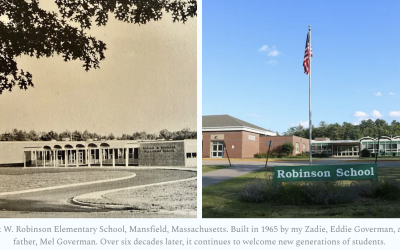
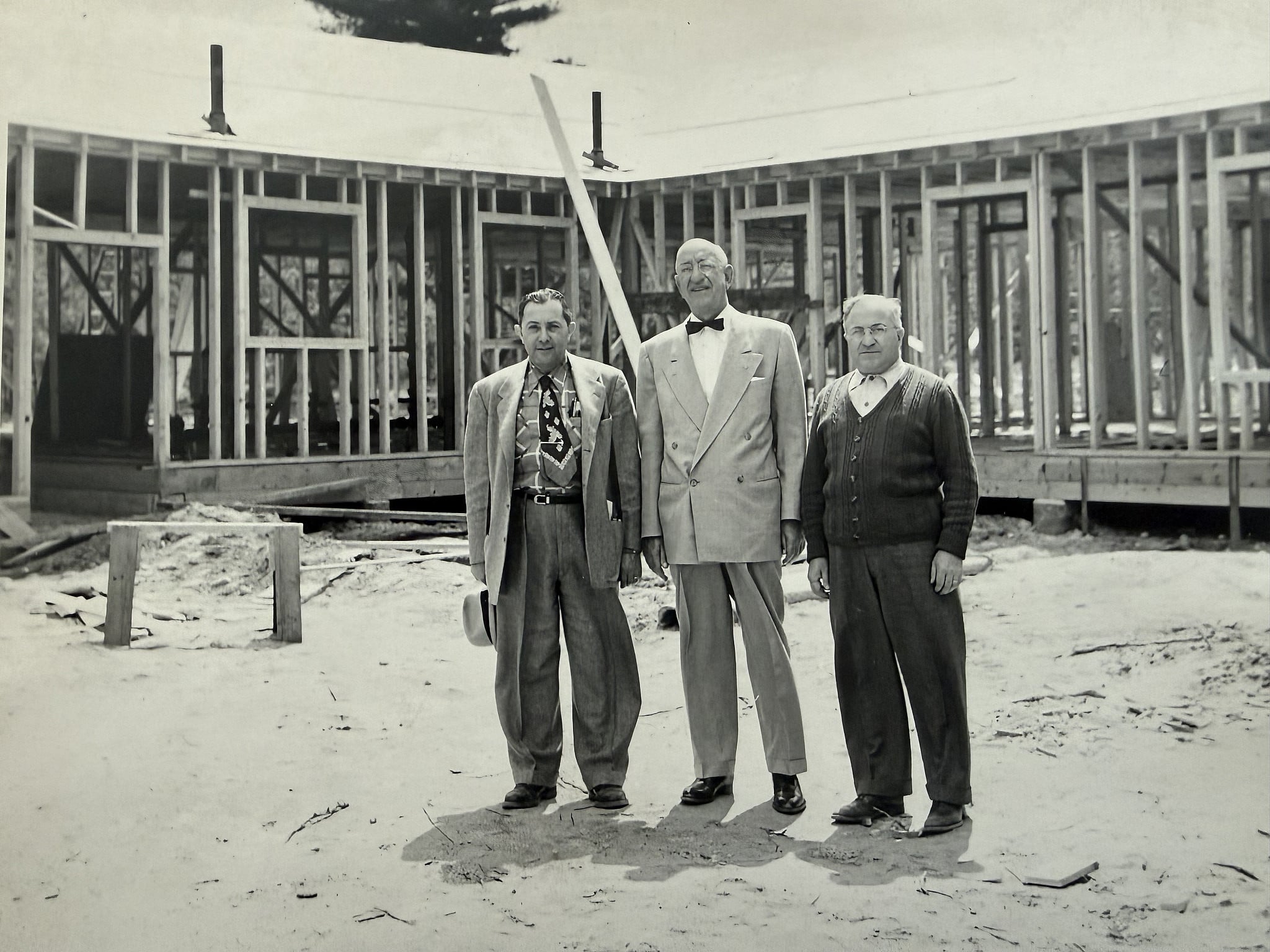
My Zadie, whom everyone else knew as Eddie, built schools and other public buildings throughout Boston’s rapidly growing suburbs during the postwar boom of the 1950s and 1960s. My father, Mel, served in the Navy after World War II. When he returned home, the GI Bill made it possible for him to earn a degree in architecture before returning to the family business. Together, they helped build places where generations of children would learn, grow, and eventually become citizens.
For most of my life, those schools existed only as a handful of old black-and-white photographs my mother passed along after my father died. I would occasionally look at them, but I never really saw them.
Only recently have I begun to see them differently.
Today, when I look at one of those photographs, I no longer see a school. I see children walking through doors built by two men they would never know. I see teachers investing in young minds. I see parents dropping off sons and daughters with the quiet confidence that another school day has begun.
I see two builders who never met any of those children, yet somehow helped shape all of their futures. That realization caught me by surprise. Until I began reflecting on America’s 250th anniversary, I had never connected those old photographs to the country I love.
My father and my Zadie thought they were building schools. In reality, they were building for people they would never meet. The Founders did much the same. They built a constitutional republic they knew they would never fully inhabit, trusting that generations yet unborn would carry it forward.
Their medium was not brick and mortar, but ideas made durable through institutions.
They understood something history has confirmed time and again: free societies are fragile. Constitutions can be amended. Laws can be repealed. Rights can be expanded—or diminished. No document, however brilliantly written, can preserve a republic by itself. That responsibility belongs to its citizens.
The Founders never expected perfection. They argued passionately, compromised reluctantly, and left important work unfinished. They trusted that future generations would preserve what was worth preserving, improve what needed improving, and leave the republic stronger than they found it.
That is the promise, and the burden, of self-government. It also explains why I worry about this moment in our country’s history. Not because we disagree. Americans have always disagreed. Not because our politics have become loud. Politics has often been loud. I worry because we seem to be losing the habits that make self-government possible.
We speak often about our rights, but far less about our obligations. Rights are among America’s greatest achievements, and they deserve to be protected. But rights alone cannot sustain a republic. Self-government ultimately depends upon self-governing citizens—people willing to stay informed, serve their communities, vote, volunteer, treat political opponents with respect, and place the long-term health of the country above the passions of the moment. Those habits rarely make headlines. But they are what keep republics alive.
Like many Americans, I worry about the decline of civics in our schools. I worry about the incentives created by social media and the twenty-four-hour news cycle. I worry that outrage has become easier than understanding, certainty more fashionable than curiosity, and cynicism more common than gratitude.
Those concerns are real. But worry is not cynicism. It is easy, in an age of endless headlines and endless outrage, to conclude that the American experiment is failing.
I don’t believe that. I’m worried about our future, but I refuse to become cynical about it. A nation does not endure for 250 years by accident. It endures because generation after generation chooses to build more than it tears down, contribute more than it consumes, and carry the torch faithfully until it is time to place it in someone else’s hands.
Which brings me back to John F. Kennedy.
My family has learned that almost any conversation can trigger my Kennedy impression. Politics. Patriotism. The Fourth of July. Sometimes no obvious reason at all.
Before long, I’m standing a little straighter, slipping into my best Boston accent and beginning, “Let the word go forth from this time and place…” By now, my son-in-law Ian usually joins in. He knows the speech almost as well as I do, and together we eventually arrive at my favorite passage.
”…the torch has been passed to a new generation of Americans…”
At that point, my wife, my son, my daughter, and my daughter-in-law are usually smiling, rolling their eyes, and wondering if I’m ever going to retire the routine.
They’re probably right. I’ve been reciting those words for ages. For years, I assumed it was because I admired Kennedy’s eloquence. Only recently did I realize it was something else entirely.
Without ever saying it aloud, my father had spent his life living the very idea Kennedy described. A torch is never owned. It is carried for a little while, and then it is passed to someone else. Without realizing it, I had already seen that torch passed once before—from my Zadie to my father, and then quietly from my father to me.
My Zadie was a complicated man. He was a loving grandfather, but not always an easy father. Like many families, ours had its share of imperfections, disappointments, and wounds. Yet somehow, across those imperfections, something precious still found its way from one generation to the next.
My father never gave me a lecture about stewardship. He simply lived it. On many weekends, I worked beside him, handing him nails from the pockets of his old Grossman’s Lumber apron while he tackled another project and assigned me the cleanup. Every job deserved to be done well. Every job site deserved to be cleaned before we went inside. When the family business eventually failed, he quietly reinvented himself and built a successful second career. Looking back, I realize he wasn’t teaching me carpentry at all. He was teaching me responsibility—for my work, for my family, and for the world I would someday leave to others.
Only now, as I reflect on America’s 250th anniversary, do I fully appreciate that Kennedy’s torch was never really about politics. It was about what every generation chooses to pass on.
All of us inherit something precious that we did not create. For Americans, it is this remarkable constitutional republic. For me, as a Jew, it is also a tradition that has endured for more than three thousand years. As a father and grandfather, it is the privilege—and the responsibility—of passing along values that cannot be measured in dollars or inscribed on a dedication plaque.
We hold these gifts for only a little while. Then, like the torch, we pass them on.
The older I get, the more I find myself wondering not only what I have inherited, but what I will leave behind. My father and Zadie left behind schools that continue to educate children they never knew. Their work was visible and tangible. Much of my own professional life was spent helping organizations implement software systems. That work was largely invisible.
For years, I wondered whether I would ever leave behind something as tangible as the buildings they constructed. I’m no longer sure that’s the right question.
Perhaps the most enduring things we leave behind can never be photographed. Perhaps they are character. Citizenship. Children and grandchildren who inherit not only our names, but our convictions.
America’s 250th anniversary is, above all, a celebration of what millions of ordinary Americans have built together over twelve generations. Most of them will never have statues erected in their honor or chapters written about them in history books. But without them, there would be no America to celebrate.
The republic the Founders entrusted to us isn’t perfect. Neither were they. Neither are we. Perfection has never been the point. Our task is to preserve what is worthy, improve what needs improving, and faithfully pass it on to those who come after us.
Perhaps I finally have my answer. A republic endures not because any one generation gets everything right, but because its citizens accept responsibility for carrying it forward.
For a little while, the torch is ours to carry.
The Jewish tradition has a beautiful phrase that captures this responsibility better than any other I know.
L’dor v’dor.
For years, I translated those words simply as “from generation to generation.” Today, they mean something more. They remind me that every generation inherits a world it did not create. Every generation is given the opportunity to make that world just a little better. And every generation must eventually place the torch into someone else’s hands.
I don’t know whether I have always lived up to those ideals. I suspect none of us do. What matters is that we keep trying. That we continue to build more than we tear down. To contribute more than we consume. To leave things just a little better than we found them.
If, one day, one of my grandchildren asks why Zadie was always quoting John F. Kennedy, I hope the answer isn’t because I admired a great speech.
I hope it’s because I was trying to live it.
L’dor v’dor.