
Pro-Zionist Peace Activist, Editor and Commentator
Bundist Ghosts vs. Living Zionists
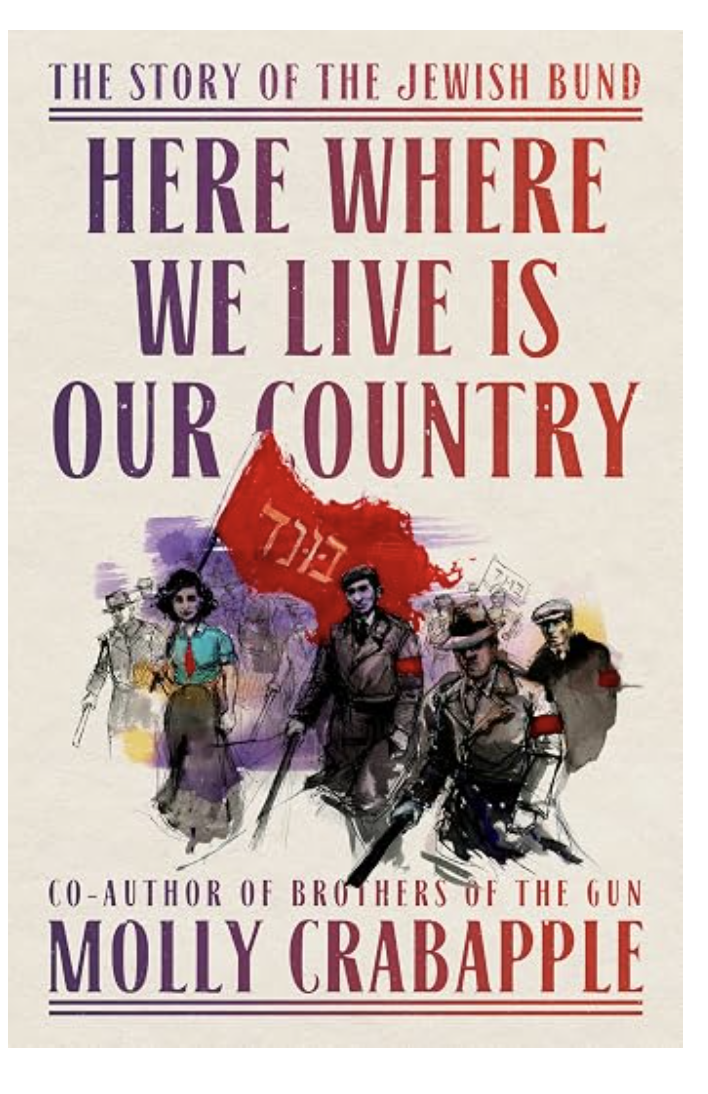
"Here Where We Live Is Our Country: The Story of the Jewish Bund" by Molly Crabapple, 2026, Random House, 480 pp.
Molly Crabapple’s book on the Jewish Labor Bund has captured the imagination of the anti-Israel left, and won herself kudos from much of the liberal press. She is an artist and writer whose birth name is Jennifer Caban. Her politics are apparently influenced by her Puerto Rican father, a professor of Latino studies and a Marxist. Her interest in art may emanate from her Jewish mother’s work as an illustrator.
The Bund was a major force on the revolutionary left in Czarist Russia, organizing workers’ councils and fighting units during the massive but ultimately suppressed revolution of 1905, and attempting to provide armed protection for Jewish communities facing bloody pogroms. As a political party in interwar Poland, it grew to become the largest vote-getter of any Jewish party on the eve of the Nazi onslaught. It cultivated the Yiddish language and culture, sponsoring schools, health facilities, sports clubs, youth groups and other institutions.
This is a fascinating story that deserves to be told. Crabapple focuses heavily on this Jewish movement’s opposition to Zionism. She forthrightly addresses some of its flaws, but in her telling, its rigidly doctrinaire anti-Zionism is not one of them.
The author’s interweaving of her personal and family history adds some warmth, but also seems forced in places. Where this works best is the story of her great-grandfather, the artist Samuel Rothbort, who was a young Bund activist apparently involved in a shootout that killed two policemen, before escaping Czarist Russia for New York.
Bundist Dogmatism
Despite her enthusiasm for the Bund, Crabapple reveals how dogmatic Bundists were, and politically naive. They rejected entreaties from Alexander Kerensky to join the provisional revolutionary government in 1917, because (correctly according to Marxist theory) Russia was not economically advanced enough to be “socialist.” The Bolsheviks had no such compunctions about taking power; as Crabapple relates, they relentlessly organized their coup against Kerensky’s hapless government, and eventually crushed all other parties, including the Bund.
In fact, Lenin’s Bolsheviks owe their name as “the majority” to a principled walkout of Bundists, a tactical blunder, during an internal socialist dispute in 1903. Crabapple recognizes that the Bund’s rigid devotion to principle and doctrine undermined it politically, but she also seems to know that they were never a match for Lenin, Trotsky and Stalin.
Almost to the end, forever true to doctrine, the Polish Bund refused to cooperate with Zionists in the Warsaw Ghetto. We also learn that the Bund turned down a proposal from a leftwing Zionist group (Dror) to join forces in Lithuania, even scoffing at early reports of the genocide. The Bund preferred its traditional alliance with the Polish Socialist Party; while generally sympathetic and helpful, the Socialists were limited in what they were able and willing to do.
As Crabapple notes without comment, the Bund refused Emanuel Ringelblum’s invitation to participate in the Oyneg Shabbos Archive project, solely because he was a “Zionist.” This provided a treasure trove of documentation on how Jews lived under the most dire circumstances behind the Warsaw Ghetto’s walls. The entirely separate Bund archive of Jewish life in the Ghetto has never been found. And the Bund initially refused to join with young leftwing Zionist activists to form the Jewish Fighting Organization (also known by its Polish initials as the ZOB), before finally relenting and fighting heroically alongside them and others.
Crabapple’s account of the Warsaw Ghetto Uprising is moving, but she can’t resist taking a gratuitous swipe at Mordechai Anielewicz, the young Hashomer Hatzair socialist-Zionist leader selected to command the ZOB; according to the author, he had an inflated ego and was the only one who really wanted it. He died at the age of 23, along with his girlfriend, as their command bunker was being flushed out by the Nazis. Their remains were never identified, but they surely lie in a mound, now a memorial, with scores of other fighters buried forever where they perished.

The Bundist Marek Edelman succeeded him as ZOB commander. A lifelong anti-Zionist, Edelman remained in Poland until his death in 2009, even after his wife and children emigrated to France because of the Communist government’s antisemitic purge campaign of 1968.
Crabapple’s fervent anti-Zionism remains to this day, as she cites the protests against “genocide” in Gaza as illustrative of the Bundist principle of “solidarity.” She describes Gaza as Israel’s “ghetto” being “liquidated,” ignoring how “liquidation” and “genocide” during World War II meant systematic and wholesale slaughter. The level of physical destruction in Gaza is epic, but over 95% of Gazans are still alive, even if living in squalor and privation. A relative handful of Jews survived the Warsaw Ghetto, and unlike some Gazans, none attacked innocent civilians.
While I reject these facile analogies to the Holocaust, I write this as someone who grieves at the suffering in Gaza and questions the relentless and brutal nature of Israel’s war there; I’m also outraged over Palestinians being attacked and dispossessed in the West Bank and East Jerusalem. Yet I favor a broader solidarity than she writes about, one that would promote peace for both Israelis and Palestinians. It would raise up anti-occupation Israelis (even if they identify as “Zionist”) who support Palestinian self-determination alongside Israel in two independent states, possibly joined in a confederation as advocated by a growing number of Israelis and Palestinians.
Zionist Pragmatism
She’s unfair to a prodigious Jewish undertaking that managed to preserve the lives of hundreds of thousands in Palestine who would otherwise have perished in Europe. The Bund was totally destroyed as a mass movement – first crushed in the Soviet Union by Communist totalitarianism, and then exterminated in Poland by the Nazi genocide – while Zionism succeeded in fulfilling Herzl’s dream of “the Jews’ state” (der Judenstaat).
In a postscript, the author addresses this obvious question: Why celebrate a movement that failed? Not “failed” says Crabapple, “lost.” She writes creatively that “Failure is what happens to those overcome by their own faults and errors; to lose is to succumb to greater force.” Then she argues more convincingly that the real failure was on the part of the Western democracies that allowed Nazi Germany to amass its power, and callously closed their doors to most of its Jewish victims.
It was a profoundly cruel and disordered world that validated the fearful premonitions of Zionists on the urgent need for Jews to flee Europe en masse. Crabapple admits this in a backhanded way, acknowledging that Britain’s White Paper of 1939 effectively shut the door to most Jews seeking escape from what became a giant killing ground.
A reviewer in The Forward finds another instance of candor in her book; Crabapple states that hundreds of post-war Bundist survivors found their way to Israel, because the Bund “had given them fairy tales. [But] Zionists offered a place where they could rebuild their lives.” Yet even this doesn’t modify her wholesale rejection of Zionism.
Having taken a seminar on the Bund years ago at YIVO with Jack Jacobs, a political science professor at CUNY and a scholar on Bundist history, I recently asked him about the nature of their anti-Zionism. In response, he sent me two articles he wrote on this very subject, back in 2005 and 2021.
While always opposed to Zionism as an ideology, some prominent Bundists felt sympathy on a human level with Jews who settled in Palestine, especially kibbutzniks who shared with them a commitment to collectivist values. But even shortly after Israel achieved statehood, they could not conceive of its population ever being more than about ten percent of world Jewry. Their post-Holocaust pronouncements generally favored bi-national dovish solutions, not unlike many prominent Zionists, such as Hashomer Hatzair and the Mapam party in their pre-state years, and such liberal supporters of Zionism as Albert Einstein, Martin Buber and Hannah Arendt.
Barry Finger, a radical-left writer who has generally been sharply critical of Israel, critiques this book on Substack, from a leftist perspective. He defends Left-Poale Tzion, a Labor-Zionist party, as another leftwing response to the oppression of European Jewry. He also disputes, with a sourced refutation, Crabapple’s understanding of how many Palestinian tenant-farmers were displaced by absentee Arab landowners selling their properties for Zionist settlement; either way, there was displacement.
Crabapple delights in quoting Bundists on the inevitability of the Zionist-Arab conflict and its corrosive effect on Israeli society. While largely true, this ignores how close Israel came to peace with the Palestinians in the 1990s (under Rabin), in 2000 (under Barak), and in 2008 (under Olmert), and the progress Israel has made in forging cooperative relationships with much if not most of the Arab world.
‘Ethno-nationalism’ vs. ‘Solidarity’
Crabapple reduces Zionism to a single entity, an “ethno-nationalism” that’s all about power, ignoring its ideological diversity. A.B. Yehoshua, the late Israeli writer, speaking before a Meretz party conference about 20 years ago, described Zionism as a “shared platform” for political and philosophical streams ranging across the spectrum from left to right, and Orthodox religiosity to militant atheism, rather than a single movement.
We may also ask how many modern countries did not begin as ethnic nation-states, and how many still essentially exist as such? This includes most countries in the Muslim world that present themselves explicitly in their names or otherwise as either Islamic or Arab. It’s not that this is ideal, but the Jewish State is not unique in this regard. Israel’s most fervent enemies – Hamas, Hezbollah, and the Islamic Republic of Iran – are resolutely opposed to secularism and diversity.
In this book, the actions of pre-independence Zionists and post-independence Israelis are generally portrayed in isolation, as if armed Palestinian factions have never acted to prompt a nasty reaction, undermining efforts toward peace. Sadly, massacre and extremism has been a two-way street.
The mournful European history which Crabapple documents runs counter to the repeated invocation of her title, that “here, where we live, is our country.” This was not the experience of most of Europe’s Jews during World War II, nor even of most survivors after.
She pulls no punches on violent Polish antisemitism, even within elements of the anti-Nazi Home Army, and during the immediate post-war period, culminating with the Kielce pogrom in 1946. Still, she cannot bring herself to draw a different, or at least a more nuanced conclusion. Instead, her political messaging invites unbridled hatred of all that’s “Zionist” and Israeli.
When you’re part of a minority group too small to defend yourself, “solidarity … is all we have. It is the only thing that can save us,” she writes. But what to do if that solidarity is not forthcoming, as it wasn’t in the face of the Holocaust? She refuses to recognize the Zionist logic of flipping the switch, of building one small corner of the world where Jews would not be a minority.
I’m not justifying the Nakba of 1948, but rather regretting that the Arab side violently rejected the UN Partition Plan, intended to establish a mini-European Union, with two states sharing a common currency and economic market. If not for all-out attacks by Palestinian militias and then the invasion by five outside Arab armies (never mentioned by Crabapple), there would not have been the catastrophic expulsion of that time. Similarly, if not for the massive aggression against Israel on Oct. 7, 2023, Gaza would not have been devastated.
There’s still a need for Israel to pursue a kind of solidarity, of nations and governments, which means forging friendships and alliances, and not simply relying on brute force; but the Bundist principle of Doikayt – “Here-ness” – was an abject failure. Nostalgia cannot reasonably address the human reality of Israel as the national home for nearly half of the world’s Jews, and the largest single Jewish community ever.
Related Topics
Related Posts