
Burdens Worth Bearing
The Torah describes itself as a “song.”[1] This is rather telling about the complex structure of the Torah. A song communicates with its listener through multiple means. The words of the Torah are, in the words of the sages, “poor in their place, and rich in another place.” It is full of deliberate literary imbalances, cross-references, hints, multi-dimensional stories and carefully chosen narrative structures. This complex design makes it far richer than a normal linear text. For example, if everything was ordered chronologically, there would be no message to be taught from where something is placed. If every story was told with the same tone, there would there could be nothing learnt from a change of tone. If characters always went by one name, they might appear one-dimensional. Like a song, the Torah expresses much more than what is contained in its words alone.
Many of the best examples of this principle appear in Sefer Devarim. It repeats many of the stories and laws already mentioned in the Torah. Yet, never perfectly so. There is always a change of nuance, detail, reason or explanation. Sefer Devarim adds new perspectives to what was taught in the preceding books. The Torah is not complete until it has multiple perspectives.
One small but pertinent example of this comes at the beginning of Parashat Devarim. Moshe begins his speech, describing leaving Mount Sinai: “God spoke to us at Horev saying…you have spent too long at this mountain, you must get up and travel…and possess the land that I promised to your forefathers…”[2]. Immediately afterwards, Moshe tells a familiar story that sounds somewhat different:
Thereupon I said to you, “I cannot bear the burden of you by myself. Hashem your God has multiplied you. You are today as numerous as the stars in the sky. May Hashem, the God of your forefathers, increase your numbers a thousandfold, and bless you as promised. How can I bear unaided your troubles, your burden, and your quarrelling! Bring from each of your tribes people who are wise, discerning, and experienced, and I will appoint them as your heads.” …chiefs of thousands, chiefs of hundreds, chiefs of fifties, and chiefs of tens, and officials for your tribes. I charged your judges at that time as follows, “Listen (to the disputes) between your brothers, and judge justly between a person and his brother and his neighbour. You shall not be partial in judgment: listen to the low and high alike. Fear neither party, for judgment is God’s. And any matter that is too difficult for you, you shall bring to me and I will listen.” (Devarim 1:9-17)
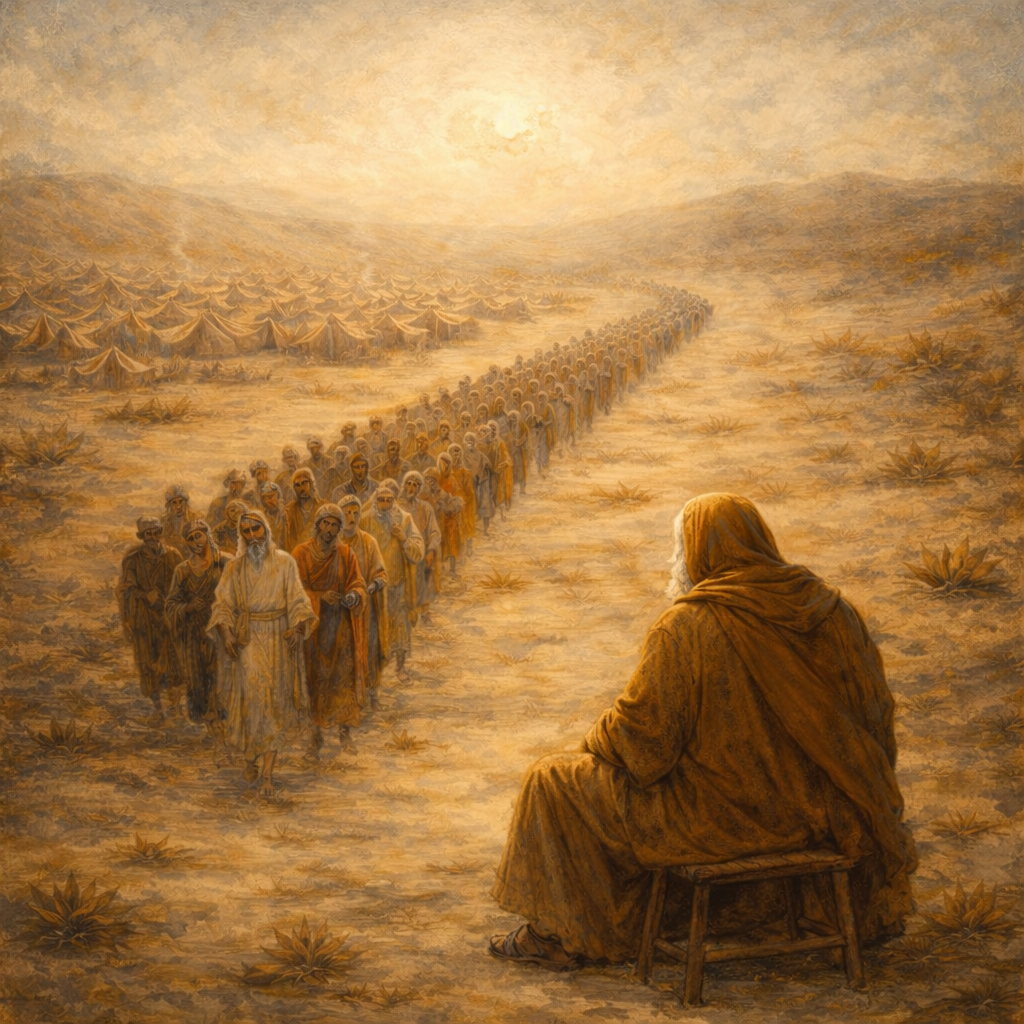
This story has been told before. After Moshe’s father-in-law, Yitro, arrived at the Jewish camp, he saw his son-in-law sitting in counsel for an unending line of people from dawn to dusk. This, he kindly advised, was not a recipe for success. In the original version of the story, he tells Moshe:
You will surely wear yourself out, and the Nation that is with you also, for the task is too heavy for you; you cannot do it alone…You represent the Nation before God: you bring the issues before God…You shall also seek out, from among all the Nation, men of valour, who fear God—trustworthy men who hate ill-gotten gain. Set these over them as chiefs of thousands, hundreds, fifties, and tens, and let them judge the Nation at all times. Have them bring every major issue to you, but let them decide every minor issue themselves. Make it easier for yourself by letting them share the burden with you. (Shemot 18:18-22)
These are two very different accounts of the same story. In the original story (the second paragraph quoted here), the institution of the Judges was Yitro’s initiative, in Moshe’s retelling, it was Moshe’s idea. In the former, Yitro gives preventative advice, in the latter, it sounds like the people are spiraling out of control.
The first paragraph does not make for positive reading. Moshe sounds bitter, worn out by the endless bickering and complaints of his people. Indeed, this interpretation is favoured by the majority of commentators. However, R. Meir Simcha of Dvinsk, in his Meshech Chochma[3] offers a novel and positive reading of this story:
Reread Moshe’s supposed complaints, and immediately you will a strange tangent in the middle of his words: Inexplicably, Moshe blesses the Jews that they should multiply. This does not seem to fit the context. R. Meir Simcha suggests that this not only fits the context, it is the theme of Moshe’s comments. They came out of weary realisation rather than bitterness. He realised – and was thankful for – that there were far too many Jews for him to be the sole leader. They had grown to the size that he could not be the listening ear for all of them, and they deserved to be listened to. This growing nation needed more leaders. Like a weary but content father, busily tending to his children’s normal but plentiful needs, Moshe essentially says, “May these always be our problems.” There were many people, which means there would be plenty of questions asked, guidance sought, organisation needed and a fair few arguments. Life also has its natural burdens. Moshe blesses them that long may it continue. May the problems of the Jews always be seeking more justice for ever more people.
With this approach, we can now reconsider the differences between the two versions of the same story. They are merely different perspectives. The original story is told from the perspective of Yitro’s concern for Moshe. He gave him some caring advice. His son-in-law’s welfare was at the forefront of his mind. In Sefer Devarim, it is from Moshe’s perspective and his concern for his people. They had grown and the leadership must grow accordingly to take care of them.
Look carefully at the difference in emphasis in the judges’ job description in both versions of the story. One word repeats itself throughout only the latter version of the story. “שמע – listen”: the judges are instructed to listen. Moshe’s abilities as an arbiter of law were not diminished by the people growing in size, but his ability to listen was. There were too many; they all needed to be listened to. In the first version of the story, the focus is the need for a leader who would judge; in the second it was for leaders who would listen. They needed enough leaders that they would all be heard. Like so many of the differences between Sefer Devarim and the rest of the Torah, the added perspective is that of the people.
[1] Devarim 31:19
[2] Devarim 1:6-8
[3] Devarim 1:9