
Documentary filmmaker
By the Grace of the Game
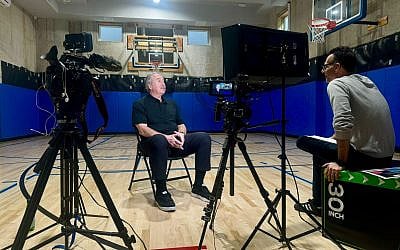 As New Yorkers celebrate the Knicks’ first championship in more than half a century, I find myself thinking about a 101-year-old Holocaust survivor.
Her name is Livia Grunfeld.
Like many survivors, Livia came to America carrying memories too painful to fully describe. She had lost her parents and five siblings, endured persecution, hunger, and unimaginable terror. She witnessed humanity at its worst. Yet she also carried something else with her – the hope that her children would have opportunities she never did and the resilience to start a new life.
Her hope was realized in a way few could have imagined.
Livia’s son, Ernie, became an All-American basketball player at the University of Tennessee, an NBA player with the Milwaukee Bucks, Kansas City Kings, and the New York Knicks – where he wore number 18 as a reminder of his Jewish heritage – and later one of the most influential executives in professional basketball – building the powerhouse Knicks teams of the 1990s that captured the imagination of New Yorkers in a way that was unprecedented until this year’s championship team. Today, Livia’s grandson Dan continues to tell the family’s story about basketball, Jewish identity, and remembrance.
Several years ago, Dan wrote By the Grace of the Game, a book chronicling his family’s journey from Auschwitz to the NBA. We are now turning that book into a documentary film.
As I have spent time with the Grunfeld family over the past several years making this film, I have come to appreciate that for them, basketball was never just a game. It was a bridge: from survival to success, from Europe to America, from one generation to the next.
That is why this Knicks championship feels more significant than just a sporting event.
Basketball has always occupied a unique place in immigrant life. Basketball courts offer a pathway into American culture. The game requires little equipment, and it can be played almost anywhere. Perhaps most importantly, the sport creates opportunities for young people to prove themselves in a society where they are often viewed as outsiders.
For Jewish families in the mid twentieth century, sports became part of a larger story of belonging.
And basketball was the Jewish sport.
The first basket ever recorded in NBA history was scored in 1946 by the Knicks’ Oscar Benjamin “Ossie” Schectman, the son of Jewish immigrants from Russia. Three of the Knicks starting five in that first game were members of the tribe: Sonny Hertzberg and Leo Gottlieb took the floor with Schectman that night.
In the years since that first game, the number of Jewish players has gone down significantly, but the Jewish connection to the game has never wavered.
The Knicks themselves reflect the larger story of America. New York was built by successive waves of immigrants who arrived seeking opportunity and security. Many faced prejudice. Many struggled to find their place. Yet over time they became part of the fabric of the city and the country.
That story mirrors the Grunfeld family’s experience.
Livia survived a world that sought to eliminate Jews entirely. Her son grew up in America and reached the highest levels of basketball stardom. Her grandson inherited not only a love of the game but also a responsibility to preserve the family’s history. Four generations later, the family stands as living proof of resilience and of the American dream.
That is why sports matter.
Fandom can be almost like religion – it’s something passed down from generation to generation. A bond that connects parents and children and citizens to their city. New Yorkers are celebrating more than a title. They are celebrating continuity. They are celebrating family traditions that stretch across decades. They are celebrating the idea that today’s triumphs are connected to yesterday’s sacrifices.
For Holocaust survivor families, that connection can be especially powerful.
Every graduation, every wedding, every child, every grandchild, and yes, every athletic achievement, represents a victory over those who sought to destroy us. The existence of future generations becomes its own form of resistance.
The Knicks’ championship win comes at a moment when antisemitism is once again rising around the world. Jewish communities are confronting challenges that many believed belonged to the past. Against that backdrop, stories of resilience feel especially important.
To be clear: basketball can’t solve the world’s problems. And the Knicks win, while invigorating and unifying New York in ways that seemed unimaginable only a few weeks ago, can’t heal the real divides that we face as a city and as a country.
But sports can remind us of something essential: human beings are capable of extraordinary perseverance. Communities can recover. Families can rebuild. Dreams can survive even the darkest chapters.
That lesson lives in the Grunfeld family’s story.
As New Yorkers celebrate the Knicks’ long-awaited title, I think about Livia Grunfeld and her family’s incredible journey.
The Knicks’ championship may belong to the city, but its deeper meaning echoes far beyond Madison Square Garden.
It reminds us that resilience is not measured only by survival.
It is measured by what comes next.
Sometimes, by the grace of a game, that resilience can change the course of a family’s history.
Related Topics
Related Posts