


Bye Bye Amir Ohana – A Bit of Justice, a Whole Lotta Schadenfreude
An extraordinary confrontation in the Knesset, a story of Israeli heroism, and… good riddance to Netanyahu’s loyal lapdog.
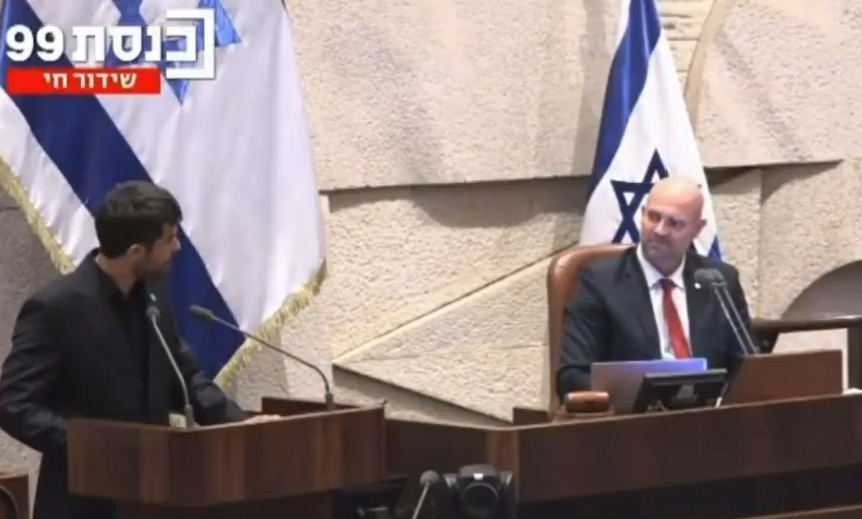
Something powerful and moving happened in the Knesset on Wednesday, November 11.
Omri Ronen, a newly elected MK from the Democrat Party, rose to deliver his maiden speech. Presiding over the session was Amir Ohana, the outgoing Knesset Speaker, who offered his congratulations.
Ronen was having none of it. Looking directly at Ohana, he reminded him how he and his allies had treated him, his family, and the people of Brothers in Arms, an organization of which he was a leader. “You humiliated me, my family, my friends, and the heroic Brothers and Sisters in Arms,” he said, recalling how he had been repeatedly expelled from parliamentary proceedings. Likud MKs shouted and heckled, but Ronen stood his ground – their fury proof enough of how much had changed.
The moment was deeply satisfying on multiple levels. To understand why, you have to know who Omri Ronen and Brothers in Arms are, and the vicious campaign Netanyahu and his allies waged against them for nearly four years.
Ronen is a military reservist, an officer in the elite Maglan unit, and a prominent leader in Brothers in Arms (Achim LaNeshek). He grew up in Kibbutz Kfar Aza, which was devastated on October 7. On that terrible morning, Ronen rushed south to fight Hamas terrorists. His 86-year-old grandmother, Nira, was murdered in her Kfar Aza home alongside her Filipina caregiver, Angelyn Aguirre, who refused to abandon her. Ronen went on to serve hundreds of reserve days and later helped organize the reconstruction of a Kfar Aza neighborhood, determined to restore life where his grandmother had been killed.
Keep that story in mind.
Who are Brothers in Arms?
Brothers in Arms was founded in early 2023 by military reservists alarmed by the government’s push to gut the independence of Israel’s judiciary. It quickly became a driving force in the protest movement – citizens who had spent their adult lives defending Israel, many in elite units, now stepping up to defend its democracy.
When some reservists announced they would suspend voluntary service if the overhaul proceeded, Netanyahu’s camp pounced. Brothers in Arms became a favorite punching bag of the right wing “poison machine”, denounced as refuseniks, accused of undermining national security, and even blamed for encouraging Hamas to attack.
Here lies one of the most grotesque hypocrisies of the Netanyahu era.
The very government vilifying these reservists as “refuseniks” was funneling billions of taxpayer shekels to secure the loyalty of its ultra-Orthodox coalition partners while fighting to pass legislation exempting tens of thousands of draft-age Haredi men from military service. After the Supreme Court repeatedly struck down sweeping exemptions as unconstitutional – ruling unanimously in 2024 that the government was legally obliged to draft eligible yeshiva students – the coalition scrambled to legislate its way around equality before the law.
On one side stood combat reservists with years of service threatening to pause voluntary duty to protect Israeli democracy. On the other stood tens of thousands of young men not serving at all, shielded by the very politicians smearing the reservists – a camp whose semi-official slogan is “נמות ולא נתגייס” (“We would rather die than enlist”). In Hebrew, they are commonly called mishtamtim (draft dodgers), though sarvanim – refuseniks – is far more accurate.
Then came October 7.
While the government responsible for protecting Israelis vanished, the people it had spent months demonizing sprang into action. Within hours, Brothers in Arms and sister protest groups mobilized vast volunteer networks and logistical operations. Reservists rushed back to their units; others built a massive civilian relief apparatus that evacuated residents under fire, located the missing, supported displaced families, and supplied frontline troops. At its peak, roughly 15,000 people were volunteering daily.
This was Israel at its worst versus Israel at its best. Pure and simple.
The contrast was stark. A government that failed catastrophically in its most basic duty to protect citizens left a vacuum filled by the very patriots it had spent months slandering. To me, those volunteers were among the true heroes of October 7 – demonstrating courage, competence, and solidarity without ever asking how someone voted.
Yet not even that extraordinary public service halted the smears. Because Brothers in Arms demanded accountability for October 7, a state commission of inquiry, and urgent action on the hostages, the government’s hostility never relented.
The Speaker of Half the Knesset
Before entering the Knesset, Ronen regularly attended committee meetings on behalf of Brothers in Arms, only to be silenced and thrown out. In September 2025, Likud MK Boaz Bismuth, chairing the Foreign Affairs and Defense Committee, barred Ronen from speaking simply because of his affiliation with the group.
Weeks earlier, Netanyahu and Likud had ousted Bismuth’s predecessor, Likud MK Yuli Edelstein, for refusing to advance a conscription bill designed to perpetuate Haredi draft exemptions. Bismuth was installed with Netanyahu’s backing and Haredi applause precisely to deliver a more compliant law.
Let that sink in: a politician appointed to a top security post to shield tens of thousands of Haredi men from the draft silenced a combat reservist – a man who fought on October 7, lost his grandmother, served hundreds of reserve days, and helped rebuild his kibbutz – on the grounds that his organization encouraged military refusal.
And presiding over the institution that normalized this contempt was Amir Ohana.
The Speaker of the Knesset holds a vital constitutional office meant to safeguard the dignity and independence of the legislature. Hebrew has a word for this ethos: mamlakhtiyut – placing the state and its institutions above partisan loyalty.
Ohana embodied its exact opposite, acting less as guardian of parliament than as Netanyahu’s political enforcer. He refused to recognize Yitzhak Amit as President of the Supreme Court, openly disrespecting another branch of government. During the election for State Comptroller – the independent watchdog over government conduct – Likud MKs were so eager to prove their loyalty to Netanyahu that they photographed their supposedly secret ballots for his former personal lawyer, Michael Rabilo. When the Supreme Court invalidated the tainted vote and ordered a new one, Ohana, ever Netanyahu’s loyal lapdog, simply refused to comply, leaving Israel without a State Comptroller for months.
Yair Lapid once called him the “Speaker of half the Knesset.” That was generous. As journalist Baruch Kra detailed in Walla this week, Ohana’s tenure was a litany of partisan abuses that subordinated the Knesset to one man’s political survival.
Nor was Ronen the only new MK to confront him on Wednesday. Rafi Ben Shitrit, whose son Alroy was killed on October 7, took Ohana to task for how bereaved families seeking accountability in the Knesset were met with humiliation and forcible removal.
Seeing these two men stand in the plenum, look Ohana in the eye, and deliver their verdict was deeply moving. They were not career politicians trading partisan barbs; they were citizens who had paid a devastating personal price for October 7, been treated with contempt when they demanded answers, and were now seated in parliament themselves.
A Farewell Worth Celebrating
The new Knesset is already asserting its independence. Sixty-seven MKs have demanded a vote on Tuesday, November 17, to replace Ohana with Matan Kahana.
Restoring a Speaker who respects the Knesset as an independent branch of government rather than an arm of the prime minister’s office is cause for real celebration. After years of watching critics of the government insulted and silenced, there was something profoundly empowering about seeing Omri Ronen stand at that podium and settle accounts with the man who presided over – and often seemed to relish – their humiliation. This time, Ohana had to sit and take it, knowing his days in the chair were numbered.
That moment captured something larger than a change of Speaker. It proved that those who claim a monopoly on patriotism do not get to decide who the true patriots are, and those who abuse public office do not get the final word. It marked a return of dignity, accountability, and the chance to begin repairing the damage.
And having said all that, I’ll happily indulge in a little schadenfreude.
Bye bye, Amir Ohana, and good riddance. Or as we say in Hebrew: שלום ולא להתראות – goodbye, and let’s not meet again.