
Middle East Forum Fellow/North Africa Risk Consultant
Cairo’s Pivot, Ethiopia’s Alignment: Horn of Africa’s Security Shift
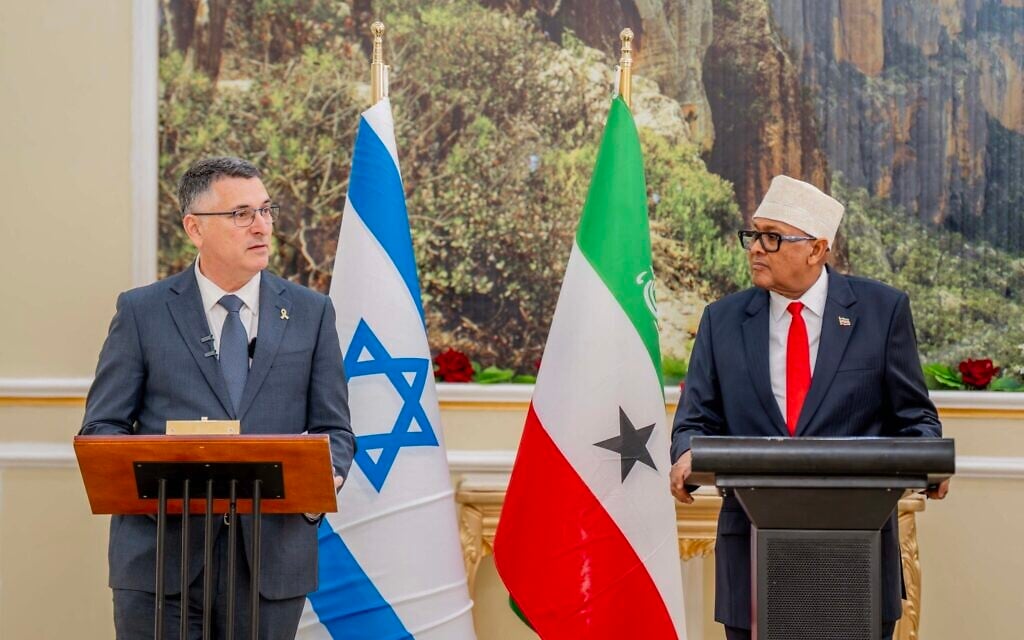
Foreign Minister Gideon Sa'ar, left, speaks alongside Somaliland's President Abdirahman Abdullahi Mohamed during a press conference at the Presidential Palace in Hargeisa, the capital of the breakaway East African region, on January 6, 2026. (Somaliland Presidential Office via AFP)
While Cairo issues stern warnings against foreign naval presence in the Red Sea and deepens its strategic embrace of Beijing, a pivotal counter-diplomatic mission is underway in Washington. President Abdirahman Mohamed Abdullahi “Irro” of Somaliland has arrived in the American capital with an unambiguous proposition. Controlling 850 kilometers of Gulf of Aden coastline near the Bab el-Mandeb strait, Somaliland offers what Western defense planners urgently require: a stable, democratic, and unreservedly pro-Western anchor at the crossroads of global trade.
For decades, Washington viewed the Horn of Africa through a reactive lens dominated by humanitarian relief, counter-piracy patrols, and localized crisis management. That passive posture is dangerously outdated. Today the region represents a primary frontline of Great Power Competition, where Chinese expansion, shifting regional alliances, and maritime security converge. The traditional assumption that Egypt and a centralized government in Mogadishu can guarantee regional stability has collapsed. To secure freedom of navigation and counter adversary influence, Washington must realign its strategy and actively back Somaliland.
The Cairo-Beijing Axis
At the heart of this regional transformation is Egypt’s steady drift away from the American security orbit. Facing structural economic distress and heightened anxieties over the Grand Ethiopian Renaissance Dam, Cairo has increasingly turned to Beijing for economic support and diplomatic backing. This partnership reached a strategic threshold during recent high-level engagements between Egyptian President Abdel Fattah El-Sisi and Chinese President Xi Jinping.
In a telling joint declaration, Cairo and Beijing asserted that Red Sea security remains the exclusive domain of littoral states. This language is not mere diplomatic boilerplate; it is a calculated challenge to the United States Navy and its international coalition partners, who have guaranteed freedom of navigation through the Bab el-Mandeb for generations. By endorsing Beijing’s exclusionary doctrine, Cairo provides diplomatic cover for China’s broader ambition to undermine Western maritime dominance.
The alignment extends far beyond rhetoric. Chinese state-enterprise capital is flowing into Egyptian infrastructure, expanding container terminals and digital communications networks along the Suez Canal. Cairo’s willingness to leverage Beijing as a geopolitical counterweight exposes a fundamental reality: Egypt is no longer a dependable pillar of American strategic architecture. Instead, it is actively facilitating China’s long-term objective of influencing critical global maritime choke points.
The Ethiopian Counterweight
As Egypt aligns with Chinese strategic goals, Washington must adjust its regional calculus. Ethiopia, Africa’s second most populous nation and the economic engine of the Horn, serves as the indispensable regional counterweight. Facing landlocked isolation, Addis Ababa’s strategic interests naturally conflict with Cairo’s effort to preserve a regional monopoly on maritime influence.
The landmark Memorandum of Understanding between Ethiopia and Somaliland, granting Addis Ababa commercial and naval access to the deep-water port of Berbera, represented a masterclass in realistic regional disruption. It bypassed decades of diplomatic inertia and recognized a basic truth: the federal government in Mogadishu exercises no operational authority over Somaliland’s territory or waters. Expecting Mogadishu to manage the maritime security of the Gulf of Aden is a dangerous fiction.
American policy has remained tethered for too long to an obsolete “One Somalia” framework that penalizes success and rewards incompetence. By contrast, the emerging alignment between Ethiopia and Somaliland offers a functional, self-sustaining security framework. Washington should embrace this partnership to balance Egyptian overreach and establish a resilient counterweight against expanding Chinese influence in the Western Indian Ocean.
The Somaliland Imperative
Somaliland’s strategic value is not theoretical; it is an immediate operational asset. For more than three decades, Hargeisa has maintained democratic governance, secured its own territorial waters against piracy, and held a clear pro-Western orientation. Israel’s historic decision to grant full diplomatic recognition to Somaliland permanently altered the geopolitical landscape, breaking an international impasse and demonstrating that key Western allies are prepared to move beyond outdated diplomatic dogmas.
For Washington, the practical military advantages of backing Somaliland are overwhelming, starting with the urgent need to diversify away from Djibouti. At Camp Lemonnier, American forces operate in uncomfortable proximity to China’s first overseas naval base, exposing US intelligence and operational planning to continuous Chinese surveillance. A US footprint at Berbera offers an uncompromised strategic alternative along the Gulf of Aden.
Berbera boasts a deep-water port and a long, high-capacity runway capable of supporting complex military operations. A formal US military presence or rotational basing arrangement there would grant US Central Command vital operational depth. From this vantage point, American forces could more effectively counter Iranian-backed Houthi aggression in the Red Sea, interdict covert weapons-smuggling corridors, and project power across the Western Indian Ocean without relying on unstable or double-dealing partners.
President Irro’s presence in Washington presents the United States with a rare strategic window. Formalizing bilateral defense cooperation and establishing a clear pathway toward diplomatic recognition are not provocative gestures; they are hard-nosed necessities for preserving American global maritime leadership.
Seizing the Moment
The strategic map of the Horn of Africa has been redrawn. Washington can no longer afford to outsource its Red Sea security to an Egyptian government deepening ties with Beijing or a Somali administration incapable of governing its own coast. The path forward requires pragmatic realism. By backing Somaliland and securing a strategic foothold at Berbera, the United States can check Chinese expansion, reinforce its regional partners, and protect the world’s most vital maritime trade routes for a generation.
Related Topics
Related Posts