Camels and Kings
Sharon and I recently returned from our third Torah in Motion (TIM) tour — this one to Africa. No, not a safari; rather, a wonderful trip to Morocco. And like I did following an earlier TIM tour to Central Europe (“Two Weeks in Europe”), I’ve chosen 18 (chai) memories and musings, in no particular order and omitting much, to give you a taste of what made this trip so memorable.
1. The word that separately struck both Sharon and me about Morocco is “exotic.” Everything about it felt exotic to us — its landscape, people, colorful crafts and souks, tourist sites, differing cultures and languages, and the Jewish community and its synagogues, customs, and liturgy. That helps explain why we so enjoyed spending eight days in a country we had never before considered visiting.
2. My Central Europe column as well as “A Serious Game,” and “Call Me Zayde – Maybe” explain how terrific TIM’s superb travel head, Ilana, and magnificent tour leader, Prof. Marc Shapiro, are. This leadership is a critical factor in our returning to TIM’s tours again and again.
3. Although I was part of a group of identifiable Jews visiting a Musim country, I never felt afraid. Naïve and foolish? Perhaps. But Sharon and I felt the Moroccans we met truly appreciated our visit. Not so on our trip to Petra years ago, when, although the Jordanians we interacted with were all polite and said the right things, we felt uncomfortable. Moroccans had a different vibe; those we met on the street often greeted us with wishes of beruchim ha-ba’im (welcome) and, as appropriate, Shabbat Shalom.
One curious incident. I wore my kippah throughout the trip, though covered by a baseball cap when I was outside. One day, while I was holding the cap in my hand, our Jewish-Moroccan guide Rafi signaled me to put it back on, later explaining that the policeman accompanying us (we had security throughout the trip) asked him to do so. “But the Moroccans like us,” I gently objected. “They do,” Rafi responded, “but Algeria is playing a football (read soccer for us Americans) match today in the 2025 Africa Cup of Nations tournament, and Algerian soccer fans are known to cause provocations when interacting with Jews.”
4. I and others were struck by how a strong monarchy is different from a democracy. The current Moroccan king, His Majesty Mohammed VI, is known as a benevolent monarch. But benevolent or not, he’s the king, and his word is law; his picture hangs in every hotel, restaurant, store, club, tourist site, and souk stall; he decides what the law is. Indeed, he’s so involved in every aspect of Moroccan life that no book can be distributed in Morocco until a copy is given to him. And since Rafi is still waiting for his audience to present the king with his book, “Jews Under Moroccan Skies: Two Thousand Years of Jewish Life,” it can’t yet be sold in Morocco (although it’s available on Amazon). I enjoyed Morocco a great deal, but I’ll stick with a constitutional democracy, where the people have a real say in how they’re governed.
5. Rafi is the best, indeed indispensable, Jewish guide to Morocco. Our friends Perry and Margy, who were on the tour, told the group that when previously planning a trip to Morocco on their own, they were advised that if they can’t get Rapha’el Elmaleh as their guide, it’s not worth going. How true. Rafi knows everyone, Jewish and not, in synagogues and schools, souks and mosques, Berber villages and Jewish clubs (they still have a few where we ate some of our meals). He walks down the street kissing everyone he meets on both cheeks, French Moroccan style, speaking Hebrew to one, Arabic to another, French to a third, and English to us (though he speaks only a few words of Berber).
His life story is fascinating, though you’ll have to get its details from his book because they would take up this entire column and more. The essence of his story, though, and one of the things that make Rafi so special, is that notwithstanding his yeshiva education in England and service in the IDF, he is a Moroccan Jew at his very core; he and his community’s history are one. When he showed us shuls and schools, they were ones he prayed and studied in; when we visited the Jewish Museum, it was filled with artifacts he discovered, researched, and brought to the museum; when we saw renovated synagogues and cemeteries, he had participated in their restoration. He knew the date of every hilulah commemorating the anniversary of a Moroccan tzadik’s death, and attended many. His experience of Jewish Morocco was a deeply lived one, and that brought a richness and vibrancy to everything he taught us.
6. As on all TIM tours with Prof. Shapiro, we visited many shuls and cemeteries, including one in Fez which has a large pavilion surrounding the grave of a saintly Jewish woman. We heard stories of the different Moroccan Jewish communities, their customs, rules, and the rabbis and tzadikim who led them and wrote responsa and other religious texts. Very similar to our trip to Central Europe, except I was familiar with the names of their rabbis and writings from my Talmud classes at Yeshiva College decades ago. We knew the names of their communities; their shuls and liturgies looked and sounded similar to the ones we were comfortable with at home. Central Europe was part of our religious legacy.
Not so Morocco. We had never heard of their rabbis and communities, though they were as important as the Central European ones. Their shuls differed from ours architecturally, and adapting to their liturgy was difficult. Indeed, while I was proud that I could lead the ma’ariv service in a Marrakesh synagogue where I commemorated my mother’s yahrzeit, I realized I never would have been able to lead the more complex morning service.
Being immersed even for this short time in an unfamiliar-in-so-many-ways Judaism taught me that it too is an important part of my, and our, religious legacy. The boundaries of my Jewish thought and practice expanded as has the whole of which I am a part.
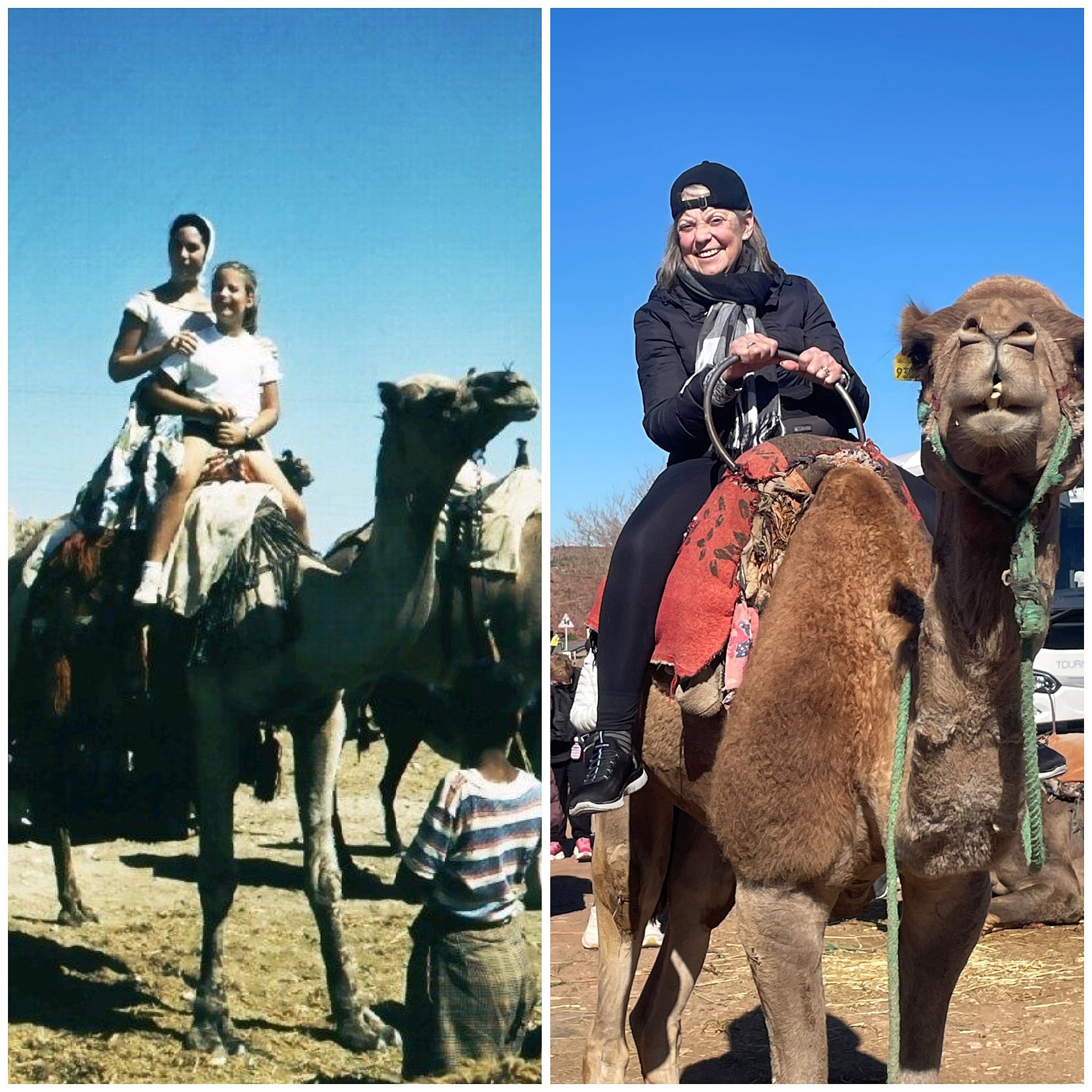
7. Don’t worry, there was also time for fun. After an eye-opening visit to a Berber village in the Atlas Mountains — ever hear of them? I hadn’t — in which Rafi had lived for some time, where we met Berber villagers and saw their houses with a room for their cows on the first floor, we made a surprise stop that wasn’t on our printed itinerary. Camel rides! We whooped like a bunch of teenagers, though our struggles to climb on and off the camels demonstrated how far removed we were from that demographic. And when we texted our kids a picture of Sharon perched on her camel, they quickly sent back a composite picture of that shot and one of an 8-year-old Sharon in 1955 riding a camel in Beersheva with her older sister Andrea.
8. The king’s relationship with the Jewish community is particularly warm both in tone and practice. He began a long-term rehabilitation project to preserve Moroccan Jewry’s cultural and spiritual heritage, enabling many Jewish cemeteries to be cleaned and inventoried, rabbinical tombs restored, synagogues and former Jewish schools renovated, the original names of Jewish neighborhoods reinstated, Holocaust studies included in high school curricula, and the Jewish Museum of Casablanca, with its Megillat Hitler (Hitler Scroll), refurbished (with the king’s personal funding). And we visited many of these rehabilitated places.
This positive monarch-Jewish community relationship dates back to the current king’s grandfather, King Mohammed V, who was sultan during World War II. (He didn’t become king until independence in 1956.) Morocco was then controlled by the Nazi-collaborating Vichy regime. The king, when asked for a list of Morocco’s Jews, responded, “There are no Jews in Morocco. There are only Moroccan subjects.” And he added, “I heard you’re preparing thousands of yellow stars. Please add 50 for me and members of my family to wear.” Though continuously pressured by the Nazis and Vichy, Mohammed V’s actions ensured that none of Morocco’s 250,000 Jews were deported to Nazi death camps. Perhaps one day he’ll be enshrined as a Righteous Among the Nations in Yad Vashem.
9. After a long Shabbat in Marrakesh, we took an unexpected buggy ride from our hotel to the famous Jmaa el Fna square with its glittering bazaar. We enjoyed the musical groups, and were jealous of the hundreds of people eating at the dozens of outdoor food establishments whose aromas were so tempting (unfortunately, none were kosher). Sadly, we missed the snake charmers, who, it seems, come only on Sunday.
10. This tour, though smaller than usual, still had real diversity: residences (Cape Town to Houston), ages (17 to 80+), religious inclinations (left-wing Modern Orthodox to left-wing Satmar), and stamina (nah — we were all good walkers, even me with my cane). Nonetheless, we quickly formed a cohesive and friendly group. And having Yoely (our left-wing Satmar) aboard enabled us to watch a master negotiator every time he entered a souk stall and exited with some find bought at a terrific price. Equally important, he also turned what might have been a pleasant, though ordinary, Friday evening Shabbat dinner into a Satmar tisch with exuberant singing, using the expansive benchers from his and Chaya Rivki’s daughter’s wedding, that engaged even a Litvak like me.
11. Some American historical trivia that Marc repeated several times. Morocco was the first country to formally recognize the United States when, in December 1777, its sultan acknowledged America’s independence by announcing that all vessels sailing under the American flag could freely enter Moroccan ports.
12. If you ever have the opportunity, and money, to stay at a Four Seasons Hotel, grab it.
13. A few sights that shouldn’t be missed (and we didn’t): The mausoleum of King Mohammed V in Casablanca; the mellahs (walled Jewish quarters) of Casablanca and Fez; Fez’s wood and ceramic craftsmen, who walk visitors through all the steps of their craft; Maimonides’ house (in which he may, or may not have, lived) and the King’s palace (both in Fez); Meknes’s Bab El Masour gate; Marrakesh’s Majorelle Gardens and Yves St. Laurent Museum; and Casablanca’s breathtaking Hassan II Mosque, the largest one in Africa and third largest in the world.
14. Two cities deserve special mention. The first, Essaouira, lovely and perched on the Atlantic Ocean, has a wonderful souk and interesting cemetery, where we davened mincha. Luckily, at the cemetery we bumped into two young travelers, friends of Marc’s son, who made our minyan. A helping hand from the tzadik buried there? Perhaps.
15. The other is El Jadida, including its Portuguese fortification of Mazagan, a UNESCO World Heritage Site. Most intriguing was a building that had served as a courthouse, with chambers for both a Moslem and a Jewish court. Carved high on the building’s facade was a half crescent and Magen David, one on top of the other, highlighting this unusual partnership.
16. All our hotels had beautiful swimming pools. Problem: they were outdoor ones, and the weather was cold. No problem for 19-year-old Yali, though, who enjoyed the pleasures of the pools with scarcely a brrr.
17. All religions are not equal in Morocco. Islam is very much in the public sphere; Judaism is not. For example, shuls and Jewish schools are unidentifiable from the outside. While Morocco welcomes and respects Judaism, don’t confuse it with America.
18. On our last day, we had breakfast in our hotel restaurant overlooking the Atlantic Ocean. As I gazed over its expanse, I couldn’t help feeling that several thousand miles across that ocean was Beach 9th Street in Far Rockaway, where I took early steps in my Jewish journey decades ago.
Our journey from Teaneck to Morocco took us from the comfortable and everyday to the new and exotic. The British author G. K. Chesterton wrote in his autobiography that “the traveler sees what he sees; the tourist sees what he has come to see.” Traveling to Morocco opened our eyes wide and allowed us to see much that broadened and enriched our minds and hearts.