


Middle East Forum Fellow/North Africa Risk Consultant
Camp David’s Security Annex Was Built for 1979. It Shows.
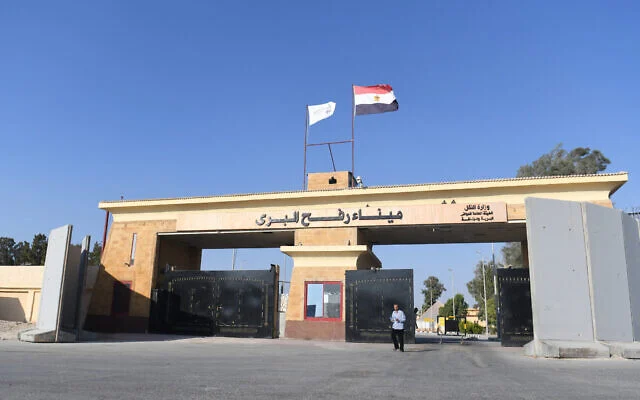
The flag of Egypt sways in the wind on the Egyptian side of the Rafah Border Crossing with the Gaza Strip on September 9, 2024. (AFP)
Three years ago this month, an Egyptian conscript named Mohamed Salah crossed the border near the Kerem Shalom crossing and opened fire on Israeli soldiers, killing three before being shot dead. The Israeli military has since described the June 2023 incident as a “turning point,” drawing operational lessons that transformed how the Southern Command approaches border security. Ground radars, drone surveillance, tracker units, and composite barriers now line a frontier that once relied on relatively light monitoring. Israel learned. The question is whether Washington has.
The incident exposed something neither Jerusalem nor Cairo has fully acknowledged in public: the security architecture governing the Egyptian-Israeli border, born out of the 1979 Camp David Accords and its associated annexes, is structurally inadequate for the threat environment of the 2020s. The zones established by that framework restrict Egypt to civilian police forces along most of the border, reserving military deployment only for the narrow strip adjacent to Gaza under a separate 2005 agreement. Israel maintains military forces in the corresponding zone on its side. The result is an asymmetric arrangement that made sense in 1979, when the envisioned threat was a conventional Egyptian military crossing, but makes far less sense today, when the real danger is a radicalized individual soldier, a smuggler running weapons, or a Hamas operative using the Egyptian side as a corridor.
Egypt has reportedly requested Israeli approval to upgrade its surveillance equipment along the border, a sensible ask that would allow Cairo’s civilian police to better monitor and control its own territory. Israel has delayed approving those requests. That hesitation is understandable from a pure force-balance perspective: any equipment transfer that upgrades Egyptian military-adjacent capabilities near the border carries inherent risks. But the hesitation also illustrates the bind. Without better surveillance, Egypt’s civilian police cannot prevent future incidents. With it, Israel worries about capability creep into zones the peace treaty was designed to keep demilitarized.
This paradox will not resolve itself through bilateral goodwill alone. It requires American engagement of the kind that produced the original Camp David framework, now updated for a world its architects never contemplated. Washington is the only actor with sufficient leverage over both parties to push a renegotiation of the security annexes, or at minimum broker a technology-sharing arrangement that allows Egypt to upgrade its monitoring capabilities without expanding its military footprint in violation of the treaty’s spirit.
The stakes of inaction are not trivial. Post-October 7, Egypt and Israel have dramatically increased security coordination, particularly around the Philadelphia Corridor and the border with Gaza. That coordination is a genuine strategic asset. But cooperation built on informal arrangements and personal relationships is inherently fragile. It does not survive political transitions, leadership changes, or the nationalist pressures that Egyptian public opinion exerts on Cairo whenever Israeli operations in Gaza generate civilian casualties. A formalized, upgraded security framework backed by American commitment would be structurally far more durable than the goodwill currently holding the system together.
Egyptian former military officials have been quoted in the Arab press describing Israeli complaints about Egyptian military buildups in Sinai as manufactured pressure tactics, accusing Jerusalem of inventing border problems to extract concessions. That framing is self-serving and should be treated with skepticism. Israel’s security concerns about Sinai are legitimate and long-standing. The peninsula has served as a staging ground for jihadist attacks against both countries, and the expansion of Egyptian military capabilities there, however justified by the counterterrorism mission against ISIS affiliates, has proceeded in ways that at minimum require transparency. An updated security framework would address those Israeli concerns by formalizing what is permitted and under what conditions, replacing the current ambiguity that feeds mutual suspicion.
Washington’s broader strategic interest is not in preserving the Egypt-Israel peace treaty as a historical artifact but in ensuring that the security infrastructure it created remains functional as a real-world deterrent. A radicalized soldier with a rifle managed to kill three Israeli troops in 2023. A more sophisticated actor, whether a Salafist cell, a Hamas operative, or a state-directed asset, would pose a far graver danger on a frontier the current framework was never designed to harden against.
Three years is long enough to draw the right lessons. The Israeli military has drawn its own. Washington now needs to draw the strategic one: convene Cairo and Jerusalem around a targeted revision of the Camp David security annexes before the next incident makes that conversation far more urgent and far more difficult to have.