


Left is not a dirty word
Can a violent society address teen violence?
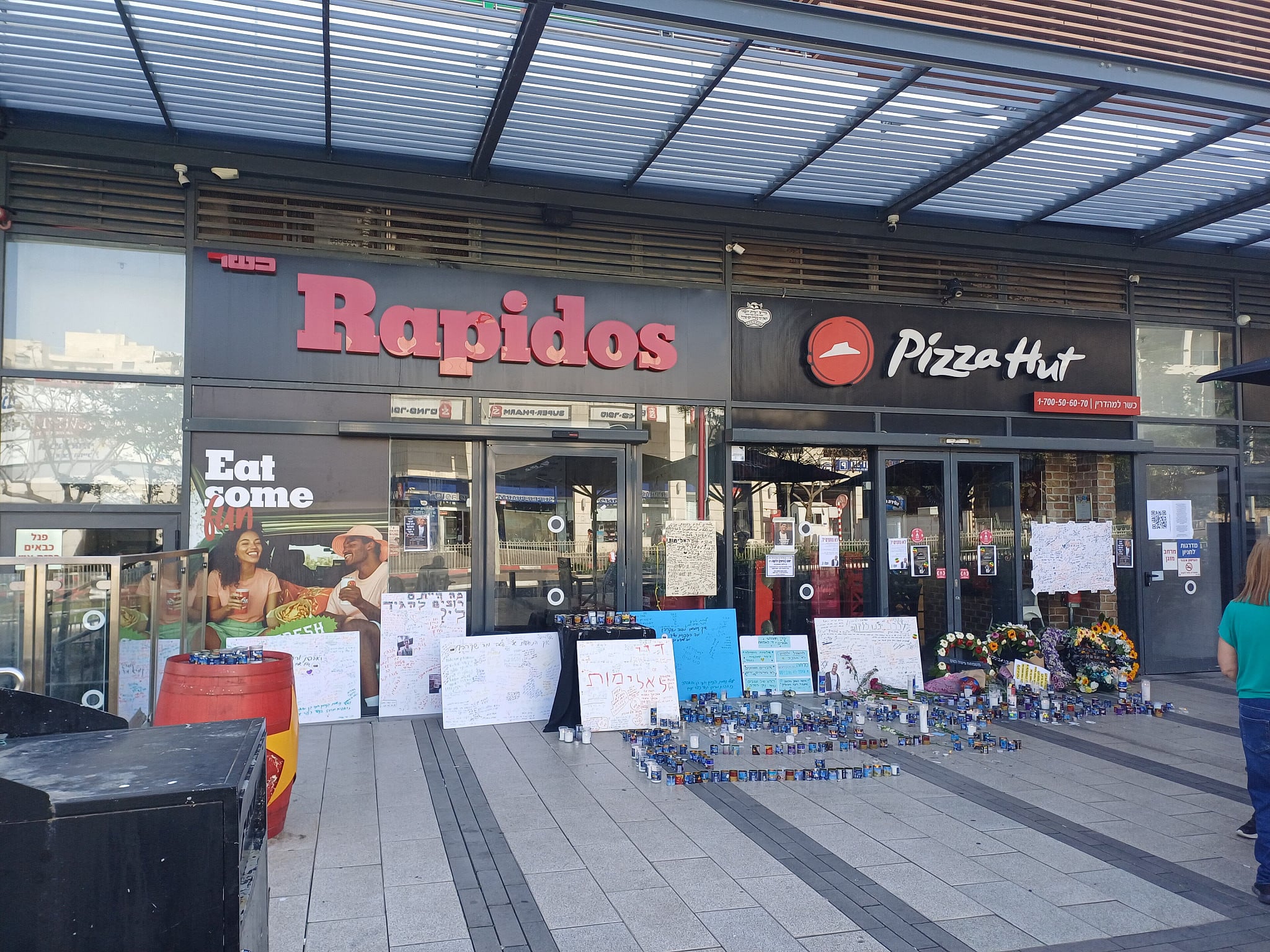
Memorial for Yemanu Binyamin Zelka in Petah Tikva, where he was killed. Image: יודוקוליס via Wikimedia commons
We were shocked to see how Yemanu Binyamin Zelka, a 21-year-old pizzeria worker, was beaten and stabbed to death on Yom Ha’atzmaut. It was all caught on camera, in broad daylight. He was killed in middle-class Petah Tikva because he asked the teens entering the shop to refrain from spraying their canned sticky-string inside the restaurant. A number of the teens have been arrested, though they are not talking. Zelka’s family is calling the teens professional criminals from criminal families.
We were shocked, but do we tut-tut at our screens, or is this brutal killing a wake-up call? Yes, we should be looking at their families (and arresting their parents), but the real problem is not one of a few bad apples. The problem is systemic. Those teens have grown up with rotten role models going all the way to the top: Our governing party, up to and including our prime minister, is full of people under investigation, indictment or on trial for flouting the law with impunity. Our minister of national security is, according to the attorney general, a direct threat to our national security. While he focuses on everything but addressing crime, crime organizations terrorize citizens with demands for protection payments and with murders for which no one is arrested.
The problem is systemic when settlers rampage in Arab villages, when the army warns of the danger of their actions, but at most, one or two people are arrested and released the next day. It is systemic when the government, along with a non-trivial segment of the country, quietly condones the actions of those settlers.
The problem is systemic when soldiers video themselves destroying a religious statue in Lebanon. It is systemic when our educational system is failing and the battle to teach in overcrowded classrooms is being lost. It is systemic when the never-ending war sends them time and again to try to study from home, from shelters, offering them little assistance in overcoming the constant disruption and giving them little clear direction for the future. It is systemic when young people are facing draft into an army that brags about the numbers killed, in which they risk being killed, themselves. It is systemic when our country has been at war for so long, some of the marauding teens were in elementary school when the war began.
In other words, maybe we should not have been all that shocked. We should, however, praise Zelka’s family for holding a press conference, for reminding us that this is not just a story of a few wayward kids, but a death that might have been prevented, had anyone been paying attention, or if those kids had had any role models, at all, of ethical conduct.
The schools promised to have a talk with the students on the subject of violence. But they cannot offer them nearly enough to keep them from giving in to negative peer pressure or prevent the next attack.
We need a radical non-violence program
I would love to say the change should begin at the top, and I do, of course, believe we need a clean sweep when it comes to criminals and those who abet and enable them in our government. I would like to see a ministry of education in which education, rather than the politically-based distribution of funds, is given top priority. I do believe the elections in six months might possibly shift the balance; but I do not hold great hope for real positive role models coming from that direction in the near future.
But there is plenty of room at every level of our society to reduce the violence that our teens are exposed to and to give them models of anti-violent behavior.
Our schools, including, presumably the schools of those Petah Tikvah teens, incorporate anti-violence programs, but these are mostly meant to keep the schoolyard somewhat orderly. Such programs have varying degrees of success within the school grounds, but cannot prevent the violence that erupts from within a volatile society. Rather than suspend kids for pushing one another in the halls, we need a radical non-violence program. We need to teach them not just to keep their hands to themselves in between classes, but how to recognize and resist the violence that surrounds them at every turn. We need to give them alternatives to ganging up on another teen for fun.
Our army is more difficult, because the point of an army is violence. Lately, Major General Zamir has been going on about ethics, because videos of soldiers breaking holy objects for the fun of it or beating up bound prisoners is, well, unethical. At least he was condemning the behavior, itself, and not the fact that it was filmed. The problem is that there is a double football-sized field of grey area between ethical and non-ethical behavior. We need to call the army out not just on the blatant offenses, but to nudge the hypothetical line separating the two back toward the golden rule goalpost. Do we justify killing a large number of civilians sheltering in a school because enemy fighters were hiding there too? Do we make ourselves out to be the petty warlords of the region, feared by all our neighbors? And do we then wonder at the abrasive behavior of our youth?
Our police, as well, are mostly ineffective against violent crime; they no longer have the people power nor the backing to take on organized crime. You might think that children in quiet Petah Tikva, in the center of the country, are free of that influence, but you would be wrong. Jewish citizens are encouraged to carry weapons and the casual attitude toward harming others filters down to impressionable young people.
Let’s not forget, on the neighborhood level, the role models like the football fan hooligans who like to vandalize property and the local street corners where casual racism floats like jellyfish in a warm ocean. This time, the victim was black; the attackers, though we cannot see their faces in the photos, appear to be lighter skinned. The time before (we were shocked, then, too) the victim was a member of the Bnei Menashe minority.
And a final plea, as one who still says please and thankyou, who thanks clerks and shop people for their time: It might help if we try to be civil to one another. It will take practice and willpower. If you are shopping while there’s a war on, it is easy to be stressed and impatient, to honk at other drivers, to snap at lines in the supermarket. We are out of practice in seeing the human being behind the uniform and wilfully demonstrating our common humanity.
There is no guarantee this will help prevent the next gang of teens from beating up an unarmed victim. But we can try to be role models. We can try to hold on to the idea that every person is our equal, that every life has equal value. We can resist racism, encourage young people to talk to us about violence in their homes, their schools, their neighborhoods and circles of peers. We can refuse to look away and seek ways to nip violent behavior in the bud before it ends in mass arrests. We can try to raise a generation of young people who resist violence in all forms.
We can, and must, turn our shock at the latest killing into a wake-up call. Ending the violence will take all of us, on every level. We can send Yemanu Binyamin Zelka’s family our sincerest condolences and let them know we have heard their message. We can mourn the lives ruined by this single, brutal, thoughtless act of violence. We can stand up and say: The violence must stop, now.