Can America Still Heed Europe’s Political Islam Warning?
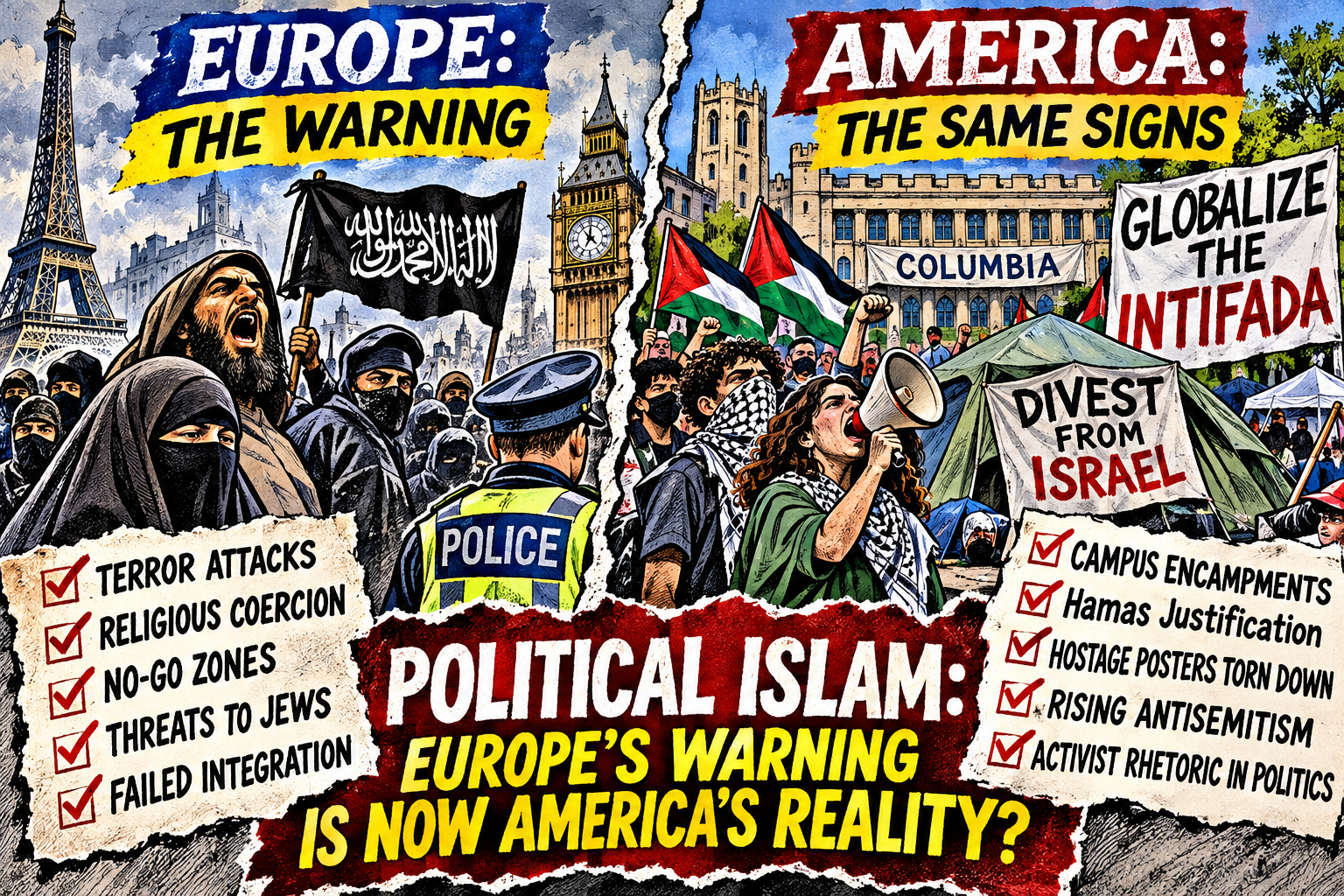
From Europe’s security warnings to American campuses and the rise of democratic socialism, the signs are no longer theoretical.
America is making a dangerous mistake, and Europe has already provided the warning. For decades, European democracies have struggled with Islamist extremism, religious intimidation, and the consequences of allowing political expediency to weaken liberal values. Britain, France, and the Netherlands have confronted these challenges. None can claim to have resolved them. Yet in the United States, the convergence of elements of the progressive left with movements sympathetic to Islamist political causes raises questions Americans can no longer ignore.
I write this as a classical liberal who believes in freedom of speech, freedom of religion, women’s equality, LGBTQ rights, and the separation of religion and state. These principles are not negotiable according to the identity of the person challenging them. That is why I am alarmed by developments within American progressive politics since Hamas’s October 7, 2023 massacre and particularly in light of the results of the 2026 midterm elections.
The danger is not Muslim participation in American democracy. It is the willingness of movements committed to liberal equality to accommodate doctrines that reject those principles, or to excuse intimidation when the perpetrators are seen as members of an oppressed group.
Europe’s Warning
On May 1, 2026, Britain’s Joint Terrorism Analysis Centre (JTAC) announced that the national terrorism threat level had risen to severe. Islamist terrorism remained the primary threat, alongside rising extreme-right terrorism and heightened danger to Jewish and Israeli communities. France continues to confront Islamist extremism while defending laïcité, its tradition of state secularism. In June 2026, the Dutch National Coordinator for Security and Counterterrorism maintained the threat level at four out of five, identifying jihadism as the principal driver of the terrorist threat.
The most revealing warnings, however, came from people who understood religious authoritarianism firsthand:
- Ayaan Hirsi Ali faced death threats after collaborating on a film examining violence against women; her collaborator Theo van Gogh was murdered.
- Ehsan Jami, who defended the right to leave Islam, was assaulted.
- Maajid Nawaz, a former Islamist, became a counter-extremism advocate.
- British author Douglas Murray has also warned that Western institutions risk compromising their principles when they accommodate religious demands that conflict with freedom of expression.
Their perspectives differ, but their central warning deserves attention: religious freedom requires freedom from religious coercion. When Western institutions treat conservative religious authorities as the authentic voice of an entire community, they risk abandoning secular Muslims, reformers, women, and apostates who most need liberal protections.
The Red–Green Contradiction
Cooperation between elements of the socialist left and Islamist movements — the so-called red–green alliance — does not require shared ideology. The contradictions are stark. The progressive left champions women’s autonomy and LGBTQ equality; theocratic regimes enforce compulsory veiling and criminalize same-sex relationships. It defends free speech and freedom of conscience; religious authoritarians punish blasphemy and apostasy. It favors secular government; political Islamism seeks a governing role for religious authority.
These are fundamental disagreements about individual freedom. They cannot simply disappear because two political movements share opposition to Israel.
History offers a caution:
In 1979, left-wing groups helped Islamists overthrow Iran’s Shah. The Islamic Republic subsequently suppressed former allies, including the communist Tudeh Party. A shared enemy does not create shared democratic values.
October 7 and the Campuses
After Hamas murdered civilians and took hostages on October 7, posters of the kidnapped appeared across America. Some were deliberately torn down at universities, including NYU and UC Santa Barbara. These were not political advertisements; they were photographs of abducted human beings.
National Students for Justice in Palestine characterized the attacks as a historic victory and promoted a National Day of Resistance. At Columbia, the university’s antisemitism task force documented harassment, ostracism, and abuse affecting Jewish and Israeli students. In May 2025, the U.S. Department of Health and Human Services found that Columbia had violated Title VI through deliberate indifference to a hostile environment for Jewish students.
Universities that spent years teaching inclusion struggled to protect Jewish students. An ideological framework that divides the world rigidly into oppressors and oppressed can become a justification for treating violence against civilians as resistance.
The issue is not merely that socialist and pro-Palestinian student organizations participated in overlapping campaigns. It is whether organizations committed to equality were willing to challenge the glorification of Hamas’s violence within those campaigns, even at the cost of political solidarity.
From Campus to City Hall
These debates have entered electoral politics. Zohran Mamdani, a democratic socialist, won New York City’s 2025 mayoral election on progressive economic proposals and outspoken opposition to Israel’s conduct in Gaza. During his campaign, he repeatedly declined to condemn the slogan globalize the intifada, language many Jewish New Yorkers associate with violence against Israelis, before later saying he would discourage its use. He has accused Israel of apartheid and genocide while also condemning Hamas’s October 7 massacre.
His significance is not his religion. It is the growing influence of activist rhetoric within elected Democratic leadership. Progressives have long argued that political language can marginalize minorities. Yet when Jewish communities expressed fear over this slogan, the debate often centered on whether those fears should determine its acceptability.
None of this establishes an organized alliance between Democratic officials and Islamist movements. That would require evidence of partnerships and shared political objectives. What is visible is the growing electoral influence of some positions associated with campus activism, alongside unresolved contradictions concerning antisemitism, political solidarity, and the consistent defense of liberal values.
America Has Been Warned
America has Europe’s experience, the testimony of those who challenged religious authoritarianism, and evidence from its own universities. These examples are not identical, but they raise a common question: whether democratic institutions will defend individual rights when doing so conflicts with the interests of their political constituencies.
The Democratic Party faces a choice. It can insist that liberal principles apply to every political ally, or allow political convenience to determine when those principles deserve defending.
Freedom of religion cannot mean freedom to impose religion. Tolerance cannot require tolerating intimidation. Opposition to discrimination cannot become an excuse for overlooking antisemitism.
Will American institutions defend their principles when doing so means confronting their own political allies — or will they recognize the danger only after those principles have been compromised?
Europe has provided the warning. Will America listen?