


Can Cyprus Provide Answers for Israel/Palestine?
I just returned from a five-day study tour of Cyprus organized by the Israeli Association of Periodical Press. The combination of an Israeli tour guide Bina who has been living on the island for 8 years, and a local guide Martine, provided a tremendous amount of information and insight into the history, reality and culture of the country.
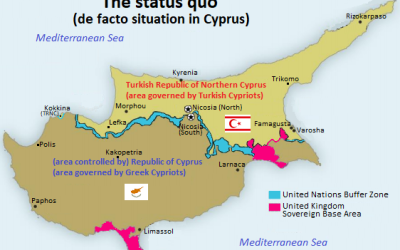
The flight to the beautiful port town of Paphos where we landed takes just 40 minutes, which makes it Israel’s closet neighbor. A flight to Cairo, Egypt from Tel Aviv takes 1 hour and 25 minutes, while a flight to Amman, Jordan, takes about 1 hour.
When we reached the capital Nicosia, we received a description of the bloody battles that took place in 1974 when Turkey attacked and captured one third of the island. One of the results of that battle is that Nicosia is the only divided capital city in the world today.
Though if you ask any Jewish taxi driver in Jerusalem to go to a destination in East Jerusalem, he will most likely say no, and you have to find a Palestinian taxi driver to take you there (about half of the taxi drivers in the city). When one of the guides made the comment about “the only divided capital today” I added that when in the future there will be a Palestinian state alongside the State of Israel Jerusalem also will also be a divided city. Of course with open borders.
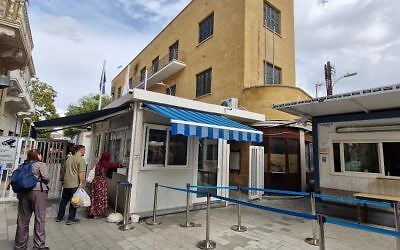
Today Nicosia too has an open border. Some of the members of our group went over to the other side. Being Israeli was not a problem. All they had to do was to show their passport to the officials at the border crossing. I crossed over to the other side on a previous visit when I participated in a regional conference with people from Israel, Lebanon, Egypt, Jordan, Palestinians and some 3rd party countries on a Weapons of Mass Destruction Free Zone in the Middle East organized towards the 2015 NPT (Nuclear Non-Proliferation Treaty) conference. That project was in the context of the “Academic Peace Orchestra-Middle East” organized by Prof. Bernrd Kubbig from the Peace Research Institute Frankfurt (PRIF). Cyprus is a good, accessible place for all peoples in the Middle East for such conferences.
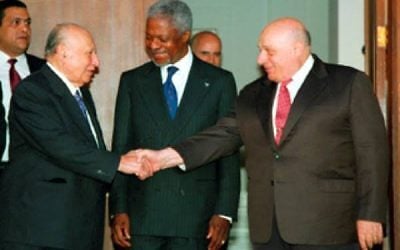
In 2004, UN Secretary General Kofi Annan presented a plan to reunify the two sides of Cyprus, creating a united federal state, with a power-sharing arrangement between the two communities. The plan, which dealt with all elements of the conflict, territory, property, refugees, military, and relationship with the EU was put to a referendum. While 64.9% of the Turkish Cypriots voted in favor, 75.8% of the Greek Cypriots rejected it. If you want to find out why, look it up.
As a result only the Greek side joined the EU in 2004 while the Turkish side didn’t. The Euro is the official currency on the Greek side, while the Turkish lira is the currency on the Turkish third of the island.
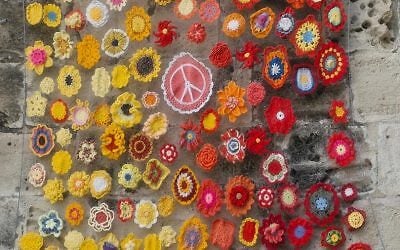
However, like in Israel/Palestine, where the Israeli Women Wage Peace organization is working together with the Palestinian Women of the Sun organization to achieve a peaceful resolution of the conflict, there is a similar women’s movement in Cyprus. When we reached the Limassol Castle we discovered that the walls were covered with extraordinarily beautiful embroidery. They were created by Greek and Turkish Cypriot women from both sides of the divide in the “Peace2Peace Connected Threads” project. Our local guide Martine, who is active in the Green Party, told me that she totally supports the project.
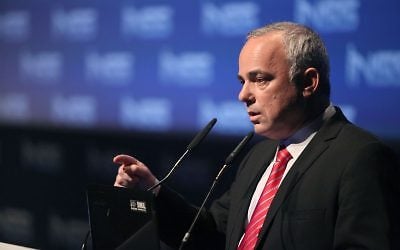
In 2004 I interviewed Likud member Dr. Yuval Steinitz when he was Chair of the Knesset’s Foreign Affairs and Security Committee together with a Palestinian colleague Omar Karmi for the Palestine-Israel Journal (www.pij.org). He told us that his solution for the Israeli Palestinian conflict was that both Israel and the Palestinians should become Associate Members of the EU. That may sound surprising for a Likud member but in the past he was a member of Peace Now and was actually wounded by the grenade that was thrown by right-wing extremist Yonah Avrushmi at the 1983 post-Sabra and Shatila massacre demonstration in Jerusalem calling for the resignation of Defense Minister Ariel Sharon, where Emil Grunzweig was killed.
Being an EU member seems to work very well for Cyprus, so perhaps it can also be an answer for Israel-Palestine.
At the same time a future comprehensive peace arrangement for Israel should clearly be based on a relationship with all of our immediate neighbors in the Middle East, the 22 member states of the League of Arab States. That would be based on the Arab Peace Initiative of 2002 that calls for recognition and normal relations with the State of Israel with the establishment of a Palestinian state in the West Bank and Gaza, with East Jerusalem as its capital, alongside the State of Israel. For those Israelis who are naturally worried about security concerns, the PLO leadership has said that their state would be demilitarized.
Jeremy Ben-Ami, the President of J Street calls that the 23 state solution. The late Prof. Johan Galtung, the father of the peace research discipline, proposed another variation, a six state community based on Israel with all of its immediate neighbors, thus Israel, a Palestinian state, Syria, Jordan, Egypt and Lebanon.
So perhaps we could have two concentric circles: 1) Israeli and Palestinian membership or associate membership in the EU, and 2) a 23 state or six state community with our Arab neighbors.
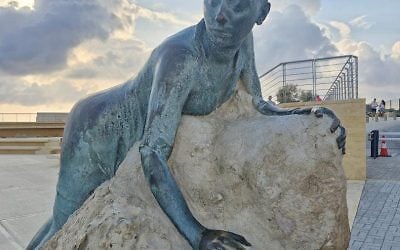
It’s not possible to visit Cyprus without bringing back some souvenirs. The island is of course the home of Aphrodite, Venus if you are a Roman, and I bought a replica of the famous armless statue of Aphrodite. I also discovered that there is a mermaid who watches over the port of Paphos, so I had to buy a small statue of that mermaid.
Then there was a visit to the Linos Winery in Omodos, with its unusual blue wine. Our guide Bina suspects that they add some coloring, but the owners claim that it’s authentically blue. We actually tasted at least six different types of wine.

And there is the delicious Commandaria wine from the Crusader period, considered one of the world’s oldest wines, that was apparently used by King Arthur and his Knights of the Round Table and others. After tasting endless little cups, I brought back 3 little bottles
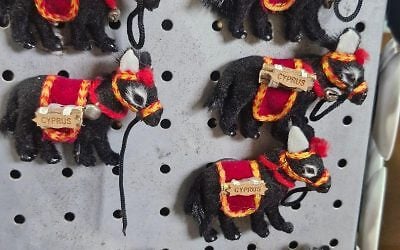
I also learned that the national animal of Cyprus is…the donkey! The reason being that originally it was the only way to get around. I didn’t bring back a donkey, but I did bring back a bar of donkey milk soap, which supposedly offers “deep hydration, gentle exfoliation and anti-aging support” according to AI, as a gift.