
CEO of Time to Stand Up for Israel
Can We Teach a Generation to Stop Hating?
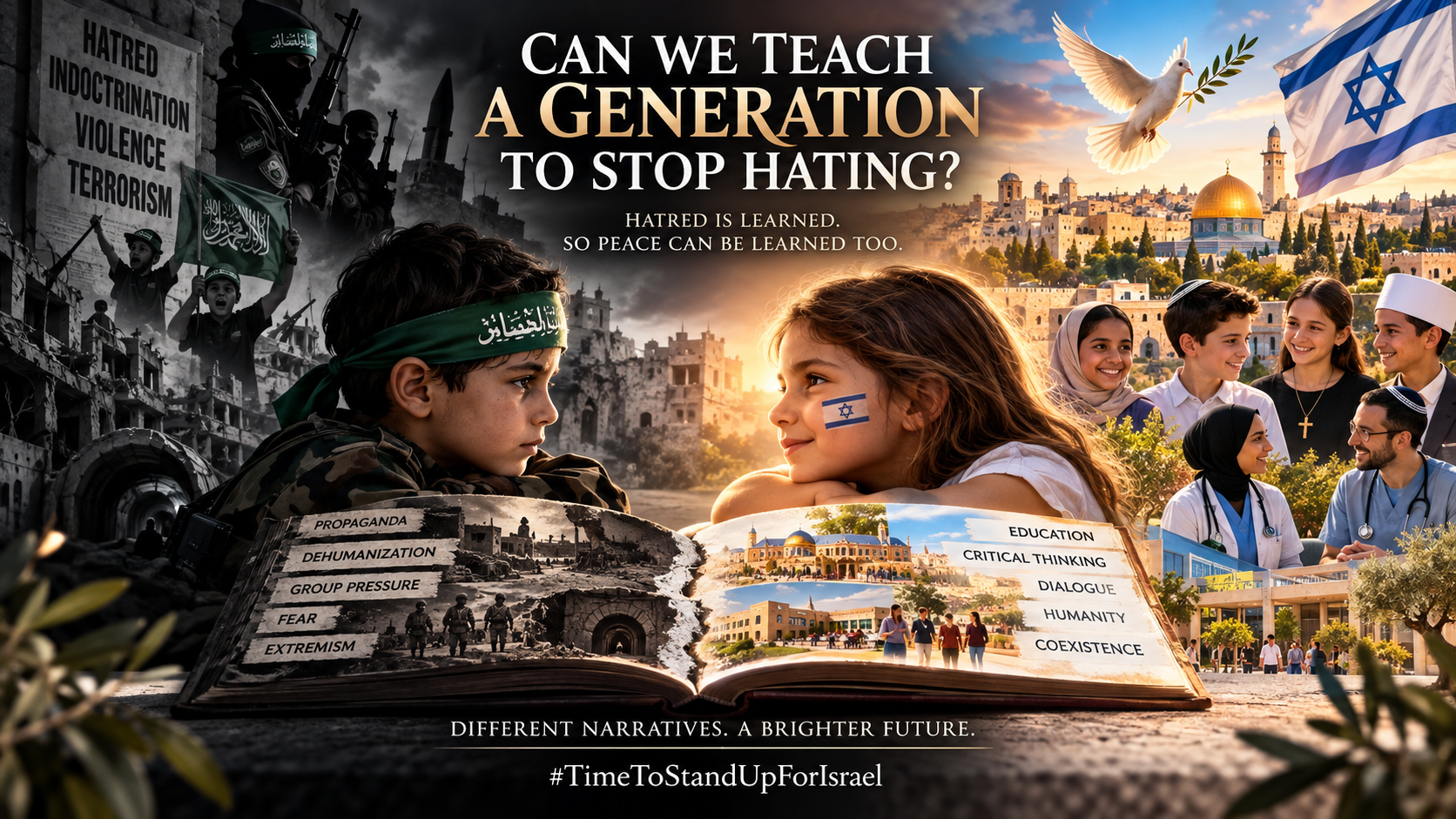
Photo Credits: Sabine Sterk ( AI)
There is a question that has occupied my mind for a long time, particularly when I look at the hatred directed toward Israel and the Jewish people. Can we actually change the convictions of people who have been taught from childhood that Jews are their enemies? Can we reverse an ideology that has become so deeply embedded in someone’s identity that even the most undeniable facts no longer seem to matter? And perhaps the most important question of all, can we change the mindset of an entire generation when hatred is not merely an individual opinion, but something reinforced by families, schools, religious authorities, political leaders and entire communities?
History has already shown us what can happen when hatred becomes institutionalized. Nazi Germany did not emerge overnight. Millions of ordinary people were gradually exposed to propaganda that portrayed Jews as dangerous, inferior and responsible for society’s problems. Children were taught to admire Hitler, young people were organized into ideological movements, and entire communities learned to accept the unacceptable. The Holocaust was not simply the consequence of a handful of evil individuals. It was made possible by a system that normalized antisemitism, rewarded conformity and progressively destroyed the moral barriers that should have protected innocent human beings. Yet after 1945, Germany faced the enormous challenge of rebuilding not only its cities and institutions, but also its moral foundations. That transformation was neither immediate nor complete, but it demonstrated that societies are not necessarily condemned to repeat the ideologies that once dominated them.
Today, when I see footage of children being encouraged to celebrate violence against Israelis, or crowds glorifying the murder of civilians, I cannot help thinking about the psychological mechanisms that allowed earlier generations to embrace destructive ideologies. The circumstances are different, and historical comparisons must be made carefully, but the mechanisms of indoctrination, dehumanization and group conformity deserve serious examination. Hamas and other extremist organizations have demonstrated how the glorification of violence can become part of a political and ideological culture. The atrocities of October 7, 2023, including the deliberate murder and abduction of civilians, showed what happens when the humanity of another people is denied. Equally disturbing is the willingness of some individuals, far beyond the Middle East, to excuse or celebrate those crimes.
But how do we change such thinking? Psychology provides some uncomfortable answers. When people become deeply attached to an ideology, that ideology often becomes part of their personal identity. Their beliefs are reinforced by the people around them, and disagreement can feel like betrayal. Facts that contradict their worldview may be dismissed as propaganda, while information that confirms their existing convictions is embraced without question. This phenomenon is known as confirmation bias. Add group pressure, fear of exclusion and moral disengagement, and you create an environment in which even atrocities can be justified. The individual no longer asks whether an action is morally acceptable, but whether it serves the interests of the group to which he belongs.
This is precisely why I believe that defeating a terrorist organization militarily, however necessary it may be to protect civilians and prevent further attacks, cannot by itself eliminate the ideology that sustains it. Weapons can be confiscated, tunnels destroyed and terrorist leaders removed, but an idea can survive long after its organizational structure has collapsed. If children continue to be taught that murdering Jews is heroic, that compromise is betrayal and that Israel has no right to exist, the next generation may inherit the same hatred. A lasting peace requires more than the absence of war. It requires the presence of an education that teaches children to recognize the humanity of people they have never met.
We should also be careful not to confuse an extremist ideology with an entire population. Palestinians are not born hating Jews, just as Germans were not born Nazis. Hatred is learned, reinforced and sometimes rewarded. That means it can also be challenged, although the process is difficult and the outcome never guaranteed. There are Palestinians and other Arabs who reject terrorism, recognize Israel and seek peaceful coexistence. Their voices deserve protection and encouragement, especially when speaking openly may expose them to intimidation. Any serious effort to counter extremism must distinguish between those who promote violence and those who are themselves trapped within an environment dominated by fear and ideological pressure.
Israel itself offers an important example of why coexistence should not be dismissed as an impossible dream. Jewish, Muslim, Christian and Druze citizens live within the same country. They study at universities, work in hospitals, establish businesses and participate in public life. Israeli society certainly has tensions, inequalities and disagreements, as every society does, but its diversity demonstrates that different religious and ethnic communities can share institutions and build relationships without surrendering their identities. In Israeli hospitals, Jewish and Arab medical professionals regularly work side by side to treat patients regardless of their background. That everyday cooperation may not attract the international headlines that conflict does, but it represents something far more constructive than the glorification of hatred.
The challenge is therefore educational, psychological and cultural. Children must be taught to question propaganda rather than repeat it. They must learn that disagreement does not justify violence, that historical grievances do not grant permission to murder civilians and that human dignity is not reserved for members of their own community. Teachers should encourage critical thinking rather than ideological obedience. Political and religious leaders must be held accountable when they glorify terrorism or encourage dehumanization. Former extremists who have rejected violence may help others reconsider their beliefs, while genuine encounters between communities can gradually undermine stereotypes that survive only because people have never been allowed to know one another.
However, we must also recognize that changing an entire society takes time. Germany’s transformation after the Second World War required institutional reform, education, accountability and the gradual development of a different political culture. It did not happen because someone presented a convincing argument in a public debate. Nor did every individual suddenly abandon antisemitism. Real change involved generations of difficult work. The same principle applies wherever extremist ideologies have become deeply rooted. There is no magical psychological technique capable of instantly reversing decades of indoctrination. There is only the persistent effort to create conditions in which people can question what they have been taught without fearing that doing so will cost them their lives, their families or their place in society.
The international community also has responsibilities. It is not enough to demand that Israel make concessions while ignoring the ideological environment in which future generations are being raised. Any serious peace initiative must include scrutiny of educational materials, opposition to the glorification of terrorism, support for independent thinking and meaningful protection for those who advocate coexistence. These standards should apply consistently, including to Israeli education and public discourse wherever prejudice or dehumanization occurs. Peace cannot be built by teaching one generation that another generation is inherently evil.
I have spent many years defending Israel against misinformation, antisemitism and the denial of Jewish history. Yet I increasingly believe that one of the greatest challenges is not simply correcting false narratives, but understanding why people become emotionally dependent on them. We can publish historical documents, present archaeological evidence of Jewish roots in the land of Israel and expose contradictions in extremist propaganda. These efforts matter enormously. But information alone may not reach someone whose entire social world depends on rejecting it.
Perhaps the most powerful question we can ask is not merely how to defeat hatred, but how to make hatred unnecessary to someone’s identity. How do we offer young people a future in which their dignity does not depend on another people’s destruction? How do we teach them that their own history and suffering can be acknowledged without denying Jewish history or Israeli suffering? How do we replace the admiration of those who kill with respect for those who build, heal, educate and protect human life?
Israel has every right to defend its citizens against terrorism. That right should never be conditional upon the willingness of its enemies to accept peace. But if we want future generations of Israeli and Palestinian children to grow up without the constant threat of another war, we must confront the ideology that makes violence appear noble and coexistence appear shameful.
The greatest victory over extremism would not simply be the destruction of its weapons. It would be the day when a child who was once taught to hate a Jew grows up refusing to hate anyone merely because of who they are.
That is not weakness. That is the foundation of a future worth fighting for.
Related Topics