
Candace Owens’ Latest Attack on Ben Shapiro Uses Old Tropes in a New Media War
Candace Owens no longer flirts with antisemitic suggestions; she invites them to the prom. In her most recent episode, she frames her professional conflicts as something closer to a gang war than a public disagreement, casting Ben Shapiro as a mustache-twirling villain. In her telling, he is both the crime boss orchestrating a coordinated campaign against her and the obsessive ex who cannot let go. He’s a lethal cross between Don Vito Corleone from The Godfather and Kathy Bates’ Annie Wilkes in Misery.
She does not stop at arguing that Shapiro mistreats her or seeks to undermine her professionally. She describes him as a type of succubus who “sees health” and “believes that it belongs to him,” then moves into explicit dehumanization. She calls him a parasite, a worm, a maggot on a corpse. She pairs this dehumanizing language with insinuations that appear to move toward accusations of lethal wrongdoing.
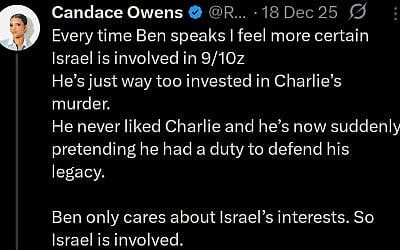
Owens tells her audience that Charlie Kirk “wanted out” and “was killed,” then says that Ben Shapiro’s behavior since Kirk’s death makes her believe he “may know more than the public knows.” She offers no evidence, describing the belief instead as something she feels “in [her] soul.” Owens then adds that Shapiro behaves as though Kirk’s company had been “promised to him 3,000 years ago.” She concludes by accusing Shapiro of seeking to “pervert the legacy of a dead man” for his own benefit. The effect is not a direct allegation but a narrative that links death, motive, and moral corruption while allowing her to avoid making a claim she would need to prove.
Dehumanization does not require a direct call to violence to raise the risk of violence. It works by stripping a person of human complexity and moral standing, by reducing them to the equivalent of an infestation, which must be torn out root and stem. Owens claims she was fired because she merely surmised that Hollywood is “being run by a gang.” Then states, “Yes, there were Jewish mafiosos, bootleggers.” In her telling, outrage at this claim becomes proof of its truth. Punishment confirms conspiracy.
This idea that “they run things” sits at the heart of classic antisemitism: the belief that Jews operate as a shadow elite that controls institutions and punishes dissent. The International Holocaust Remembrance Alliance notes that antisemitism often explains why things go wrong by blaming Jews and relying on dark stereotypes. The US State Department has similarly warned that antisemitism frequently takes the form of conspiracy accusations meant to portray Jews as sneaky and dangerous.

She then misrepresents aspects of the Jewish faith, telling her audience that Shapiro grew up with a silver spoon and claimed he was taught that “the whole world is yours because you were born chosen.” In a world where antisemites have long distorted Jewish religious identity into a charge of supremacy, the phrase cannot be read as neutral.
She then places Shapiro inside a narrative that unfolds like a Gillian Flynn thriller. Owens claims that people are being recruited as “attack dogs” to go after her and Tucker Carlson under the guise of a comedy show she says the Daily Wire is developing. While the show appears to mock conspiracy theories across the political spectrum, Owens insists its true purpose is to target her and Carlson personally. Instead of presenting herself as the butt of a joke, Owens frames herself as a threatened truth teller and Shapiro as the bully, even as she uses rhetoric that renders him a subhuman belly creature embedded in a conspiratorial machine. This inversion invites listeners not simply to disagree with Shapiro but to fear him, loathe him, and see him as a cancer.
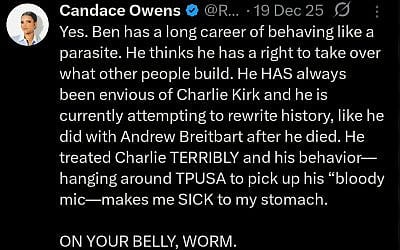
Owens never needs to say “do violence.” She only needs to do what demagogues have always done: portray a target as a corrupting parasite, place him inside a secret criminal network, and insist that ordinary moral rules no longer apply because she faces underhanded tactics by elites.
Owens presents herself as a rebel against conservative orthodoxy. In reality, she works to fracture one of the most stable features of American conservatism: a broadly philosemitic orientation and a strong pro-Israel posture. Polling consistently shows high Republican support for Israel. Gallup found that more than four out of five Republicans held a favorable view of Israel in early 2025. Even among younger conservative activists, pro-Israel sentiment remains dominant. A Turning Point USA straw poll at AmericaFest found that a large majority viewed Israel as a US ally, with many calling it America’s closest ally.
When Owens frames a Jewish commentator as a parasite within a shadowy gang, she does more than offend. She revives the old, though well-preserved, antisemitic scripts in a moment when a single radicalized listener can turn words into violence. That is what makes her show not merely offensive, but dangerous.