London based entrepreneur, cybersecurity analyst doing a PhD in AI
Capability does not equal Trust.
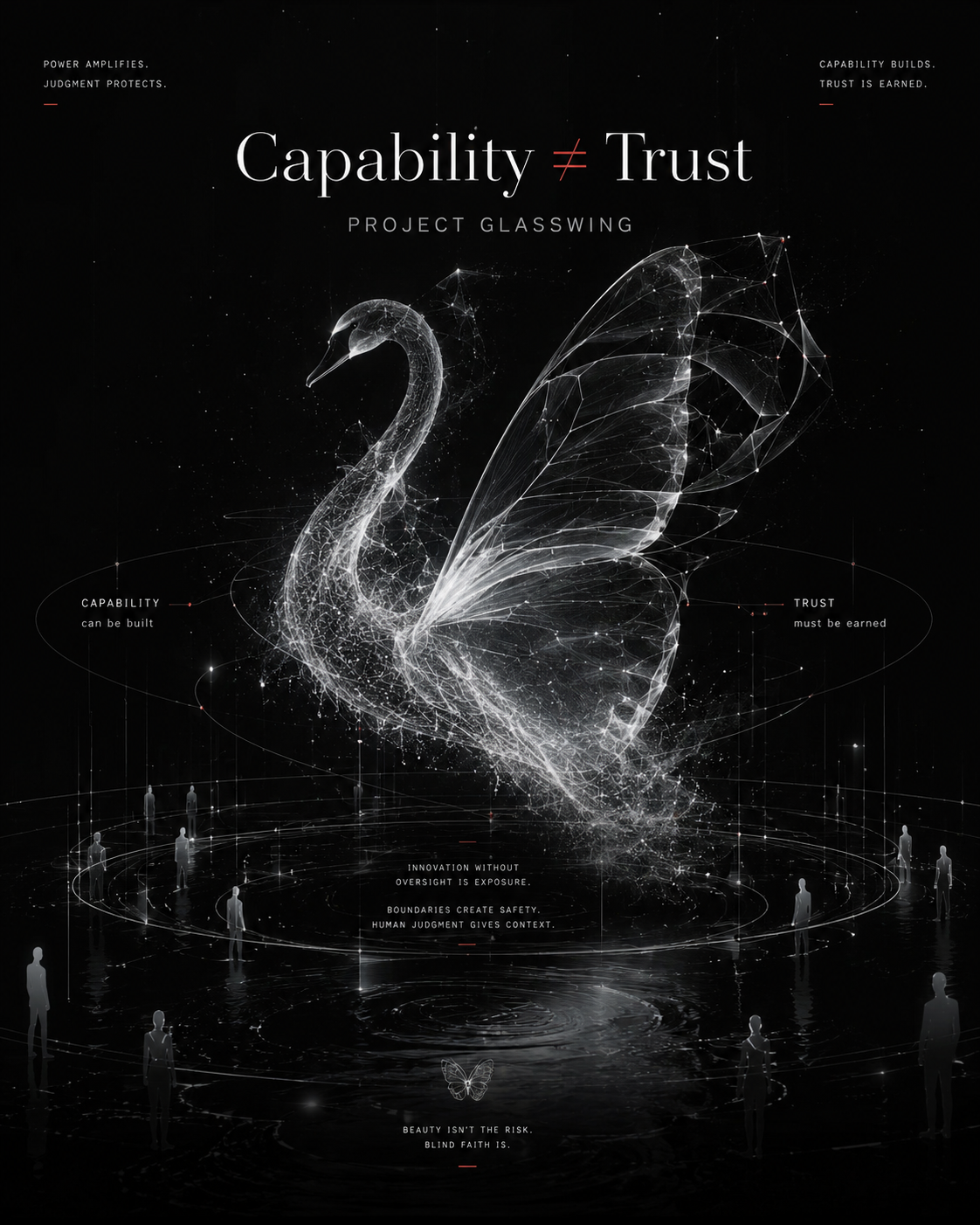
Capability ≠ Trust
Project Glasswing, artificial intelligence, human expertise — and why the most capable system is not necessarily the system we should trust
Artificial intelligence is becoming extraordinarily capable.
That sentence is increasingly difficult to dispute.
Models can write software.
Read medical literature.
Analyse images.
Translate languages.
Search enormous document collections.
Generate engineering designs.
Operate computers.
Call external tools.
Interact with databases.
And increasingly, rather than merely answering a question, they can take an action.
That distinction changes everything.
A language model producing the wrong paragraph is inconvenient.
An autonomous system producing the wrong instruction inside a bank, hospital, electrical grid, telecommunications network or military system can be something else entirely.
The central problem of the next stage of artificial intelligence is therefore no longer simply:
How capable can we make the machine?
It is:
When does capability justify trust?
The Qur’an offers an unexpectedly useful distinction.
In the story of Mūsā (a.s.), one of the two women recommends him to her father:
“O my father, hire him. Indeed, the best one you can hire is the strong and the trustworthy.”
— Qur’an 28:26. (Quran.com)
Two qualities.
Not one.
Al-qawiyy.
The capable.
The strong.
The person able to perform the task.
And:
Al-amīn.
The trustworthy.
The one to whom responsibility can safely be entrusted.
That distinction may become one of the most important axioms of the AI age.
Capability ≠ Trust.
What the Verse Actually Means
The verse occurs after Mūsā (a.s.) assists two women by watering their animals.
One later recommends that her father employ him.
Ibn Kathīr records explanations attributed to early authorities concerning why she characterised Mūsā (a.s.) as both strong and trustworthy: his strength had been demonstrated through his physical assistance, while his trustworthy character was inferred from his conduct and modesty. (King Saud University Quran Project)
The important point is structural.
She does not say:
Hire the strongest person.
She effectively says:
Hire the person possessing the capability to perform the work and the character required to be entrusted with it.
Warren Buffett famously states that if a person lacks integrity, their intelligence and energy become dangerous weapons instead of useful tools.
Ability by itself is incomplete.
This is not merely a rule for recruitment.
It is a remarkably useful theory of delegated power.
And AI is, increasingly, delegated power.
The Most Capable Model Is Not Automatically the Safest Model
Imagine two systems.
AI A is enormously intelligent.
It solves 99.9 per cent of tasks correctly.
It also has unrestricted access to:
production databases;
financial systems;
email accounts;
customer records;
cloud infrastructure;
source-code repositories;
and external APIs.
AI B may be slightly less capable.
But it operates inside carefully designed boundaries.
It has:
limited permissions;
independent monitoring;
action logging;
rollback;
security controls;
human escalation;
and restrictions on consequential actions.
One of the key features from databases which AI models must adopt is the ability to rollback as well as something similar to CRUD operations. We are launching these features as part of the next update of Erasys ClearFrame – as well as other new features, which currently is the market leading AI agent framework we believe based on the feature set.
Which should run a hospital?
Which should control a bank?
Which should administer state infrastructure?
Benchmark capability alone cannot answer that question.
Because:
al-qawiyy is only half of the equation.
Artificial Intelligence Is a Function Before It Is Anything Else
Strip away the anthropomorphic language and a neural network is fundamentally a mathematical mapping.
Inputs enter.
Parameters transform them.
Outputs emerge.
One neuron accomplishes little.
Connect enormous numbers of computational units, train the network over vast quantities of information and adjust its parameters to minimise error, and complicated representations begin to emerge.
Large language models add architectures such as the transformer and attention mechanisms that allow information at different positions in a sequence to interact.
The result can be extraordinary.
But nothing about this process creates an automatic certificate saying:
This output corresponds to reality.
That is the distinction we repeatedly forget.
Intelligence Is Not a Truth Machine
A model may be capable of producing:
a brilliant medical explanation;
and a fabricated citation.
Excellent software;
and a security vulnerability.
A sophisticated legal argument;
and a nonexistent judgment.
A plausible investment analysis;
and an incorrect assumption buried five steps earlier.
A good answer and a dangerous answer can be produced through the same machinery.
The model’s fluency does not contain its own proof.
This creates a fundamental problem:
capability is observable through performance, while trust requires evidence about behaviour across circumstances we may not yet have encountered.
That second problem is considerably harder.
The Difference Between an Answer and an Action
This becomes especially important as AI evolves into agents.
A chatbot says:
Here is what I think you should do.
An agent may instead:
open the account;
authenticate to the service;
write the code;
change the configuration;
transfer the information;
send the message;
commit the transaction;
and continue to the next task.
The unit of risk has changed.
It is no longer merely:
Was the answer wrong?
It becomes:
What did the wrong answer cause?
That is Project Glasswing’s starting point.
One Error Can Become a Chain
Consider an autonomous infrastructure agent.
It sees unusual network traffic.
It incorrectly diagnoses the cause.
It modifies a routing configuration.
Another automated system observes the changed traffic pattern and interprets it as a security event.
It begins isolating services.
A financial system dependent upon those services starts activating contingency procedures.
A logistics platform interprets missing information as a supply interruption.
A fourth autonomous system reacts to that.
Every component may be behaving reasonably according to its local objective.
The system as a whole becomes unreasonable.
The danger does not require a conscious malevolent machine.
It requires only:
interconnection + autonomy + an unexpected condition.
That is enough.
Black Swans Become Machine-Speed Events
Nassim Nicholas Taleb’s Black Swan describes a rare and difficult-to-predict event with enormous consequences.
Artificial intelligence can potentially make systems safer by noticing anomalies humans miss.
But it can also accelerate correlated failure.
Imagine thousands of organisations using:
similar foundation models;
similar cloud infrastructure;
similar agent frameworks;
similar security assumptions;
similar data sources;
and similar automated responses.
We create not merely automation.
We create correlated cognition.
A vulnerability or mistaken premise can propagate at computational rather than institutional speed.
The failure that once took twenty people three days to create might be produced across several systems in three seconds.
That is why the risk surface changes fundamentally when AI moves into critical infrastructure.
Project Glasswing
The glasswing butterfly is remarkable because much of its wing appears transparent.
That is the metaphor.
AI does not necessarily need to expose every internal numerical weight for us to govern it effectively.
But its operations must become transparent.
For every consequential AI action, we should increasingly be able to answer:
What did it do?
What instructed it?
What information did it use?
What systems did it access?
What permissions did it exercise?
What changed as a consequence?
What independent system checked the action?
What person remains accountable?
Can the action be reversed?
Can the agent be disconnected?
That is operational transparency.
And it needs to become infrastructure.
AI Needs Antibodies
Cybersecurity evolved because connecting computers created both extraordinary value and extraordinary vulnerability.
We responded by building technological immune systems:
firewalls;
antivirus;
intrusion detection;
identity controls;
network segmentation;
zero trust;
endpoint monitoring;
security operations centres;
incident-response systems.
AI needs a comparable transition.
Call the next layer:
AI antibodies.
An antibody does not need to perform the original task.
Its job is to watch what is happening.
An independent monitor could examine:
which resources the agent is accessing;
whether its behaviour has changed;
whether it is attempting to expand its privileges;
whether information is leaving an expected boundary;
whether instructions originated from legitimate sources;
whether an action violates policy;
whether a sequence of individually ordinary actions has become collectively abnormal;
and whether the system should simply be stopped.
The monitor should not ask only:
Is this AI intelligent?
It should continuously ask:
Is what it is doing acceptable?
Human Oversight Is Meaningless Without Human Knowledge
This produces another uncomfortable conclusion.
People often answer autonomous-AI risk with:
Keep a human in the loop.
That sounds reassuring.
But:
Which human?
Suppose an AI generates a change to electrical-grid control software.
The operator receives:
APPROVE CHANGE?
If the person does not understand electrical engineering, the software or the downstream consequences, pressing Approve is theatre.
A human being has technically been placed in the loop.
Knowledge has not.
The real safeguard is therefore not:
human presence.
It is:
human competence.
This is where another Qur’anic example becomes striking.
Yūsuf (a.s.) says:
“Put me in charge of the storehouses of the land, for I am truly a reliable guardian and knowledgeable.”
— Qur’an 12:55. (Alim)
Again:
two characteristics.
Ḥafīẓ — able to preserve, guard and discharge the trust.
ʿAlīm — knowledgeable.
Ibn Kathīr explains ḥafīẓ here in terms of honest guardianship and ʿalīm as possessing the knowledge and insight appropriate to the task. (King Saud University Quran Project)
There is an important AI principle hiding in plain sight:
Responsibility without knowledge is not meaningful supervision.
AI May Require More Experts, Not Fewer
This is why the simplistic claim that artificial intelligence necessarily eliminates expertise may prove badly wrong in high-consequence professions.
It will certainly automate parts of expertise.
But consider the consequence of amplification.
One junior programmer manually writing bad code may damage an application.
One junior operator approving an AI-generated configuration deployed across 50,000 machines may damage a corporation.
One autonomous mistake inside interconnected national infrastructure could affect:
telecommunications;
finance;
transport;
energy;
water;
healthcare;
defence.
As productive leverage rises, the cost of ignorance rises with it.
The professional role changes.
The expert may perform less routine production while doing more:
verification;
system design;
testing;
exception handling;
red teaming;
auditing;
adversarial review;
risk modelling;
and intervention when the machine encounters circumstances outside its competence.
AI could make ordinary cognitive production cheaper while making judgment more valuable.
The Automation Paradox
Automation creates an old problem.
The better an automated system performs routinely, the less frequently humans practise the skill required when it fails.
Eventually:
the machine handles the ordinary cases;
the human loses familiarity;
then the extraordinary case appears;
and precisely when expertise is most required, it has deteriorated.
Imagine this across entire professions.
Doctors who cease independently constructing differential diagnoses.
Engineers who rarely solve problems from first principles.
Programmers who deploy code they cannot explain.
Financial analysts who no longer understand the assumptions behind forecasts.
Lawyers who cease reading primary sources because the model summarises them.
The machine works.
Until it doesn’t.
Then comes the crucial question:
Does anyone in the room still know enough to realise it is wrong?
Project Glasswing therefore treats human expertise not as redundant overhead, but as systemic redundancy.
Trust Must Be Earned Per Action
A useful principle is:
Do not trust the AI globally. Trust specific actions conditionally.
Reading a public document carries relatively little risk.
Deleting a production database does not.
Drafting an email is not equivalent to transferring £100 million.
Generating a drug hypothesis is not equivalent to prescribing a drug.
Recommending a configuration is not equivalent to deploying it across an electrical grid.
Permissions should therefore rise with assurance.
The more consequential the action, the more demanding the safeguards.
This suggests:
least privilege;
sandboxing;
independent validation;
simulation;
human authorisation;
continuous monitoring;
complete logging;
rollback;
rate limiting;
and hard technical boundaries.
The Qur’anic Architecture of Trust
Qur’an 28:26 becomes particularly interesting when placed inside this architecture:
“The best one you can hire is the strong and the trustworthy.” (Quran.com)
Translated into Project Glasswing:
Capability without trustworthiness is insufficient.
Then Qur’an 12:55 adds:
Guardianship requires knowledge. (Alim)
And Qur’an 4:58 adds an institutional layer:
“Allah commands you to return trusts to their rightful owners; and when you judge between people, judge with fairness.” (Quran.com)
Ibn Kathīr explicitly treats the verse as a general command encompassing the trusts human beings owe one another and links authority with the obligation of justice. (Alim)
Combined, they yield an unusually useful governance model:
Capability.
Trustworthiness.
Knowledge.
Accountability.
Justice.
Those are stronger foundations for autonomous systems than capability alone.
The Glasswing Stack
A mature high-consequence AI deployment should consequently contain several independent layers.
The Model
Generates predictions, recommendations or plans.
The Agent
Gives the model memory, goals and access to tools.
The Guardrail
Defines actions the system simply cannot perform.
The Antibody
Independently monitors behaviour and detects anomalies.
The Sandbox
Limits the environment in which actions initially occur.
The Ledger
Preserves an auditable history of consequential behaviour.
The Human Expert
Understands the domain sufficiently to challenge the machine.
The Circuit Breaker
Stops an action chain before local failure becomes systemic failure.
The Kill Switch
Revokes access entirely when containment fails.
This is defence-in-depth for artificial agency.
The Antibody Cannot Merely Be the Same AI Twice
There is another complication.
Suppose one foundation model performs the task.
An identical model checks it.
Both may share the same blind spot.
The monitor therefore needs some degree of epistemic diversity.
Potentially:
a different foundation model;
symbolic rules;
deterministic policy engines;
statistical anomaly detection;
formal verification;
conventional cybersecurity systems;
and human domain experts.
Independent checking is useful only insofar as the checking process possesses some independence.
Otherwise we have merely asked the same mistake twice.
Capability Can Produce Fragility
A civilisation can become technologically stronger while becoming systemically more fragile.
Suppose artificial intelligence increases productivity by 30 per cent.
Excellent.
Now suppose essential services gradually become dependent upon a small number of foundation models and cloud providers.
The economy becomes more capable.
But also more correlated.
This resembles monoculture in biology.
A genetically identical crop can be extraordinarily productive.
Until a pathogen uniquely suited to that crop arrives.
Then uniformity becomes vulnerability.
Artificial cognition could create the equivalent of cognitive monoculture.
Project Glasswing therefore argues for diversity not merely as a social value but as a reliability mechanism.
Different models.
Different architectures.
Different monitors.
Different humans.
Different assumptions.
AI Assurance Becomes a Profession
This may create an enormous new professional layer.
AI auditors.
Agent-security engineers.
Model-risk specialists.
AI red teams.
AI incident investigators.
AI governance architects.
Autonomous-systems supervisors.
Domain experts trained specifically to evaluate machine-generated work.
Critical institutions may eventually operate an:
AI Security Operations Centre.
Traditional cybersecurity asks:
Who is attacking our systems?
An AI SOC adds another question:
What are our own autonomous systems doing?
That distinction could become as fundamental as cybersecurity itself.
The Most Dangerous Model May Be the Model That Is Usually Right
An obviously incompetent system receives scrutiny.
A system that fails every third task will not be trusted.
Paradoxically, the dangerous transition occurs when AI becomes extremely reliable.
Imagine 99,999 correct decisions.
Humans stop checking closely.
Then comes decision 100,000.
An unusual circumstance.
The model extrapolates incorrectly.
The operator assumes it knows.
The system acts.
This is why high reliability can create automation complacency.
The better AI becomes, the greater the temptation to confuse:
usually correct
with:
intrinsically trustworthy.
They are not the same.
Capability ≠ Trust.
Project Glasswing’s First Principle
Project Glasswing should therefore begin with one sentence:
No system earns trust merely by demonstrating capability.
Trust requires an architecture.
Capability must be surrounded by:
verification;
bounded authority;
independent observation;
human expertise;
auditability;
reversibility;
and accountability.
That is not anti-AI.
It is what permits more powerful AI to be deployed safely.
Aircraft became more powerful because engineering simultaneously became more rigorous.
Financial markets became faster because controls evolved around them.
The internet became economically useful because cybersecurity matured.
AI assurance can perform the same function.
Safety Is Economic Infrastructure
This matters economically.
The safest AI economy may eventually be the most productive AI economy.
Why?
Because trust permits adoption.
Banks will delegate more when transactions can be audited.
Hospitals will use AI more deeply when clinicians can validate decisions.
Governments can automate more when processes remain reviewable and reversible.
Utilities can safely incorporate autonomy when failures are bounded.
Businesses invest when they understand the risk.
Security therefore does not merely constrain technological growth.
Security makes technological growth investable.
Confidence is capital.
Intelligence May Become Abundant — Trust Will Not
Artificial intelligence may make many cognitive outputs extraordinarily cheap.
Code.
Analysis.
Images.
Documents.
Research summaries.
Designs.
Recommendations.
Perhaps eventually sophisticated reasoning itself.
When something becomes abundant, its economic value tends to shift toward whatever remains scarce.
The scarce resource may increasingly become:
Who knows whether this is right?
Who checked it?
Who understands it?
Who is accountable?
What evidence supports it?
Can it be trusted?
AI may therefore commoditise production while increasing the premium on discernment.
And that brings us directly back to the Qur’anic formula.
The best person to entrust with something is not simply:
al-qawiyy.
The capable.
It is:
al-qawiyy al-amīn.
The capable and trustworthy.
That conjunction may matter more in the age of artificial intelligence than either word does alone.
Footnote I — A Human Brain Is Not a 100-Trillion-Parameter Model
There is a tempting comparison between artificial neural networks and human brains.
It should be used carefully.
The U.S. National Institutes of Health describes the human brain as containing approximately 86 billion neurons forming trillions of connections, while the NIH BRAIN Initiative and NINDS cite more than 100 trillion synaptic connections. (National Institutes of Health)
Meanwhile, Reuters reported in August 2026 that ByteDance was pursuing a model of up to 10 trillion parameters. Reuters noted that the figure concerned a model still under development and that leading American developers generally do not disclose comparable parameter counts; parameter number also does not directly determine intelligence or performance. (Reuters)
So the intellectually correct comparison is:
~100+ trillion biological synapses
versus
a reported possible 10-trillion-parameter artificial model.
But a synapse is not an AI parameter.
The brain is an electrochemical, recurrent, plastic, embodied biological system involving neurons, synapses, neurotransmitters, glia, dendritic computation, metabolic constraints and continuously changing connections.
An AI parameter is usually a numerical value participating in a mathematical computation.
They are not interchangeable units.
Still, the comparison provides a useful antidote to a peculiar modern habit.
We are prepared to spend extraordinary amounts of money constructing artificial networks containing trillions of numerical parameters while frequently treating the biological intelligence contained in an ordinary human being as economically disposable.
If artificial cognition is valuable because intelligence creates possibilities, human cognition deserves at least as serious an economic analysis.
The Qur’an says of human beings:
“Indeed, We have honoured the children of Adam…”
— Qur’an 17:70.
That is a theological claim about dignity, not a statement about market capitalisation.
But economics supplies a related practical observation:
human beings are not simply costs. They are productive capital, consumers, creators, workers, entrepreneurs and sources of future innovation.
Which raises an uncomfortable question in the context of Gaza and the West Bank.
Footnote II — What Is the Economic Value of 5.56 Million Underutilised Human Beings?
We should be extremely careful here.
Palestinians are not “assets belonging to Israel,” and their economic output is not money to which Israel is automatically entitled to.
The proper economic question is:
How much additional regional output might become possible if roughly 5.56 million Palestinians were able to participate in a stable, highly capitalised, infrastructure-rich and increasingly integrated regional economy?
The Palestinian Central Bureau of Statistics estimates that approximately 5.56 million Palestinians lived in the State of Palestine at the end of 2025 — about 3.43 million in the West Bank and 2.13 million in Gaza. (PCBS)
World Bank data put 2024 GDP for the West Bank and Gaza at approximately $13.71 billion, or about $2,592 per capita. The same World Bank dataset puts Israel’s 2024 GDP at approximately $540.4 billion, or $54,177 per capita. (World Bank Open Data)
Those numbers should not be naively interpreted as innate differences in productive ability.
Capital stock differs.
Infrastructure differs.
Labour mobility differs.
Education-to-employment pathways differ.
Security conditions differ.
Investment differs.
Institutions differ.
And Gaza’s economy has suffered catastrophic wartime destruction: World Bank data show West Bank and Gaza real GDP contracting 26.6 per cent in 2024. (World Bank)
But the gap permits a useful counterfactual thought experiment.
Using 5.56 million people and Israel’s 2024 GDP per capita only as a benchmark:
Scenario A — Palestinian output reaches 25% of Israeli GDP per capita
25% of $54,177 ≈ $13,544 per person
Applied to 5.56 million people:
≈ $75.3 billion annual GDP
Compared with the actual 2024 level of approximately $13.7 billion:
≈ $61.6 billion of additional annual output.
Scenario B — Palestinian output reaches 50% of Israeli GDP per capita
50% of $54,177 ≈ $27,088 per person
Across 5.56 million people:
≈ $150.6 billion annual GDP
Potential increment over the 2024 baseline:
≈ $136.9 billion annually.
Scenario C — Long-run convergence to Israeli 2024 GDP per capita
This is a deliberately extreme upper-bound thought experiment, not a forecast.
$54,177 × 5.56 million:
≈ $301.2 billion annual GDP
Relative to approximately $13.7 billion currently:
≈ $287.5 billion of additional annual economic output.
That does not mean “Israel is losing $287.5 billion.”
It means that, under an extraordinarily ambitious convergence scenario, the regional economy could contain hundreds of billions of dollars more annual production than the presently constrained Palestinian economy produces.
The benefits would potentially accrue across Palestinian households and businesses, Israeli firms, investors, tax bases, regional suppliers, consumers and neighbouring economies.
And economic integration would generate additional effects which this simple multiplication does not model:
trade;
specialisation;
capital formation;
ports;
tourism;
construction;
technology transfer;
Arabic-language digital services;
manufacturing;
energy;
desalination;
healthcare;
and entrepreneurship.
In reality the trajectory would take decades and depend upon political arrangements, security, property rights, infrastructure, investment and institutions.
But the basic economic point remains powerful.
We currently marvel at a proposed 10-trillion-parameter artificial model because we expect intelligence to create value. (Reuters)
A few kilometres away from one of the world’s most technologically sophisticated economies are approximately 5.56 million human beings, each carrying a biological neural architecture containing on the order of tens of billions of neurons and collectively trillions upon trillions of synaptic connections. (PCBS)
Parameter counts cannot be converted into dollars.
Synapses cannot be valued like GPU weights.
People are not machines.
But that is precisely the point.
If artificial intelligence teaches us anything economically, it should be that intelligence is productive capital.
Underdeveloping human intelligence therefore has an opportunity cost.
And if the next technological revolution is going to teach us to place enormous valuations on artificial cognition, perhaps one of its unintended lessons will be to remind us of the staggering value we have always possessed in human cognition.
This equally applies to Sudan, Africa, Latin America, South East Asia, and many other parts where human intellectual capital is not properly developed – and the key point here is “valued”. If we are thinking purely in economic terms – we are as a collective humanity “leaving money on the table” – by focusing on weapons to destroy human potential instead of free universities to augment human potential. There is no shortage of food or facilities or infrastructure. 1/3rds of world food production is wasted. Nobody needs to go hungry.
Project Glasswing begins with AI.
But perhaps its deepest principle applies to people too:
Capability ≠ Trust.
Yet neither should capability be confused with worth.
A machine may need to prove that it deserves our trust.
A human being should not have to prove that he or she deserves the opportunity to develop.
Its time to think in better terms – and the Quran gives us that framework – “We have indeed honoured the children of Adam” – and nobody – state or individual should have the agency to remove that honour.
Related Topics
Related Posts