


Advancing Women's Health, One Policy at a Time
Care Must Come Before the Crisis
It should not take a mother on trial for killing her children and the death of a woman who once spoke publicly about postpartum depression, to make us talk seriously about what happens to women after they give birth.
But here we are.
The Lindsay Clancy trial has brought postpartum mental illness into courtrooms, newspapers and social media feeds around the world. At almost exactly the same time, Hayden Panettiere’s death resurfaced her earlier comments about postpartum depression and how abandoned she felt after speaking publicly about it.
What happened in either case is far more complicated than a headline can capture. I have no idea what was happening inside Lindsay Clancy’s mind, and I will not attempt to resolve questions that psychiatrists, lawyers and a jury are still grappling with. I also do not know what ultimately contributed to Hayden Panettiere’s death.
What I do know is that we still, in 2026, tend to pay attention to women after birth only when something has gone terribly wrong.
For every postpartum story that becomes a headline, there are thousands that never will.
There is the woman who has not slept for more than two hours at a time in weeks, and no longer knows whether the thoughts running through her head are exhaustion, or something more. The woman who cries in the shower every day, and then comes downstairs and says she is fine. The woman whose birth was traumatic, but who keeps hearing that everything went well because the baby is healthy. The woman who is bleeding, sore, struggling to feed her baby, trying to understand a body she barely recognizes, and simultaneously being asked to assume responsibility for another human being around the clock.
Most of these women will never become psychiatric emergencies. That does not mean they do not need care.
Pregnancy is treated as a significant medical period. Women are followed for months. We check blood pressure, blood counts, fetal growth, glucose, urine, symptoms, risk factors and emotional wellbeing. Birth takes place within an enormous healthcare infrastructure, in which changes in a woman’s condition can be recognized, assessed and acted upon.
And then the baby is born, and for the mother much of that structure disappears.
In Israel, we have built an extraordinary system for following babies. They are weighed, measured, vaccinated, and assessed. Their feeding and development are followed through Tipat Halav. There is a schedule, system, and professional infrastructure integrated into the health system. Tipat Halav nurses also do important work with mothers, including screening for postpartum depression and anxiety, while helping women access care when concerns are identified.
But the structure is still fundamentally different for the woman herself.
Medically, the first six weeks after birth are not simply the time between delivery and recovery. They are the recovery. This period, traditionally known as the puerperium, is when the extraordinary physiological changes of pregnancy are reversing and the body is trying to find its way back toward a non-pregnant state.
The uterus is contracting back down. Bleeding is continuing. Perineal tears, episiotomies, and cesarean wounds are healing. Blood volume and cardiovascular changes are shifting again. Lactation is being established. Hormones are changing dramatically. Women may be dealing with anemia, pain, pelvic-floor injury, urinary or bowel dysfunction, breastfeeding complications, and profound sleep deprivation. And it is during these same weeks that postpartum hypertension and preeclampsia can emerge, infections develop, thromboembolic complications occur, and depression, anxiety or other mental-health symptoms may first appear or worsen.
The WHO calls the first six weeks after childbirth a critical period and recommends repeated postnatal contact with a healthcare professional: within the first 24 hours, again at 48–72 hours, between seven and fourteen days, and at six weeks. The American College of Obstetricians and Gynecologists has gone even further, stating that postpartum care should be an ongoing process and that every woman should have contact with a maternal healthcare provider within the first three weeks after birth.
And yet, in Israel, for a woman whose birth has been considered uncomplicated, and who has not already been identified as needing additional medical follow-up, the routine appointment with her obstetrician-gynecologist is recommended at approximately six weeks after birth.
Six weeks.
In other words, we spend an entire pregnancy watching a woman closely, care for her continuously while she gives birth, and then send her home to navigate the very period medicine recognizes as postpartum recovery largely on her own, before routinely examining her at its conclusion.
It does not have to be this way.
In other health systems, postpartum care is not an optional extra or something a woman has to seek out once she realizes she is struggling. It is built into the system. In Germany, for example, midwifery care after birth is a routine health insurance benefit. Midwives visit women at home in the first days after birth and can continue providing visits and consultations through the first 12 weeks. They assess physical recovery and birth injuries, breastfeeding and feeding, the health of the baby, and the wellbeing of the mother. In England, community midwives routinely continue caring for women after hospital discharge, often through home visits, before responsibility transitions to health-visiting services. And in New Zealand, maternity care does not simply end at birth: the same maternity-care structure extends through the first six weeks postpartum, with midwives responsible for the care of both mother and baby.
This is not some radical new model of care. Midwives have cared for women after birth for centuries. What is striking is not that some health systems still do it. It is that somewhere along the way, we came to accept that in Israel women could simply be sent home without that same continuity of care.
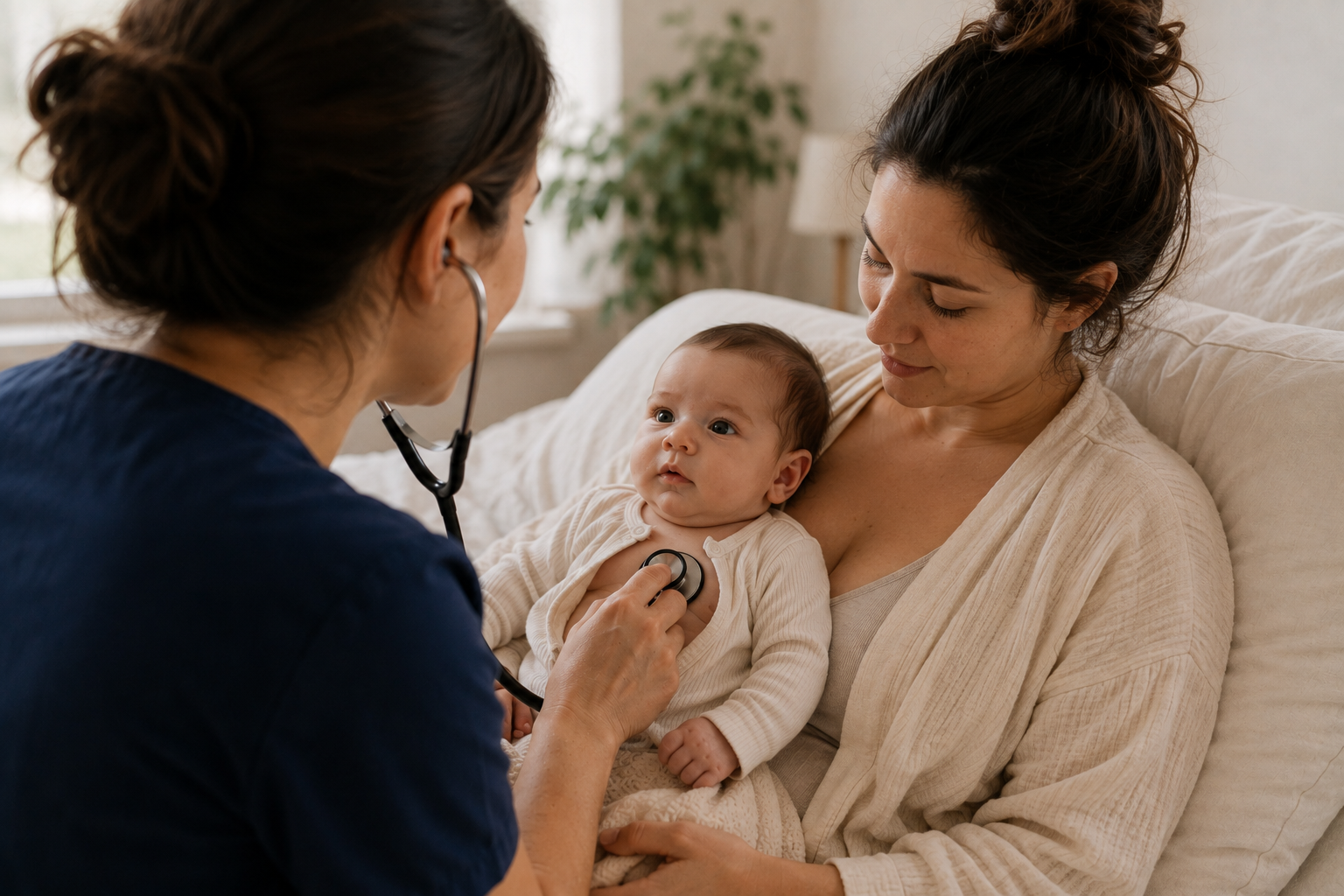
Imagine if every woman left the hospital knowing who was going to follow her recovery. Someone who knew what happened during her pregnancy and birth. Someone who could assess her bleeding, blood pressure, pain, wounds and feeding, but also ask whether she had slept, whether she was eating, whether she felt frightened or overwhelmed, whether she felt connected to her baby, whether she was having thoughts that scared her, and whether something simply did not feel right.
Not someone she had to find, but someone who came to her.
That continuity becomes even more important when we talk about maternal mental health, because the phrase “ask for help” assumes that the person who is struggling feels safe enough to ask.
Women have told me personally that they were afraid to say what was actually happening inside their heads because they feared that if they were completely honest, someone might take their baby away. They worried that admitting to intrusive thoughts, unbearable anxiety or feeling disconnected from their baby would make someone decide that they were dangerous or that they were bad mothers.
So they said nothing.
And then we wonder why screening and awareness campaigns are sometimes not enough.
Postpartum psychosis is real. It is rare, it can be devastating, and it requires urgent specialist care. But if the public face of postpartum mental illness becomes a woman on trial for killing her children, we have to think very carefully about what another postpartum woman hears when we tell her, in the same breath, to be honest about the thoughts she is having.
We need women to know that postpartum mental illness exists across an enormous spectrum, and that needing help does not make someone dangerous. We need healthcare professionals who have the time, training and relationship necessary to recognize the difference. And we need women to encounter care early enough and often enough that telling the truth about how they are doing feels ordinary rather than terrifying.
Because ultimately, we cannot build a maternal mental health system that depends on women raising their hands.
Eventually, the Lindsay Clancy trial will end. The news cycle surrounding Hayden Panettiere will move on. The social media posts about postpartum depression will slow down and another story will replace them.
Women will still give birth the next morning.
They will still go home tired and bleeding, exhilarated and frightened, and overwhelmed and exhausted. Some will be surrounded by family and some will be almost entirely alone. Some will recover easily. Some will struggle physically. Some will struggle emotionally. Many will move back and forth between all of those things in the course of a single day.
The question is whether we will still be talking about them when there is no courtroom, no celebrity, and no headline reminding us to look.
Women should not have to become a tragedy before maternal mental health matters, or a medical emergency before postpartum care begins. Care should not have to be earned by becoming unwell enough to ask for it.
It should simply be part of having a baby.