Carrying What Is Broken Into Simchat Torah
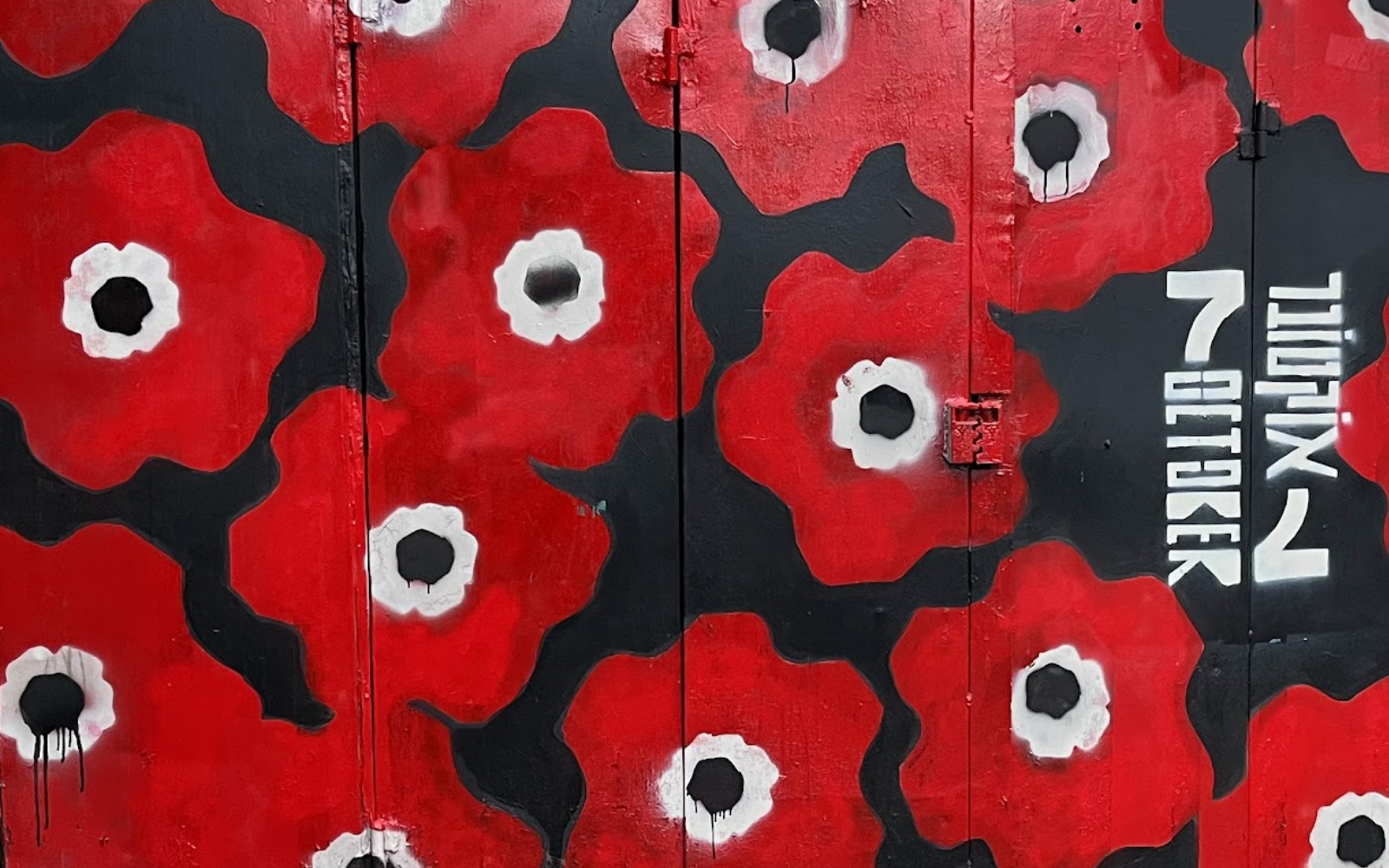
This year, in Israel, Shemini Atzeret and Simchat Torah fall on Shabbat for the first time since October 7, 2023. For many of us, this convergence brings back the devastation of that day and the ways our lives have changed, as individuals and as a community, in its aftermath.
And so we reach the end of Sukkot, complete the annual Torah reading cycle, and pray for rain to nourish the earth. We are still haunted by that morning, by where we were that day, where we have been since, and where we are now. Another cycle comes to a close, and we carry our fractures and wounds into the one now beginning. The word simcha can feel almost impossible to reconcile with this date. How do we speak of simcha, joy, on a day that also asks us to remember?
This Simchat Torah, I invite readers and communities to draw on the teaching, poems, and prayers that follow as we remember and reflect.
Holding On
In her poem “Atzeret,” Efrat Leibowitz-Ayali gives voice to the tension between the festival’s call to rejoice and the grief we carry into it, both as individuals and as a community:
Atzeret by Efrat Leibowitz-Ayali
In the midst of our Sukkot rejoicing,
The mists of clouds of glory did not shelter me,
As they had in the wilderness.
Three times the Torah calls to us to rejoice
But I, thrice, was aggrieved:
Three times lost, and once more—
A seedling that may not bloom.
On the eighth of Sukkot, Shmini Atzeret, we pray for rain,
In school, tots sing of umbrellas and Nachlieli birds that
herald the winter.
But for me–the clouds of glory will be inglorious,
The clouds will release their burden.
Yet for me—the cloud overhangs
The nest will empty
And the field will thirst
For the fourth time.
The poem’s first-person voice gives form to a loss many of us carry together. Its empty nest and thirsty field accompany us as we pray for rain: the season turns, even while grief remains.
The Sefat Emet writes about Simchat Torah as a joy in receiving words we do not yet understand:
Simchat Torah is about rejoicing in receiving the words of the Holy One, blessed be He. For the essential meaning of Torah is learning what one did not know before. And although knowledge itself naturally brings joy, the people of Israel rejoice in setting aside their own knowledge in order to receive God’s word, even when they do not understand it. As it is written, ‘Moses commanded us the Torah,’ so that we may cleave to and make ourselves wholly receptive to the life of Torah.
It is difficult to read these words simply, given the layers of memory we now bring with us into the holiday. What we have learned is indeed “learning what one did not know before”, but of a kind we would rather never have had to know. This is not knowledge that “brings joy”. Clearly, the Sefat Emet is discussing the meaning of Simchat Torah itself, not the catastrophe we now associate with it. And “setting aside knowledge” is certainly not an invitation to reconcile ourselves to suffering as though it were the word of God. Yet the Sefat Emet’s words may offer an opening for this moment, when read anew in light of our present reality.
The joy he describes rests on the verse read on Simchat Torah in “V’Zot HaBerachah”: “Moses commanded us the Torah, as the heritage of the congregation of Jacob.” His words suggest that our attachment and love for Torah need not always depend on knowing or understanding it.
Thus, even in a reality so deeply fractured and broken, we can dance with the Torah scrolls, the significance of which surpasses the specific words written in them, embodying the idea of “Torah Or”, the light of Torah, something we can refuse to let go of, even when we have no words, and even when the words we do have express protest, frustration, and profound pain.
On a day like this, we can cling to the ancient cry of “Hoshia Na”. We can seek words and meaning in prayer, and at the same time, we may feel that there are simply no words left, save for this most simple, almost primal plea: “Save us”.
In this space between words and wordlessness, the broader search for expression is reflected in poems and prayers written in these years, as well as in memoirs by those who have returned from captivity. It is also shaped by the absence of those who did not return from captivity or from the war, and by the continuing struggle of those who live with the trauma of what they witnessed and endured.
We can hold the Torah without claiming that its words resolve our anguish. The search for new Torah must begin by acknowledging that the Torah we hold is itself broken. We can also ask for help in the old language of prayer, even when we do not know what else to say.
Prayers for Remembrance and Healing
At the end of November 2023, on the evening when the women and children who had been taken hostage were released from captivity, we came together to reflect on the biblical figure of Dinah. Recognition of the sexual violence that had taken place during the attack was just beginning, and we still knew nothing about what was happening in captivity. For that evening, Rabba Tamar Elad-Appelbaum and I composed a new version of the prayer “El Maleh Rachamim,” seeking to give voice to grief in a world without mercy or compassion.
We drew on the language of the traditional prayer and of the lamentations, expressing in it a steadfast faith that, despite everything, we are worthy of healing from all the bitterness. The prayer was soon translated into English, and many communities adopted it for Yizkor services throughout the year, and for memorial ceremonies commemorating the attack.
El Maleh Rachamim Prayer for the Victims of October 7 by Rabba Tamar Elad-Applebaum and Rabbanit Sarah Segal-Katz
E-l Maleh Rachamim
God of Compassion,
In a universe that lacked compassion
Grant tender rest
Beneath the wings of the Shekhinah.
In the broken spheres of human radiance
To the souls of each and every of the injured
And the violated in the horrors
of the pogrom Of October 7.
For the fear
That fell upon each man and woman,
elders, youth, and children;
Our mouths do not know how to scream
Or put it into words.
For we lament and mourn
For them, for us,
Because of this our hearts are faint
because of these our eyes grow dim
Woe to us, for we are broken
Woe, for our homes were shattered
Our souls and bodies tormented
And our faces darkened.
Therefore, Compassionate One
Reveal our torment to the world and for all time
And from one end of the earth to the other
May the silenced voices utter:
Guard our souls in the Land of Life
For life is our heritage
May we come in peace to healing
Please God, heal all the injured.
Please God, heal the families and caretakers.
Please God, hear and heal us all.
And let us say, Amen.
* Translated by Levi Morrow and Rabbi Barry Dov Katz
Another memorial prayer was composed by Rina Levanon, a spiritual leader at Beit HaShita in memory of those we lost in the war. In “We Will Remember” she draws on Israeli identity and the landscapes of the land, weaving the language of Yizkor together with almond trees, oleanders, mulberry trees, and with the spirit of Zelda (Mishkovsky) and with an Altermanian image of laughter swinging across the sky. If our “El Maleh Rachamim” emerges from the siddur, “We Will Remember” emerges from the fields, and they meet in the “bond of life”.
We Will Remember by Rina Levanon
We will remember our brothers and our sisters,
the faithful and the devoted,
the courageous and the brave,
whom we lost amid the terror of war.
We will remember the sparkling eyes,
the warm embrace,
the trusting heart,
the photo albums,
the stories of their lives,
the homes built with great toil
and consumed by fire in an instant.
The loving families,
the beauty,
the hope,
the eyes that look upon us, unwavering.
May the souls of those who have departed from us
be bound up in the bond of life,
and may their memory remain bound to us
by a slender thread of life,
like a gathering of wildflowers and rainwater,
squills, golden pools, almond blossoms,
oleanders and mulberry trees,
laughter carried aloft on a swinging flight,
a beating heart, tenderness, and compassion.
* Translated by Sara Levy-Stevenson, Gluya team
These poems and prayers can give communities words for Yizkor or for a gathering before the hakafot. They can also make room for silence. Customs differ: some people step out for Yizkor, while in other communities everyone remains. Let people choose how to be present, and identify someone they can turn to for support.
Remembering Together
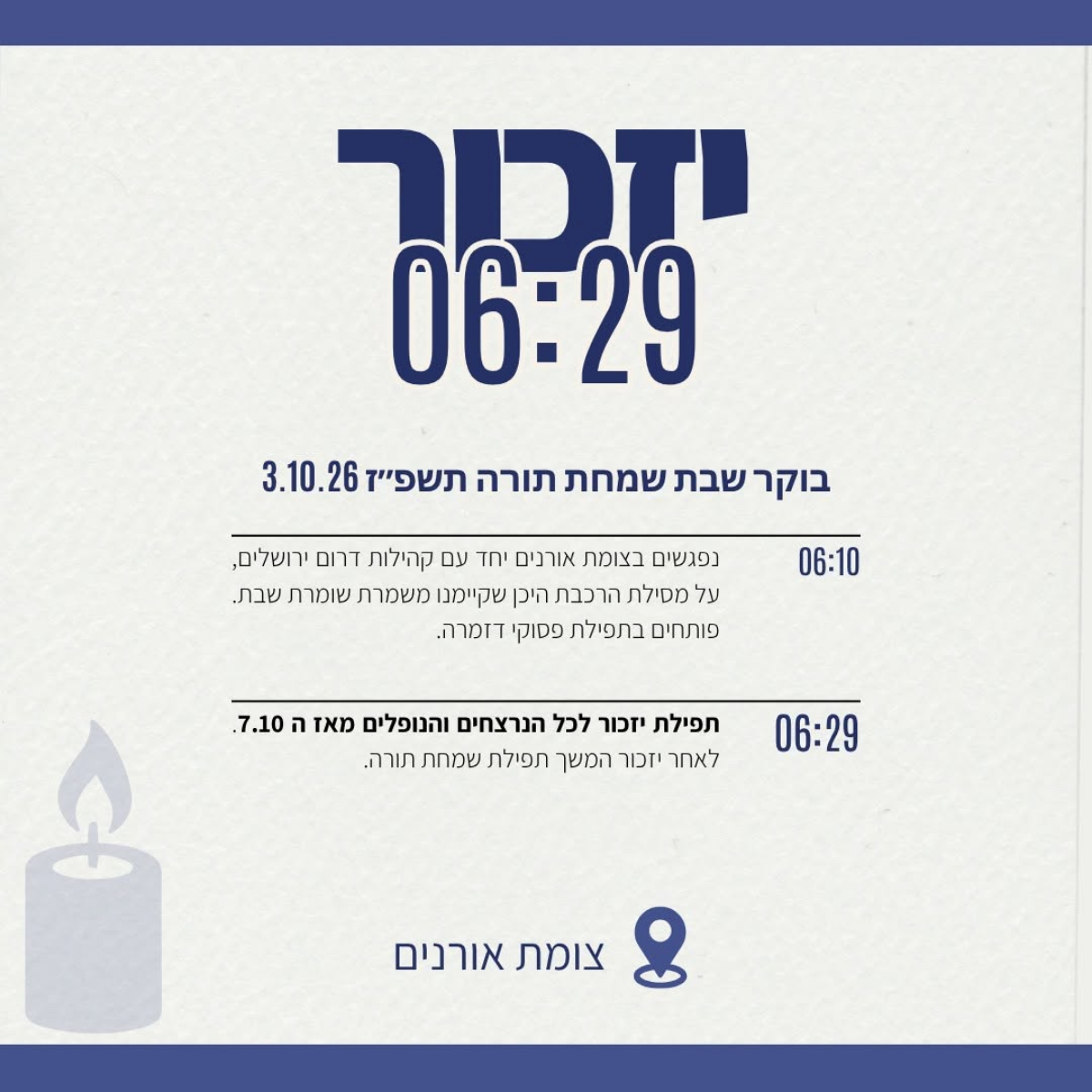
Tzvi Zussman, the father of Ben Zussman z”l, has spearheaded a prayer service to be held at Oranim Junction in Jerusalem on the morning of this year’s Simchat Torah. The service will begin early so that those gathered can recite Yizkor together at 6:29 a.m., the time when the attack began and which has since taken on symbolic significance. The service will take place at the same location where diverse local communities from southern Jerusalem regularly gathered to await the return of the hostages. I will offer there the “El Maleh Rachamim” prayer that Rabba Tamar and I composed. Standing together cannot undo the attack, but it gives grief a place to be shared.
Part of living with ongoing trauma involves many moments of solitude and immersion in profound pain. As individuals and communities navigate this journey, the understanding throughout has been that there is strength in coming together and being present with one another, even if it cannot offer full healing.
Between a Vow and a Prayer
In her short poem Lea Zvi Dobzhansky addresses war directly:
War by Lea Zvi Dobzhansky
You will not take my compassion, nor my love,
I will continue to delight in the sweetness of the sun.
The blooming of a cyclamen will bring me to tears,
My heart will clench at a baby’s cry.
My soul, you will not destroy.
I will remain myself.
* Translated by Sara Levy-Stevenson, Gluya team
After all that has happened, I hear “I will remain myself” less as a certainty than as a wish, perhaps even a prayer. We have changed, as individuals and as a community, yet the desire to preserve compassion remains.
The poem’s wish to preserve compassion has a communal counterpart in Rabbi Chen Ben-Ore Tsfoni’s new prayer for Simchat Torah, which asks for life, justice, kindness, and peace:
A New Prayer for Simchat Torah by Rabbi Chen Ben-Ore Tsfoni
Our G-d, and G-d of our fathers and our mothers, may it be your will,
in these trembling days, when the joy of Torah is tempered by awe and apprehension at the time that lies before us,
That you lead us to life and to peace, guide our footsteps to peace and to VeZot HaBerakhah,
as we complete our journey through the Torah and begin it anew, from Bereishit,
Send blessing upon the work of our hands, laboring for a Torah of life, a Torah of salvation and peace.
Hear our pleas for peace and justice, life and kindness.
Grant peace among us, peace in our homes, peace for the sons and daughters of Sarah, Abraham, and Hagar,
and may our Torah be a tree of life.
Blessed are you Hashem, who hears prayers.
* Translated by Sara Levy-Stevenson, Gluya team
Perhaps this is how we can speak of simcha this year: by gathering around Torah, making room for remembrance, and praying for life while grief remains among us. May we be able, together, today and in days to come, to hold on to both “Woe to us, for we are broken” and “Life is our heritage.”
God, please heal us all. אֵל נָא רְפָא נָא לָנוּ כֻּלָּנוּ.