


Cave Art, from Symbolic Image to Language
One striking characteristic of cave paintings is their sensation of movement. Around the head of the painted horse, flames and shadows danced as a result of the movement of the torch. The fire, flickering across the sinuous topography of the walls, generated animated shadows. At times, horses or bison were painted in successive stages, superimposed upon one another, creating an illusion of movement, a kind of animated painting.
A striking example can be found in Chauvet Cave, where several lion heads are depicted in overlapping positions, facing a group of bison. This dramatic scene testifies to conscious narrative planning. When the flickering light of the torch illuminated the scene, the lines seemed to come alive. This effect was intended to evoke a sense of life, as though the mind were breathing vitality into these representations. This was not merely a matter of aesthetics; movement expressed vitality and memory. By painting an animal in motion, the artist revived the encounter with it, the pursuit, and the anticipation of being able to master it, not merely to consume it.
In other words, the person who paints the animal also assumes a form of control over it (sympathetic magic). Some scholars suggest that such representation enabled humans to approach death without succumbing to it, capturing the fleeting moment of life and rendering it eternal. Thus, each cave painting becomes a kind of ceremony of remembrance, an act that confers meaning upon what is vanishing. Movement, therefore, asserts itself as art.
The intention of prehistoric humans was not to depict hunting scenes or an aggregate of three-dimensional animals, but to intuitively understand that the world was not limited to what was revealed to their eyes. Rather, it was a reflection of their own thought and a representation of their mental world. This process transcended realism, emerging from a need to illuminate the darkness within. In relation to reality, the result constituted an act of magic, a kind of illusion. These images were not mere fantasies.
According to some researchers, they embody a conception of a mythical world in which boundaries between entities became blurred and humans perceived themselves as part of a network of natural forces. Ancient art thus became a means of expressing a cosmic unity experienced by humans before they had distinguished the “self” from the “world.” Beyond the magic of drawing, humans began to glimpse the very process of creation, and their capacity for imagination marked a decisive turning point in the history of human consciousness.
Humans became creators at the moment when they ceased merely to reproduce their world and began to think about it. The figures on the cave wall constitute an attempt to tell an illustrated story through a kind of animal theater. A visual connection was established in the painter’s consciousness between imagination and the hand that painted. The cave represents a transitional space between life and the unknown world, between night and day, between the visible and the invisible. The person who traced the image of a group of bison on the rock sought to understand what remained hidden from his eyes, and the cave served as a laboratory for his imagination. Prehistoric humans descended into darkness in order to generate light. Ancient art constitutes a map of the unconscious, and the capacity to imagine what is not visible gives rise to abstraction. This capacity testifies not only to reason and intelligence, but also to the uniquely human ability to believe in something invisible and in the relationship between what exists and its meaning.
Over the centuries, some researchers attributed the experiences of Paleolithic cave artists to hallucinations resulting from the consumption of psychoactive plants. Others associated these works with spiritualism, animism, totemism, shamanism, and trance. They interpreted this art as an expression of a profound transformation of consciousness, a passage between everyday awareness and mystical knowledge through experiences, dreams, and visions. This position is less widely accepted in academic circles today. The animal paintings on cave walls do not describe the world itself, but rather an encounter with the force of memory, mediated by altered states of consciousness. Psychological interpretations sometimes regard the unconscious and imagination as a stage leading toward belief.
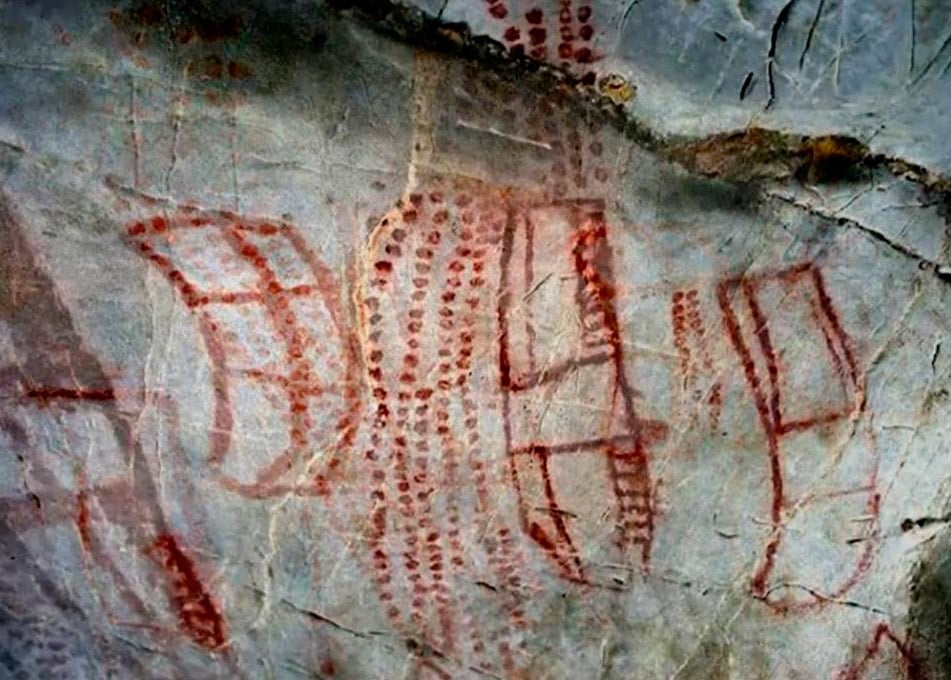
Human representation is virtually absent from cave paintings, and when it does appear, it is anonymous, schematic, or distorted, far removed from the quality and sophistication of the animal representations. The Lion Man figure in Chauvet Cave combines a human body with the head of a predator. In Pech Merle Cave, in southwestern France, a horned female figure can be found; at Altamira, a human figure is shown falling backward in front of a wounded animal; and at Lascaux, children’s footprints appear alongside those of adults. In addition, the caves reveal numerous geometric drawings, including parallel lines, zigzags, dots, spirals, grids, clusters of red dots, and sinuous lines placed near animal images. Handprints, often produced by spraying pigment around the hand (“negative hands”), or imprints of palms, do not appear to have been intended to illustrate or represent reality, but rather to express a language in their own right, one that remains difficult to decipher. Could these signs represent an ancient bodily language? Were they created in the context of dances, chants, or rituals?
Although it was once thought that non-figurative painting in caves indicated an early stage in the development of abstract thought, it now appears that these forms are often found alongside figurative images rather than preceding them. The brain learns to establish relationships among image, sound, and idea in order to express thought. The painting of a mammoth or a horse thus becomes a visual utterance, an attempt to articulate language through the image. Today, one may argue that cave art is a by-product of a non-verbal language.
Some researchers argue that certain geometric forms correspond to the images produced by human vision during altered states of consciousness, so-called entoptic phenomena, thus representing an abstract inner experience. They emphasize that these forms recur consistently at more than one hundred sites dating from different periods, suggesting that they may constitute a proto-graphic system of symbols. Parallel lines, grids, rectangles, ladder-like sequences of red dots, footprints, and patches of red ochre attest to a presence rather than to an object. Do they reflect an abstract symbolic mode of thought, personal, collective, or tribal? Or do they simply represent an aesthetic form? In reality, these forms constitute the nucleus of a visual writing system and the first elements of a universal symbolic language.
The historian Margaret Conkey argues that mural paintings represent the language of imagination, predating written language: a visual language capable of transmitting emotions, knowledge, and rituals. The Paleolithic painter was not merely an artist, but above all a storyteller. Every line on the rock is a story; every dot is a sign of thought. When we use application icons on a computer or emojis in a message today, we employ a system of abstract thinking: the transformation of an idea into a symbol. In this sense, the contemporary digital screen is a cave wall.
In the mists of deep time, tens of thousands of years ago in the history of hominins, before the emergence of language, before a single letter had been written, the art of painting came into being. Far from daylight and from the world above, an ancient artist lit a torch and created animals with his finger. He descended into the depths of the earth, barefoot and half-naked, enveloped in smoke, breathing in vapors, moving as he created shadows, engraving and touching. The breath from his nostrils mingled with the echo within the space, creating an acoustic ritual, a bodily expression of the mind. The reverberating echoes of the depths resembled a muted orchestra, incorporating low-frequency sounds, drum-like beats against the rock, and breathing through a hollow bone. The moving shadows on the sinuous walls danced in the light of the flame, transforming the silhouettes of bison, horses, and deer into living creatures. Every movement of the torch generated a theatrical scene. The animals came to life, breathed, disappeared, and were reborn. The cave was not a passive setting, but a partner in the performance.