Hadassah National Board, Chair, 2026 Hadasah Conference in Israel, Jewish Education Chair, Hadassah Writers' Circle
Celebrating Three Events on One Trip To Israel
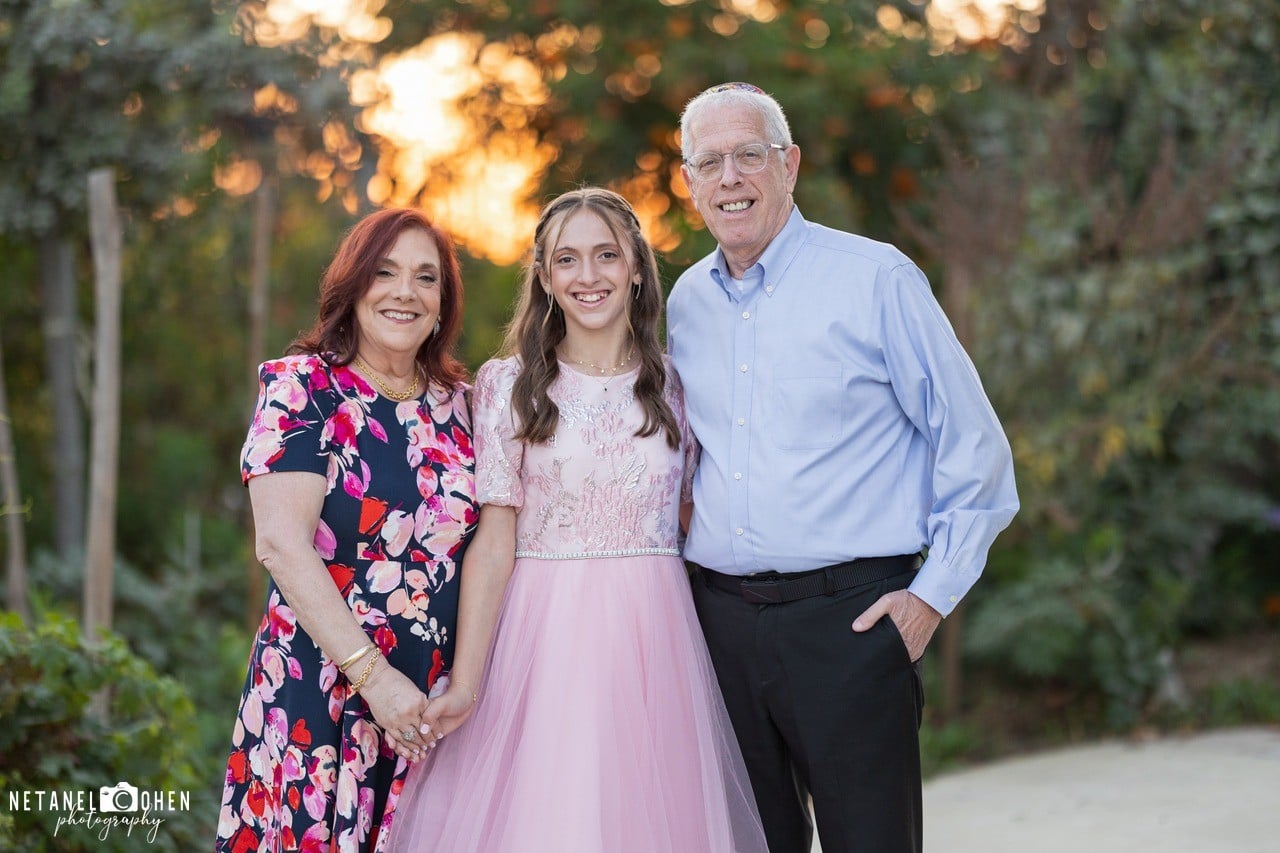
Author Miriam Aron and her husband Marc Aron and their granddaughter Bat Mitzvah Aliza Auman. Photo courtesy of the author.
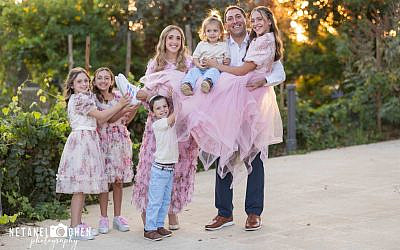
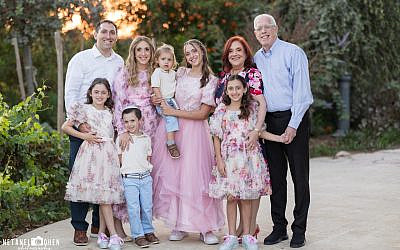
When you have children and grandchildren living far away, you tend to always be planning or waiting for the next trip. As our daughter, son-in-law and their five children live in Israel, my husband and I are definitely among those who are always either planning or knowing when the next trip will be happening.
Last April, while everyone was in the midst of the Passover holiday, our tickets to Israel for Sukkot (celebrated in October) were already purchased. All that we were left to worry about was whether there would be a worsening of the fighting with Hamas, which might cause our flight to be canceled.
Since the war with Gaza began in October 2023, the only airline that could be counted on to consistently fly to Israel — with the exception of a few days during the “12-day war” with Iran — was El Al.
Ever since our “kids” moved to Israel four years ago, my husband Marc and I began traveling to Israel twice a year. As a result, we tried to be as economical as possible when buying tickets to visit them. Unfortunately, the price of tickets on El Al has skyrocketed, so Marc spends hours (and hours and hours) searching for flights that are reasonably priced, even if it means including a short stopover somewhere.
Our trips to Israel most often take place during Passover and Hanukkah — times when flying to Israel costs even more. These holidays are also when our Israeli grandchildren are off from school and we are able to actually spend time with them!
Our most recent trip in October was different for us. Although I’ve been in Israel more times than I can count —including a semester at Hebrew University during college and two, six- week summer tours during which I worked as a counselor — I have never been in Israel for this joyous, fall holiday.
While I looked forward to this new experience, what made planning this trip even more exciting was that we were going to celebrate the bat mitzvah of my granddaughter, Aliza, just two days after the holiday ended.
My daughter, her husband and children live in Efrat, a religious community established in the Gush Etzion area in 1983 by Rabbi Shlomo Riskin, along with a group of Americans and Israelis. Many of the young families who live in Zayit — our kids’ neighborhood in Efrat — have formed friendships that are more like family relationships. Of course, that is understandable given that many of these new olim (immigrants to Israel) left their families back in America so they could fulfill their Zionist dreams of living in Israel.
All of the olim that I’ve met on our trips truly believe that, despite the war, their lives and the lives of their children are better in Israel. On the streets in Zayit, children at young ages walk alone to friends’ houses without fear, doors are left unlocked and Jewish education is affordable; these are just some of the many reasons they enjoy life in Israel.
What also made my being in Israel even more special this year was the release of the 20 remaining living hostages that had been in Hamas captivity for the last two years. On the day of their release, everyone in Israel kept checking their phones or TVs for the news. People kept updating one another and a great sense of relief and joy followed.
That night began the holiday of Simchat Torah – the holiday on which, two years prior, Hamas had originally broken into Israel, committed their original atrocities and taken hostages.
According to Shlomo Katz, the rabbi of Congregation Shirat David in Efrat, the joy of Simchat Torah could not be fully celebrated the previous two years, knowing that there were Israelis (and others) held as prisoners in Gaza.
This year was very different! In Shirat David and shuls (synagogues) all over Israel, the excitement of having the remaining living hostages returned was fully celebrated through singing and dancing with the Torah scrolls. Men, women and children danced for hours.
In many places, on the pictures of the returned hostages, the word “chazarti” (I returned) was added. Given that I had walked on a weekly basis with a “Run for their Lives” group in Teaneck, New Jersey, for the past two years, I felt especially lucky to be in Israel when those hostages were returned home; I felt like part of their welcome committee (even though I did not personally see them).
Now allow me to share a bit about the bat mitzvah we had gone to Israel to celebrate. For months prior to the actual event, my granddaughter Aliza had taken part in a class for girls who would be celebrating their bat mitzvahs. The girls and their mothers traveled to different historic locations in Israel to learn about these places and their significance to Judaism or Jewish history.
Aliza also studied the five megillot (the books of Solomon, Ruth, Lamentations, Ecclesiastes and Esther) with her father; each megillah (scroll) relates to a different Jewish holiday.
During her bat mitzvah speech, Aliza relayed the key points of each megillah. At the beginning of her bat mitzvah party, Aliza and her friends took time to create 100 packages, bursting with a wide assortment of art supplies. They included a hand-written get-well card in each packet.
Like her mother Shira, Aliza is extremely artistic and can spend hours creating pictures or other art projects. She wanted to share her love of art with hospitalized children through these packages — more about this shortly.
The bat mitzvah party took place in a beautiful winery, which was decorated with gorgeous flowers and beautiful signage (created by Shira, who just happens to be a graphic designer). There was music, provided by a DJ, a photo booth where everyone loved getting photo magnets and an outstanding buffet dinner. The dancing was lively and the bat mitzvah girl’s friends loved the swag they received — including stunning zip-up sweatshirts (designed by Aliza’s mom, naturally!). A good time was definitely had by all.
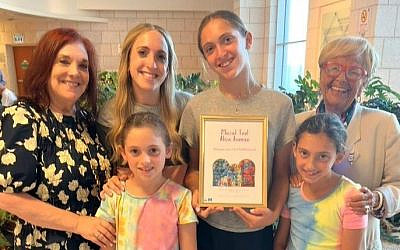
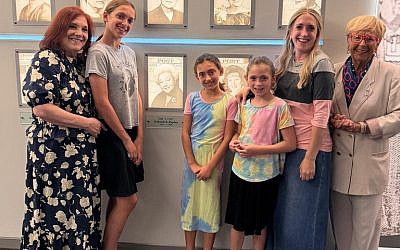
Just three days after the bat mitzvah party, it was time to deliver the art-filled packages to the sick children in Hadassah Hospital Ein Kerem. A trip to Hadassah Hospital is never complete for our family without stopping in the Legacy Center. There are pictures of all the past National Hadassah presidents there and, as soon as we entered, Aliza, Kayla and Devorah ran to find the photograph of their great grandmother, Deborah Kaplan, who served as Hadassah’s National President from 1991-1995.
After that photo-op, the girls, their mom, their aunt and I went for a private tour of the Abbell Synagogue — more commonly referred to as the Chagall Synagogue since 12 magnificent, vibrant stained glass windows created by famed artist Marc Chagall line the synagogue’s four walls.
The Hadassah Offices in Israel’s Ambassador-at-Large extraordinaire Barbara Goldstein (more commonly referred to as “BG”) shared the story of how Hadassah received these windows and then the girls were asked various questions about what was included in each of them.
Being the daughters of an artist and students of the Bible helped the girls impress “BG” with their ability to dissect what was included in each window depicting one of the 12 tribes of Israel. After this exhilarating session, we proceeded to our ultimate destination — the pediatric units of the hospital.
All three girls were initially shy about approaching the sick patients, but they warmed to their mission in no time! (Of course, they did not enter the rooms of the most seriously ill children to prevent spreading germs.)
The girls handed the gifts directly to the patients or to their parents. With each gift, the girls always wished the children, “Refuah shlayma” (a speedy recovery).
We walked onto three different pediatric floors, giving out the presents to Israeli and Arab children alike. Sometimes, parents asked for an extra package or two for the children they had at home and, of course, the girls obliged.
Each package had a sticker on top, explaining that the gift was created in honor of Aliza’s bat mitzvah. We even had enough to leave gifts for future patients. All three girls felt so wonderful about being able to put smiles on so many faces that day!
As a grandparent, I was thrilled to be able to share in the simcha (happy occasion) of my granddaughter’s bat mitzvah and her bat mitzvah project of giving gifts to the children at Hadassah Hospital.
As a Jew, I was thrilled to be in Israel at such an important time — to share in the happiness of a nation that got to welcome home 20 of its heroes, who survived hell and returned to a country that greeted them with open hearts, love and affection. And, yes, our next trip has been planned already!
Related Topics
Related Posts