Certain Jews: Lithuania’s Own Words

A criminal hearing is set for August 26, 2026. Lithuania is prosecuting a Jewish citizen over Facebook speech while the state historical institution now assigned to review Holocaust exhibitions still has an unanswered Facebook record of its own.
A Vilnius court hears the criminal case against Artur Fridman on August 26, 2026. The charge concerns a Facebook post. On November 16, 2015, the institutional Facebook account of Lithuania’s Genocide and Resistance Research Centre — LGGRTC — published a sentence about “certain Jews.” Fifteen Lithuanians demanded an apology or a public disavowal within weeks. I have located neither. Lithuania has now given that same institution the principal role in reviewing Holocaust exhibitions in its municipal museums.
Fridman is a Jewish citizen of Lithuania. Prosecutor Kristina Minko signed the indictment under Articles 170² §1 and 313 §2 in a prosecution file running to 220 pages after Fridman criticized the state-honored partisan Adolfas Ramanauskas-Vanagas on Facebook. Lithuania can identify a speaker, preserve a post, restrict his movement and bring him to criminal court.
The sentence Lithuania has not answered
LGGRTC’s 2015 statement was issued in the controversy over Jonas Noreika, the state-honored official whose own historical record includes the August 22, 1941 order directing Jews of the Šiauliai district into the Žagarė ghetto. The Centre’s institutional Facebook account wrote:
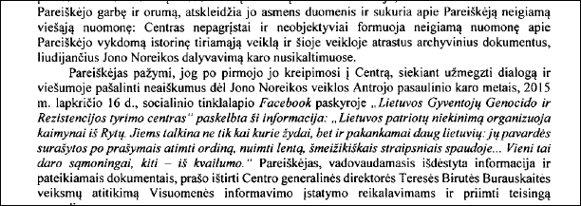
The denigration of Lithuanian patriots is organized by neighbors from the East. They are assisted not only by certain Jews, but also by quite a few Lithuanians: their surnames are written beneath requests to revoke an award, remove a plaque, and beneath defamatory articles in the press… Some do it consciously, others out of stupidity.
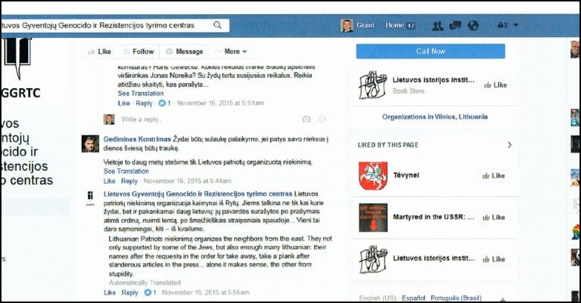
The December 2015 letter later published by Vytautas Landsbergis called the statement defamatory and “antisemitic in nature”. Its signatories asked the decisive question: was this LGGRTC’s institutional position, or an employee’s personal opinion? If institutional, apologize. If personal, disavow it publicly. Landsbergis wrote in 2021 that he did not know what Burauskaitė had answered. Neither do I.
A separate appeal that July, seeking removal of Noreika’s memorials, was reported to include historian Saulius Sužiedėlis, chairman of the sub-commission Lithuania itself relies upon to evaluate the crimes of the Nazi occupation and the Holocaust.
The record is no longer dependent on a vanished social-media page. I preserved the Facebook capture in a January 2017 submission to President Dalia Grybauskaitė, and the same wording later entered administrative proceedings and an official ethics decision. I have also corrected my own 2015 account: I then described the statement as appearing on the Centre’s government website and went too far by calling it the government’s official position. The surviving exhibit establishes the narrower and sufficient fact — publication on LGGRTC’s institutional Facebook account.
The full documented version on my Substack contains the original screenshots, the correction to my 2015 wording, the legal filings and the full source notes. The shorter question here is what Lithuania has done with that record in 2026.
The government was offered another institution
Lithuania’s government adopted a 157-measure action plan against antisemitism and xenophobia in January 2026. The plan contains worthwhile measures. But its official implementation appendix makes LGGRTC the principal implementer of Measure 3.27: analyzing Holocaust exhibitions in municipal museums, deciding whether they need updating and issuing recommendations.
LGGRTC itself proposed that the Vilna Gaon Museum of Jewish History should lead that work and that LGGRTC should participate. The government declined, saying LGGRTC had greater competence in the field. The twentieth Government was presented with the Jewish museum as the lead institution and chose LGGRTC instead. The plan passed to the twenty-first Government on July 14, 2026 with that assignment intact.
That decision arrived while Lithuania’s own oversight machinery was warning about the Centre. On March 22, 2026, the Seimas-created expert council chaired by historian Arūnas Streikus said LGGRTC leadership ignored recommendations, delayed or failed to provide documents and did not provide the feedback the council needed to work.
LGGRTC is meanwhile operating under acting leadership, its director’s five-year term having expired, after the Seimas declined in June 2026 to confirm a proposed successor.
Nor can international Jewish institutions say the historical controversy is unknown. In 2019 the American Jewish Committee said it was “deeply troubled” by LGGRTC’s defense of Noreika and quoted Lithuania’s own International Historical Commission criticizing the Centre for minimization and obfuscation. AJC’s own February 6, 2026 response welcomed adoption while identifying deficiencies, including the absence of an oversight mechanism and a Holocaust-education mandate. On February 14, 2026, Foreign Minister Kęstutis Budrys presented the new antisemitism plan to AJC CEO Ted Deutch.
The August 26 test
Artur Fridman is innocent. The prosecution against him is illegitimate. His case and LGGRTC’s 2015 Facebook statement are not legally identical, and I do not claim that they are. The comparison is institutional and directional.
Lithuania is prepared to use criminal law against a Jewish citizen for Facebook speech about a state-honored national figure. At the same time, a state historical institution’s own Facebook language placed “certain Jews” inside a frame of hostile foreign direction and stupidity. Lithuanian critics objected immediately. The wording entered the state record. I can locate no public apology or disavowal.
The government then gave that institution authority over Holocaust exhibitions after the institution itself proposed a Jewish museum as lead reviewer, and after a Seimas-created council publicly complained that it could not obtain the cooperation and documents it needed from LGGRTC.
On the eve of a criminal hearing over a Jewish citizen’s Facebook speech, Lithuania is asking the public to trust LGGRTC as a supervisor of Holocaust memory without first requiring LGGRTC to answer for its own Facebook speech.
The remedy remains the one Lithuanian signatories supplied in December 2015: if the statement was institutional speech, apologize. If it was personal speech, disavow it. If a response was sent, publish it. Before LGGRTC reviews another museum’s Holocaust exhibit, it should answer for its own sentence.