Sharing the Jewish story with the Arab world
Featured Post
Changing hearts in Senegal, one verse at a time
In the Muslim West African country, quoting the Quran showed how possible it is to find common ground in the shared themes of Judaism and Islam
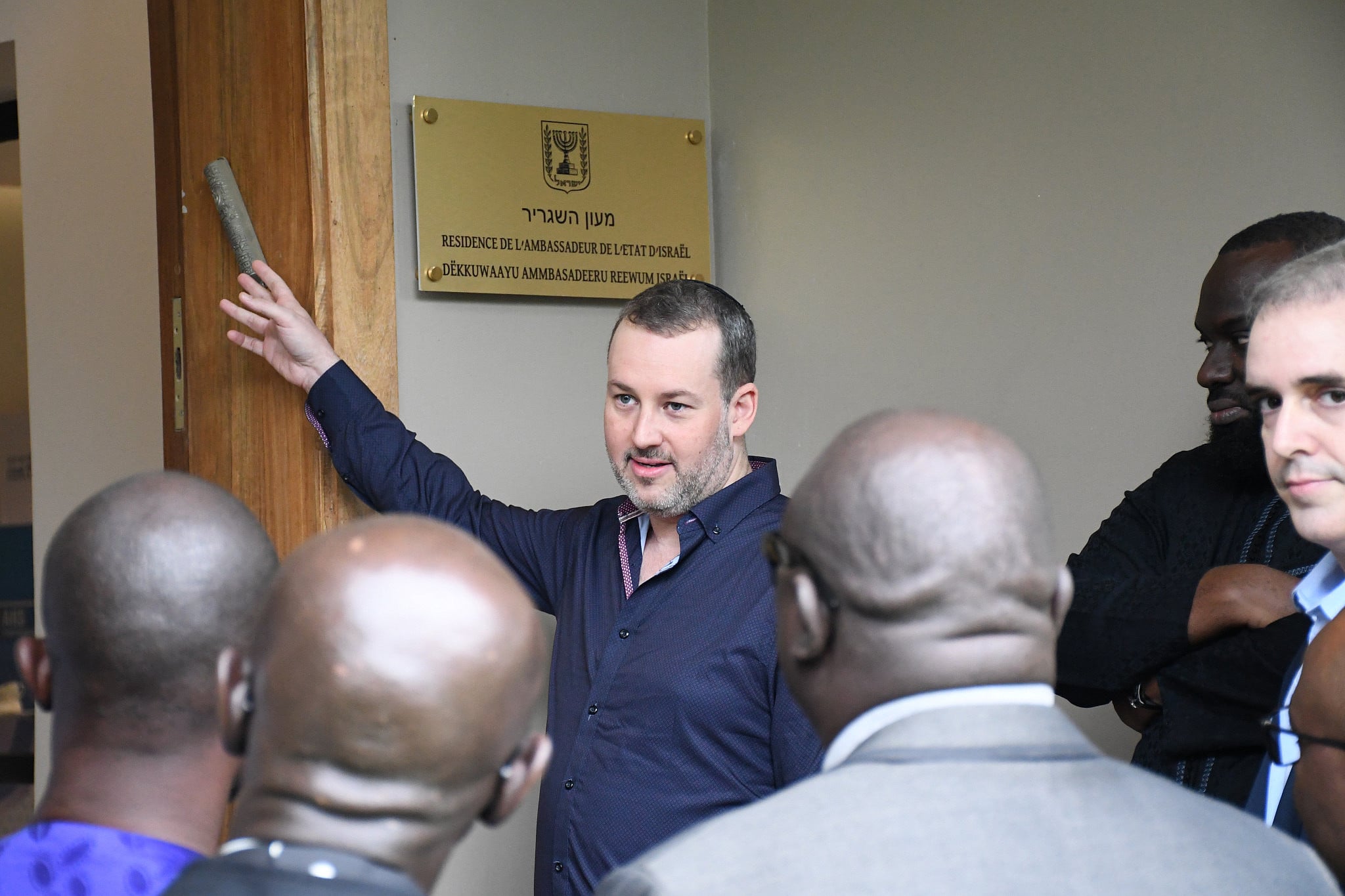
Explaining the mezuza at the residence of the Israeli ambassador in Senegal. (courtesy)
It took less than two minutes for the shouting to begin.
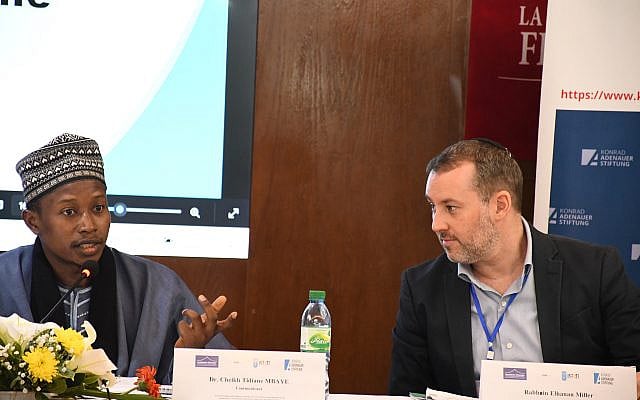
I had the privilege of representing Israel at an interreligious conference in the West African country of Senegal recently, hosted by our embassy in Dakar and the local office of Germany’s Konrad Adenauer Institute. The annual conference has been taking place for 25 years, 17 of them with Israeli participation. But things didn’t exactly go as planned.
Israel was one of the first countries to recognize Senegal’s independence from French colonialism in 1960. Foreign Minister Golda Meir visited the country in 1964, followed by Prime Minister Levi Eshkol two years later. Israel has aided Senegal massively in the field of agriculture, but the relationship has also known its downs. It went into deep freeze for five years between the Yom Kippur War and the Camp David Peace Accords in the 1970s. In 2016, Prime Minister Netanyahu recalled the ambassador in Dakar after Senegal voted in favor of a UN Security Council resolution deeming Israeli settlements illegal.
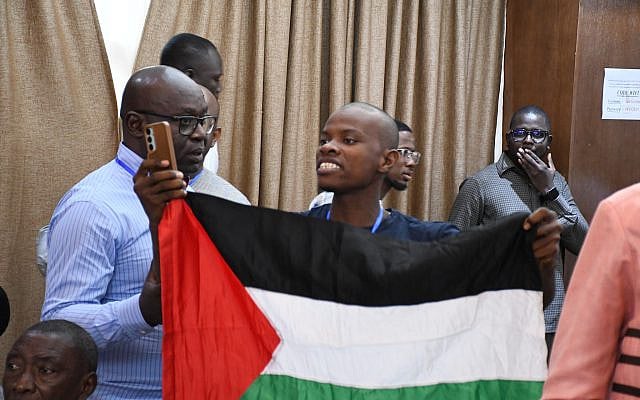
With a Muslim population of 95%, I couldn’t say I was surprised when six or seven protesters started yelling that Israeli representatives had no place in Senegal. One man pulled out a Palestinian flag and was quickly escorted out of the hall by security, along with the other disruptors. On stage, ambassador Yuval Waks didn’t flinch. He calmly told the attendants that the war in Gaza has left both Israelis and Palestinians deeply traumatized and hurting. He mentioned the recent visit to Senegal of Ali Ziadnah, a Bedouin Israeli whose four relatives were kidnapped to Gaza, two of them later killed. He noted that during that visit, his bodyguard was also a Muslim Israeli named Ali. “I entrusted my life to Ali,” he said.
Soon afterwards, representatives of the local religions were called up to the stage to deliver an opening prayer for peace: A Muslim sheikh, a Christian priest, an animist priestess. Unexpectedly, so was I. Thinking on my feet, I figured I would share the words that conclude our three daily Amidah prayers: “He who makes peace in heaven, He will bring peace on us, and on all of Israel, and on all inhabitants of the earth.” But just as I was wondering how to render that phrase in French, the sheikh standing next to me leaned over and asked: “do you know any verses from the Quran?”
I thought for a moment. “Yes, in fact I do.” My Arabic teacher at Himmelfarb, the religious Jerusalem high school I attended, was wise enough to make us memorize a number of surahs (chapters) from the Quran by heart. He knew, after all, that the Quran isn’t just studied. It’s committed to memory. “You should probably add that to your prayers,” the Senegalese sheikh suggested.
And so, after the Hebrew prayer, I recited the following words from Surah 114, the last chapter of the Quran, known as the Surah of Humankind:
“In the Name of Allah – the Most Compassionate, Most Merciful. Say: ‘I seek refuge in the Lord of humankind, the Master of humankind, the God of humankind, from the evil of the lurking whisperer – who whispers into the hearts of humankind – from among jinn and humankind.’”
I could feel the tension in the hall dissipate. Now I could calmly deliver my speech, which also dealt with the equality of all humans. The powerful Mishnah in Tractate Sanhedrin 4:5 states: “Therefore Adam was created alone […] to instill peace among people, so that no person will say to another: ‘my father is greater than your father’.”
The embassy team in Dakar is doing amazing work under impossible conditions, away from the spotlight. But in a deeply traditional country like Senegal, with strong anti-Israel currents, classic diplomacy has its limitations. That’s why, at the start of a breakfast reception for academics and religious leaders at his official residence a day earlier, Ambassador Waks asked his guests to stand outside the front door, inviting me to explain what the mezuzah is.
I touched the beautiful silver object and noted the resemblance between the Hebrew letter shin and the same letter in Arabic. I likened the mezuzah to the misbaha, the traditional Muslim prayer beads, where each of God’s 99 names is mentioned with each bead touched. The guests nodded silently. We had more in common than they’d previously realized.
Related Topics
Related Posts