
Chayei Sarah: First Words
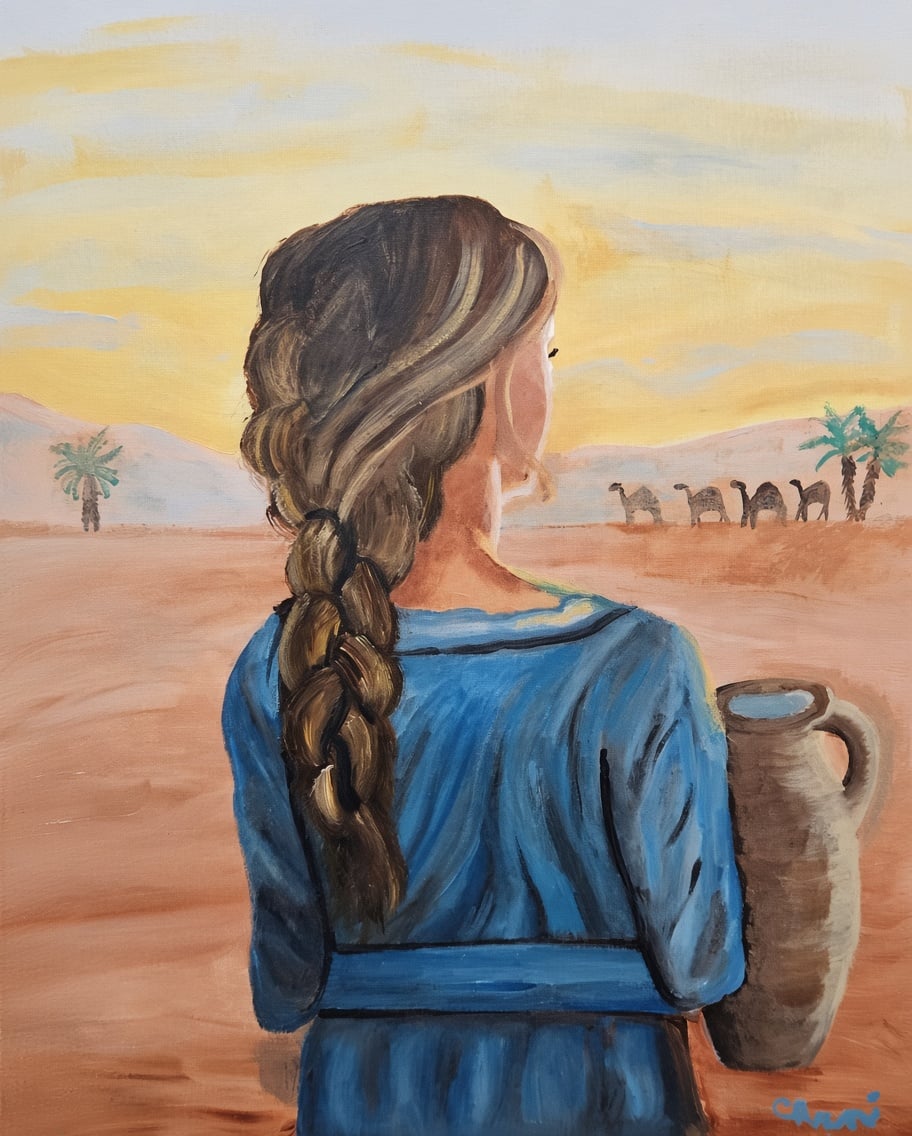
From Sarah to Rivkah, this Parsha focuses on the great women of our ancestry. But what makes it even more interesting is how the men, Avraham, Yitzchak, and Eliezer, play the role of taking care of what needs to be taken care of.
The detailed conversations in our Parsha are fascinating once we put ourselves into the frame as a fly on the wall, or better, as the speaker itself. Take Rivkah, for example. The first word we hear her say is “שתה, drink.” This word surely means drink, but if you watch closely and observe the story as it unfolds at 1x speed or less, not just in the imagination of the brain, you’ll see how much depth this word alone carries.
The word is just a word, but it is the expression given off at the time of saying it that makes all the difference. I’ve heard Mother tell me to drink my medicine when I was a sprout, and to my judgment, this wasn’t something I wanted to hear. Oh, that musty old cherry flavor.
The expression Rivkah expressed was one received well by the listener. Her excitement to help was only topped by the marriage proposal. Saying her first words, she was filled with happiness, and her lips spread with a genuine smile.
We see this similarly happening when we hear Yitzchak’s first words. As they’re on the way to Moriah for the Akeidah, Yitzchak turns to his father and says, “אבי, my father, Tatty.” Rashi in Bereishis 22:8 tells us that his heart was equal to Avraham’s. They both proceeded with joy to fulfill Hashem’s command.
Perfect Shidduch. The words they speak and the emotions behind them built their marriage and birthed our entire nation. The word בראשית has a fascinating depth to it. First we see Yitzchak and Rivkah’s words directly in it, אב (Yitzchak), שת (Rivkah). But then we’re left with the ר and י. Oh, how interesting, the י is for יצחק, and the ר is for רבקה. No wonder an entire world was created through them.
If you realize, the words they said are א”ת ב”ש, meaning the א and ב that Yitzchak said are the first letters in the Aleph Beis, and the ש and ת Rivkah said are the final letters. So maybe this is a hint to do At Bash for the ר and י. The ר is third to last and resembles the third letter is ג, the י is the tenth, and in reverse it matches up with the מ.
In Bereishis 22:20 Avraham receives the news that Milkah, wife of Nachor, sister of Sarah, had Rivkah. The word that the Torah uses is הנה ילדה מלכה “גם” הוא. In 24:19 Rivkah’s third word is the same: ותאמר “גם” לגמליך אשאב.
This is the nature of Avraham’s family. Avraham’s Middah was גמילות חסדים, which begins with these same two letters. Words that when said can only be done in a smiling fashion. “Not just this, also, this.”
In Pasuk 24:25 Rivkah insists this same word three times. We Gam have straw, we Gam have hey, we Gam have space for the night.
Lavan, poor lucky Lavan, came to the well to greet Eliezer. He put up a show as if he was running a branch of Avraham Avinu’s Chessed organization.
In 24:44, as Eliezer repeats the entire story, he tells us that as he Davened to Hashem to make this miracle happen, he told Hashem that her first word should be, you guessed it, גם. It is clear that this word plays a deeper role in our entire existence as a Jewish nation, and it all ties back to the first word of the Torah, Hashem.
The first word of a baby brings so much joy to the parents. The communication finally goes both ways, and not only do they smile, they verbalize their feelings. At first the words sre simple, אבי and שתה. A deeper knowing that explains more than just the word itself, it describes the entirety of this person’s abilities in the baby’s eyes. Mommy is the food provider, Tatty is the everything else provider.
The roles we carry, just like in the Parsha, are rooted into our characters. We are more than just the name we carry. The name we possess speaks of abilities only a single word can hold. It is packed with love and burning emotion.
Now let’s go back to talk about the אב and the שת. The גם already got a lot of attention.
I’ll preface my next thought with the Idea of Bechor. We know that a Bechor is the first. Why then is its name made out completely of 2’s? ב = 2, כ = 2, ר = 2. This asks for us to question why is it so. If Bechor means the first, why then does it start with the second?
The single answer is that in our world 2 is the greatest number to physically reach. We cannot climb higher unless we leave this realm. And that is why the Torah starts with a ב.
The א is Hashem Himself. And only through his help can a person become an אב. A ב must attach itself to belief in א in order to perform what he is meant to do.
This is why, between Kayin and Hevel, it went to שת. Yishmael and Yitzchak, it went to י = 1. Yaakov and Eisav, it went to י = 1. Reuven and Yosef, again, י = 1. Menashe and Efraim, yes, א = 1.
It went to the second son since they had a connection to the א. That is how they were able to become אבות. The Bechor in them when connected to the א of Hashem gave them powers for more generations. Their kids, until today, still benefit from their attachment.
They found belief in Hashem for real. Every day in life was special. They raised their children through thoughtfulness and prayer. Their Bechor strength built an empire only because it was built with a belief in mind. A belief of what can be, and belief in the purpose. A belief in Hashem. That’s why these merited to become the power to the next generation.
So we got אב out of the way. Now let’s go to שת. The funny thing is that Adam, who was the original human אב of the world, his son takes over the world, and his name is שת.
There is a large space between generations if the father’s message does not transfer to the heart of the son. The same is with us in ourselves. We may want a life of belief, but in practice we still fall for our urges and dirty impulses. This gap is like the distance from א to ת.
In order for the thoughts of Av-raham, the belief of the א-ב, to materialize, the belief has to be convincing enough to make you move and act upon it.
That is שת, שתה, definition: Placed, drink. Action words. The belief has to go through the chain of the א ב until the ש and ת, the whole trail of nails. Good luck with ד, good luck with ח. But only so will your שת be impactful for generations! The wives of the men are called אשת since they bring the fathers’ belief into the world and birth new Bechorim.
Sarah, Rivkah, you both have been the mothers, wives of this Avos. You were the אמהות. You take us from א to ם. You link us to find the beautiful Middah of אמת, truth. We learn the truth from you. You have a secret passageway that allows us to surpass all other letters and go directly to truth through you. It’s a gift only a true mother can give.
We love you dearly. We thank you so much. Mommy, I want to see you again soon. Mein Yiddeshe Mama! I love you Mom, intuition and blessing to you forever.
Love you
Good Shabbos
Duvi Lemmer
LemmerHypnotherapy.com