


Chayei Sarah: The Greatness of Small Acts
 What truly defines a person’s worth? Their knowledge, their beliefs, their achievements, or the way they treat others?
This week’s Torah portion, Chayei Sarah (חיי שרה), invites us to reflect on this question through a seemingly simple yet deeply meaningful story.
Interestingly, the portion is called The Life of Sarah, although it begins by recounting her death at the age of 127. Abraham purchases the Cave of Machpelah to bury her and later entrusts his servant, Eliezer, with the mission of finding a wife for his son Isaac.
It is precisely in this second story that we encounter one of the most interesting lessons of the Torah portion.
An Unexpected Test
When Eliezer reaches his destination, he stops beside a well and asks God for a sign that will help him recognize the right woman for Isaac.
The test he proposes is surprisingly simple.
He does not ask to find the most beautiful woman, the most intelligent one, or someone from the most prestigious family. Nor does he seek an extraordinary demonstration of religious devotion.
His criterion is different: when he asks a young woman for water, the chosen one will be the woman who, in addition to offering him a drink, voluntarily offers to water his camels as well.
And that is exactly what happens.
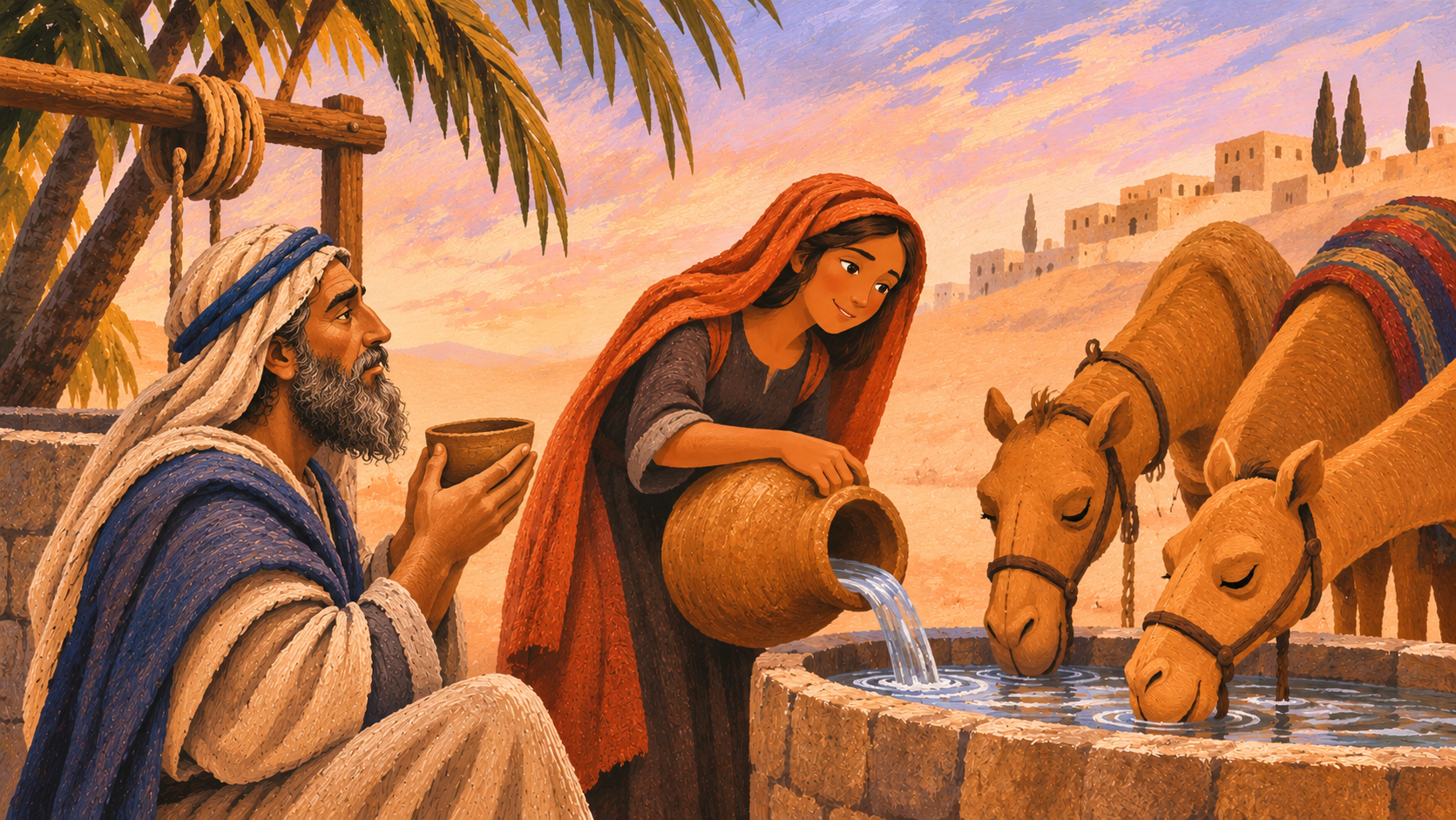
Rivka arrives at the well, and when Eliezer asks her for water, she does not merely fulfill his request. On her own initiative, she offers to give water to his animals as well.
The Torah tells us:
“שתה, וגם גמליך אשקה”
“Drink, and I will also water your camels.” (Genesis 24:19)
At first glance, this might seem like a simple gesture of courtesy, hardly worth much attention. Yet it is worth considering what this act actually involved.
Providing water for several camels was no small task. It required time, physical effort, and a considerable amount of water.
Rivka did not know who this man was, what wealth he possessed, or what he might offer her in return.
She simply decided to help him.
The Difference Between Fulfilling an Obligation and Doing Good
There is an important difference between responding to a request and taking the initiative to help.
When Eliezer asks Rivka for water, she could have limited herself to giving him exactly what he requested. She would have acted properly, and no one would have had any reason to criticize her.
But she does something more.
She notices a need that no one has asked her to address and decides to take care of it.
In Jewish tradition, this attitude is associated with the concept of chesed (חסד), commonly translated as kindness or benevolence, but which implies something deeper than simple courtesy.
Chesed is not merely about avoiding harm to others. It involves an active attitude: recognizing the needs of others and being willing to do something about them.
This distinction has significance far beyond the religious context.
A society can establish laws prohibiting certain behaviors and require its citizens to respect the rights of others. But no legislation can, by itself, guarantee that people will be generous, considerate, or compassionate.
Laws can require us not to cause harm. Kindness begins when we choose to do good, even when no one obliges us to.
What Qualities Do We Value in Others?
We live in an age when it is relatively easy to learn about someone’s academic, professional, and financial achievements.
We can look up their qualifications, work experience, publications, and opinions. Social media allows us to construct a carefully curated public image.
Yet all this information tells us relatively little about how a person behaves when confronted with someone who needs help.
We may know the beliefs someone publicly claims to defend without knowing how they treat people who have nothing to offer them.
And we may admire someone’s intelligence without knowing their capacity for empathy.
Rivka’s story offers a different criterion.
Eliezer does not try to discover what she thinks about generosity. He observes how she acts.
He does not ask whether she believes helping others is important. He sees whether she is willing to do it.
The difference is fundamental.
Beliefs can be expressed through words. Character is revealed, above all, through actions.
Greatness Is Not Always Found in the Extraordinary
When we think of the great biblical figures, we tend to remember exceptional events: divine revelations, miracles, sacrifices, and decisions that changed the course of history.
Yet Rivka enters this narrative by performing an entirely ordinary act.
She does not deliver a memorable speech or participate in a supernatural event.
She offers water.
And that gesture becomes a decisive moment in the continuation of Abraham’s family.
Perhaps one of the most beautiful lessons of this story is precisely this: we do not need to encounter extraordinary circumstances to demonstrate who we are.
Our character is revealed in much more ordinary situations.
In the way we respond to someone asking for help. In our willingness to devote time to someone who cannot reward us. In the attention we give to needs that others prefer to ignore.
These are small decisions, but they are not necessarily insignificant.
A Lesson for Our Time
Contemporary society places enormous importance on opinions.
We debate politics, religion, justice, rights, and values. We publicly defend our positions and frequently judge others by the ideas they express.
But Rivka’s story reminds us that there is another dimension of moral life that deserves at least as much attention.
It is not enough to ask ourselves what values we defend. We should also ask how those values are reflected in our everyday behavior.
We can speak at length about solidarity without practicing it. We can defend human dignity in the abstract while remaining indifferent to the concrete difficulties faced by those around us.
Kindness does not necessarily require grand declarations.
Sometimes, it begins with something as simple as offering a little water.
And perhaps that is one of the reasons why, thousands of years later, we continue to read Rivka’s story.
Because it reminds us that a person’s true greatness is not always found in what they achieve for themselves, but also in what they are willing to do for others.