Choose Your Own Adventure (Part 1)
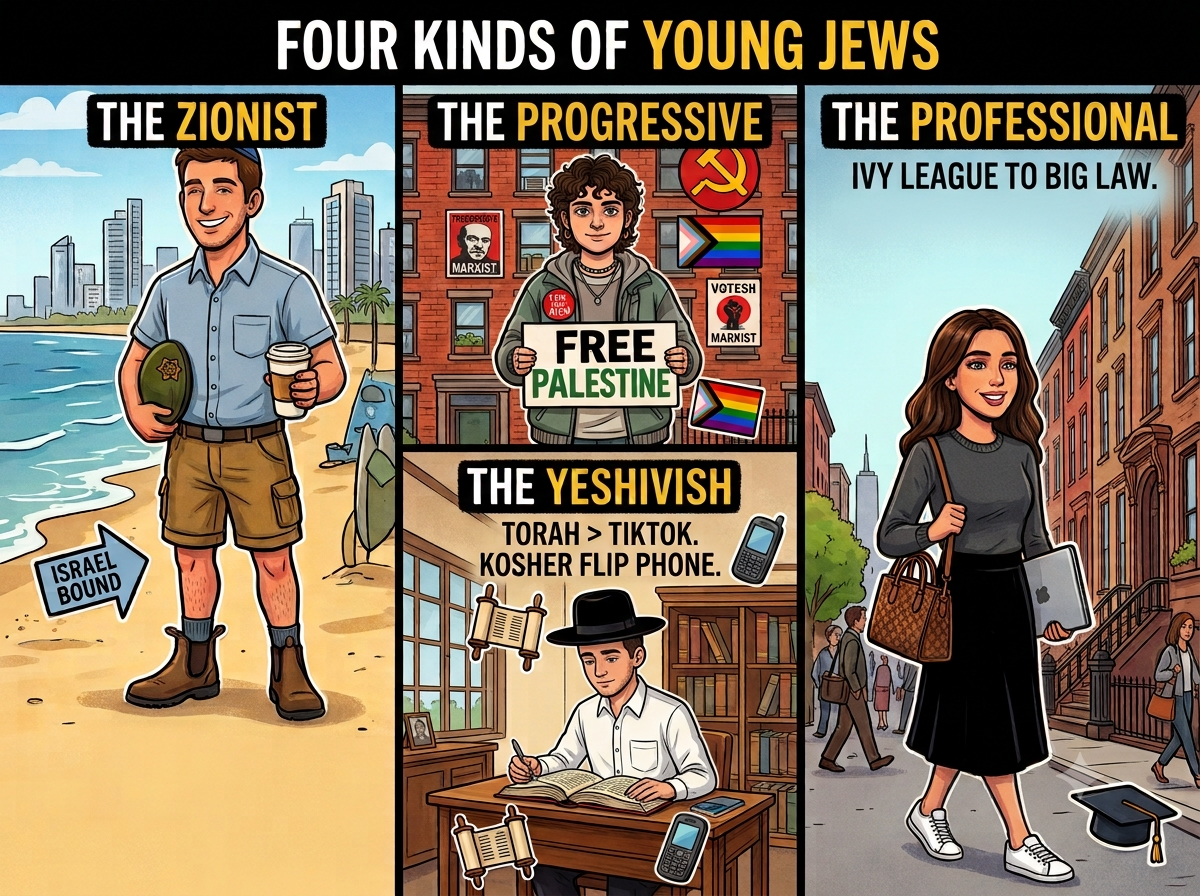
Four Competing Visions of a Meaningful Jewish Life
When my great-grandmother (z”l) was a teenager growing up in a Ger Chasidic family in Poland in the years leading up to World War II, she watched many young Jews leave the religious lives of their parents. They were drawn to competing ideological movements: Communism, the Bund, Zionism or dreamed of leaving Europe altogether for North America, South America, or Israel. Organized youth movements competed for the minds, loyalties, and futures of an entire generation.
Today, I see something very similar among my peers from Modern Orthodox day schools.
Modern Orthodox education often succeeds in teaching ideals, but not necessarily where those ideals will lead. Students are encouraged to think critically, pursue meaning, and live lives of purpose. Some emerge more committed to Zionism than their parents, others more religious, and still others more progressive. They want to walk the walk, not just talk the talk.
Looking around my own graduating class, four broad identities emerge that describe the different directions my peers have taken: the Zionist, the Progressive, the Yeshivish, and the Modern Orthodox Professional.
These are, of course, caricatures. Most people fall somewhere between them. But each represents a distinct answer to the same question:
What does it mean to live a meaningful Jewish life today?
1) The Zionist
Location: Herzliya, Israel
Role Model: Camp counselor, IDF soldier
Highest values: Jewish sovereignty, collective responsibility, and nation building.
Vision for the future: To help shape the future of the Jewish state.
These are the young adults choosing to make aliyah to Israel. In a piece I wrote for the Jewish Journal, I interviewed young adults who moved to Israel after October 7th. For many day school graduates, aliyah had been a life long dream rooted in the values of Zionist schools and summer camps. For others, a gap year in Israel changed the trajectory of their lives. Instead of returning to America for college, they chose to remain in Israel and serve in the IDF, build careers, and raise families there. For young Jews who did not attend Jewish day school, Birthright often served as the catalyst.
For the Zionist, Jewish history is being written today and they want to help write the next chapter.
2) The Progressive
Location: Brooklyn, New York
Role Model: Zohran Mamdani
Highest values: Equality, social justice, and universal human rights.
Vision for the future: To build a more just and equitable society.
The Progressive is primarily driven by left wing politics. This worldview includes democratic socialism, environmentalism, feminism, social justice, and LGBT activism. Think of the stereotypical Gen Z Mamdani voter working at a nonprofit, coffee shop, or creative agency.
At its core is the belief that moral obligations extend equally to all people, often taking precedence over national or religious identities. Politics becomes more than policy preference, it becomes a moral framework for engaging with the world.
While the Progressive may still identify culturally as Jewish, religious observance has often faded into the background. Social activism becomes the primary source of purpose, identity, and community.
3) The Yeshivish
Location: Far Rockaway, Queens
Role Model: The local rebbi or rosh yeshiva
Highest values: Torah learning, halacha, and spiritual growth.
Vision for the future: To build families and communities centered entirely around Torah.
The Yeshivish young adult believes Modern Orthodoxy does not go far enough in its commitment to Torah and halachic observance.
For many, this transformation begins during a gap year in Israel. Certain yeshivot and seminaries are known for powerful mussar talks that inspire students to deepen their religious commitment. The experience can be so transformative that students stay for Shana Bet and change their college plans in favor of Yeshiva University or kollel learning.
Unlike the Zionist or the Progressive, whose identities emphasize helping shape a movement, the Yeshivish path offers certainty, continuity, and submission to an established tradition. These young adults intentionally distance themselves from the secular world, trading in their smartphones for flip phones, in order to prioritize marriage and Torah learning over secular culture.
4) The Professional: Establishment Modern Orthodoxy
Location: Upper West Side, Manhattan
Role Model: Parents and community leaders
Highest values: Torah U’Madda, responsibility, stability, and engagement with the broader world.
Vision for the future: To build successful families while transmitting the institutions and values of Modern Orthodoxy to the next generation.
This path represents the traditional Modern Orthodox ideal of Torah U’Madda: integrating Torah values with higher education, professional success, and participation in modern society.
These young adults attend colleges like NYU, Maryland, or the Ivies before pursuing careers in medicine, law, finance, or technology. They follow a familiar trajectory: establish a career, get married, move to the suburbs, and send their children to the same yeshiva day schools they attended.
While the establishment Modern Orthodox path offers a vision of religious commitment and engagement with the modern world, it lacks a clear mission and purpose to meet this moment. Additionally, many young Jews see it as having become more focused on material success than a religious or spiritual identity.
In contrast, both the Zionist and the Progressive offer young adults the opportunity to help build a better future. While the Yeshivish path offers the certainty of tradition and the authority of Torah.
Which vision of Jewish life will inspire the next generation?
Stay tuned – in Part II I’ll explore the “push” factors that are driving so many young Jews away from the traditional Modern Orthodox model and what may be fundamentally broken within the movement.