Distinguished Professor of Sociology Emeritus CUNY
Choosing an Ayatollah: Lessons from Hasidism
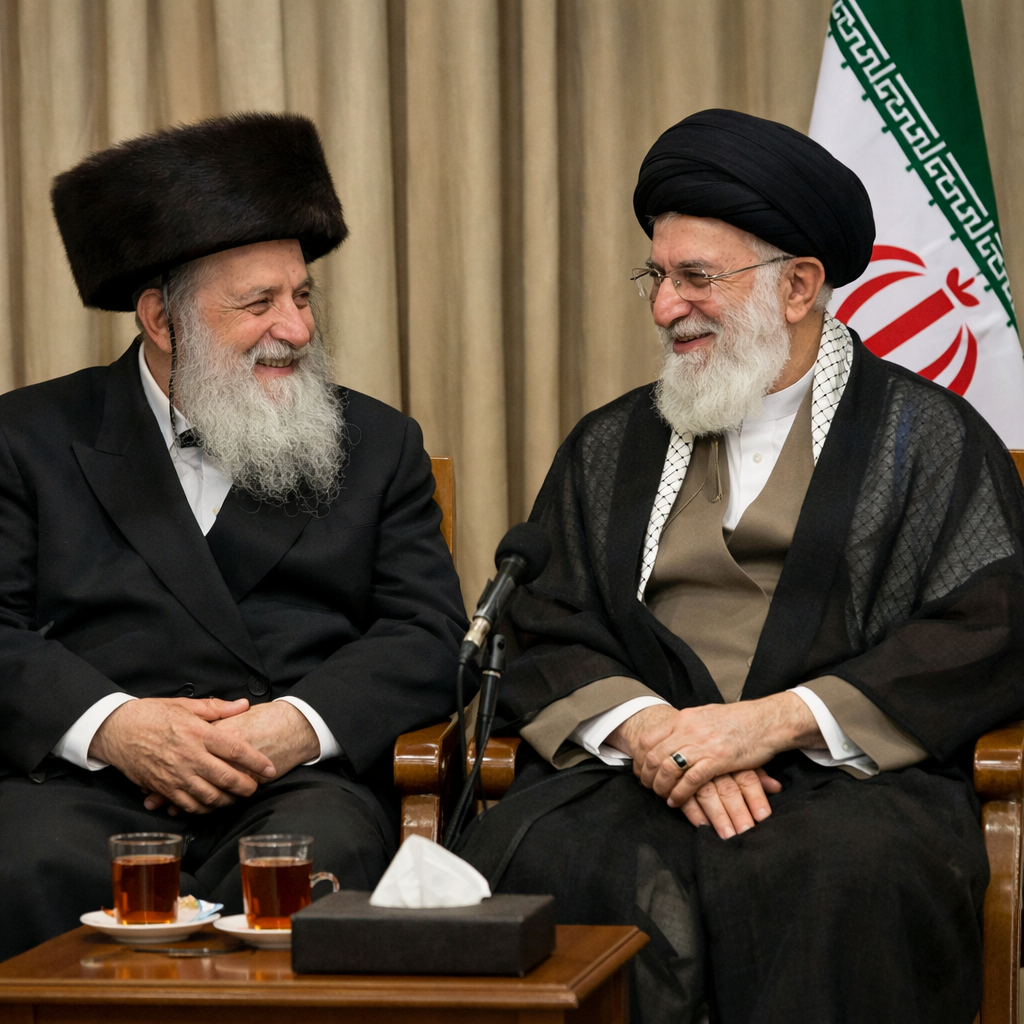
AI Generated
Much is being made these days about the fact that the Iranian Assembly of Experts chose Mojtaba Khamenei to succeed his father as the Supreme Leader. Although the founder of the revolution, Ayatollah Ruhollah Khomeini, described hereditary succession as a practice that was “sinister,” “evil” and “invalid,” and said it has “no place in Islam,” the “experts” overruled him.
Khomeini’s opposition to hereditary succession is a bit disingenuous, given that the origins of Shi’a Islam, as the Ayatollahs and Iranians observe it, is precisely about the issue of succession and the importance of its being hereditary. Shi’a Muslims maintain that Muhammad, the founder and first prophet of the faith, explicitly designated his cousin and son-in-law, Ali ibn Abi Talib, as his rightful successor. They believe leadership must remain within the Prophet’s bloodline. In contrast, those who followed Abu Bakr, the Prophet’s closest companion and chief disciple or student, became known as Sunni (the followers of the Prophet’s example – Sunnah). The latter remain the majority among Islam today.
This sort of controversy between a disciple or a blood relative is at the heart of the problem of succession in all groups that eschew democracy. In my research and writing on transitions in Hasidic leadership, I have explained just how this happens. It is a process that can help shed light on why the ascension of the younger Khamenei to his father’s position as supreme leader was predictable and inevitable.
In the insular world of Hasidism, the man they call in Yiddish Der Heiliger Zaddik – the Holy Rebbe, has stood above all others, almost like royalty. To his followers, he speaks directly to God, and the Hasidim believe that if they’re attached to him, he will persuade the Almighty to bless and answer their prayers and petitions. Sociologist Max Weber defined charisma as the quality by virtue of which someone is set apart from ordinary people and treated as endowed with supernatural, superhuman, exceptional powers or abilities. For their Hasidim, Rebbes were clearly charismatic. This is no less true for those who believe in the leadership of the Ayatollahs – a confidence that in the Islamic Republic of Iran has also become attached to political power, at least since the early days of the mullahs’ assumption of political control over the state. While the political power of a Hasidic rebbe is more modest, within the world of Hasidism, it can be quite significant depending on the number of his followers and the economic assets a particular Hasidic group has.
Among the first crises Hasidism had to confront in its early years was whether a Zaddik’s charisma outlives him, and if so, how? In the late 18th century in Europe when the movement began to grow, the field of charismatic Zaddikim was unrestricted and not yet institutionalized. People were drawn toward an individual rebbe or preacher by virtue of his charisma and not his pedigree. Following a zaddik’s death, his Hasidim might simply disperse and find someone else to follow. In fact, one of the earliest leaders actively worked to promote Hasidism as a decentralized movement, with no thought of bequeathing a unified body of followers to his own biological heir. Early on they tended toward a major disciple or someone who shared the wisdom that the late leader had. Presumably that was also what Ayatollah Khomeini had in mind, when he designated a Assembly of Experts (much like what Israelis know as the Moetzes Gedolei HaTorah) to choose his successor – after having dismissed Ayatollah Hossein-Ali Montazeri, his initially designated successor, due to his criticisms of Khomeini’s regime.
While Hasidism started off as a charismatic movement, almost immediately the problem of succession confronted it with challenges. First was the fact that when Hasidim became attached to the Rebbe, they also became attached to one another, making up what might be called a “charismatic fellowship,” a group that shared in the qualities and esteem of the man to whom they were attracted. After his death, they still felt attached to their identities as his Hasidim and to one another. Some solved the problem by trying to ignore the problem of the Rebbe’s death by ignoring it (much like Breslov Hasidim whose only Rebbe died in 1872) and followed his ideas, with a variety of disciples taking over some leadership – this is also the strategy of the Chabad Lubavitcher Hasidim who have never anointed a new leader after the death of Menachem Mendel Schneerson in 1994, the seventh and so far last of their supreme leaders. The Seventh Rebbe’s physical absence since that time simply allowed his authority to be shared by the thousands of his emissaries in Chabad Houses throughout the world.
In Iran after Ali Khamenei’s death, the Iranian regime tried this, appointing Ali Ardashir Larijani, an Iranian politician and former military officer in the Islamic Revolutionary Guard Corps (IRGC) and speaker of the Parliament of Iran from 2008 to 2020, who was serving as the secretary of the Supreme National Security Council since 2025 along with an interim leadership council run things. Leaving aside the fact that since Mojtaba’s selection it seems that no one has been able to contact him directly, because his candidacy was backed by the all-powerful IRGC, the reigning powers have been able to continue their dominance.
Mojtaba’s confirmation succeeds because, like the Hasidic movement, the Iranian regime soon discovered that the interim solution of a council running things would not work. Why? Here too the Hasidic example offers some explanation.
As it grew in influence in the 18th century and even more so during the 19th, Hasidism attracted new waves of followers among the Jewish folk, creating an expanding movement that occasioned economic strength, spiritual fame, and political interests. Much of this became concentrated in the position of the Rebbe, who shared it with his family, and the Hasidic clique of aides and influencers who were connected to the running of his court or domain. While in the beginnings of the Hasidic movement a leading disciple (though the criteria for qualifying were vague) might be an attractive successor because of his knowledge of the leader’s thinking and methods, this sort of replacement would mean that after his selection, all those who were politically, socially, and economically tied to the previous Rebbe – primarily his surviving family and staff – would be dispossessed, lose their influence and power and find themselves set adrift upon his death. If a disciple became the next Rebbe, his family and those close to him would inherit all those assets and power, while those attached to the previous one would lose their status, livelihood and influence. Thus, over time, the inevitable choice for successor became someone other than the disciple but rather one with blood ties: a son, son-in-law, or at times a brother. The ‘royal’ bloodline assumed that charisma was inherited. In this way those attached to the previous Rebbe retained their positions and power as well as their share of the assets. Thus even if the successor had little charisma, the office which he inherited did and all those who helped it operate as the Hasidim had wanted it to continued into the future and some sort of stability and predictability reigned.
In the case of the Ayatollah Khamenei, this meant that the people surrounding him, including staff and of course the people in the current government who are still alive, and perhaps most importantly, Islamic Revolutionary Guard Corps retained their position and power. Thus, to anyone who understands these principles, it was always obvious that only Mojtaba, the son, who was also an aide running things for his father and shared many of his connections to the people in power in the regime was the inevitable choice – Ayatollah Khomeini’s aversion for royal succession notwithstanding. When democracy is sidelined, the people in power always find a way to retain that power. In Iran, just as in the Hasidic court, democracy is not part of its constitution.
The fact that some of those who oppose the current Iranian regime look instead to Reza Pahlavi as an alternative only demonstrates how hobbled Iranian democracy is. Pahlavi, an Iranian political activist and dissident in exile in the United States, is most importantly the eldest son of Mohammad Reza Pahlavi, the last Shah of Iran. His political activism notwithstanding, the fact that he believes that he, who never lived under the mullahs’ and suffered along with the local dissidents could parachute in to save Iran is a myth. It testifies to the desires of those remaining of the Shah’s clique want him and the weakness of Iranian democracy. His ascendancy would mean simply moving from one bloodline to another. He is not a second Juan Carlos, a king in exile who brought democracy to Spain after the death of Franco (and ultimately fell into disgrace, all the same). True regime change is one that would allow democracy to come to Iran, but unlike royal or Hasidic succession, must come from the will of the people. Yet for that the people must gain an understanding of the strengths and weaknesses of democracy.
Such understanding requires at the very least an experience with democracy, something Iranians have not experienced, if at all, for generations. Moreover, as we can see in what has happened in places long associated with it such as America and Israel when those who do not respect it come to power, democracies are much more fragile than many of us alive today ever imagined.