


Civil Society’s Conscience Is Its Mandate
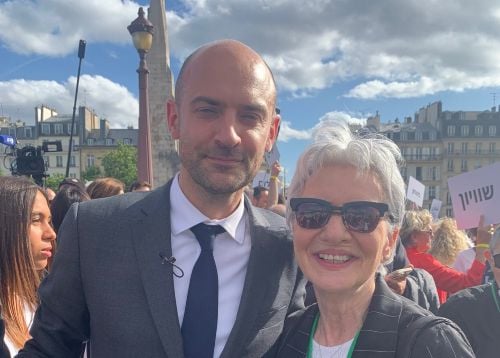
On June 12, the French Government convened a gathering of Israeli and Palestinian civil society peacebuilders for the second time. The first such conference was held in Paris on June 13, 2025, with the purpose of enabling civil society to provide input to the New York Declaration on the settlement of the Palestine question and to boost the demand for recognition of the State of Palestine. The second conference, held one year later, was convened with a similar objective: to provide a platform for civil society to convey a call to the G7 leaders gathering in Evian on what areas require urgent action and what steps should be taken.
On the eve of the event, Samer Sinjilawi, a Palestinian political activist who has spent many years advocating at home and abroad for a peaceful resolution of the conflict and was himself a featured personality at last year’s Paris conference, published an op-ed in the Jerusalem Post sharply criticizing what he called a “closed and professionalized ‘peace industry’.” He asserted that the same governments fund the same people to hold the same dialogues in order to perpetuate the cycle of awarding grants to keep alive “the illusion of investment in peacebuilding.” In fact, were it not for European funding of encounters abroad, Israeli and Palestinian peace activists would never find themselves in the same room.
To his scathing criticism of civil society engagement, he added a lack of transparency, arguing that meetings that take place under Chatham House rules are designed to keep the activity invisible. In fact, the need to observe Chatham House rules at certain gatherings is meant to protect the speakers and is no less valid than the practice of speaking off the record under complex circumstances. As for the claims that “participants are discouraged from publicizing discussions, photographs are often avoided, public debate is limited, and social media engagement is minimal,” perhaps Sinjilawi is unfamiliar with the social media platforms of the Paris Peace Forum, the Alliance for Middle East Peace (ALLMEP), the Principles for Peace Foundation, the Israeli-Palestinian Bereaved Families Forum, Rabbis for Human Rights, Women Wage Peace, and so many other organizations, not to mention the countless posts and reels circulated by activists to draw attention to their efforts to advance peace and dispel the fear that all is lost.
Sinjilawi also contended that participants in these gatherings misrepresent themselves as speaking for their societies, when in his view they represent only themselves. On the issue of representation, Sinjilawi is absolutely correct that the peacebuilders, most unfortunately, do not represent the majority of either the Israeli or the Palestinian publics. That is exactly why their work is so important. That is exactly the reason why civil society engagement is necessary. Majority representation takes place in parliaments and governments elected by the people. The beauty of civil society activity is that it is not – nor does it claim to be – dependent on a mandate from the people. Civil society activity provides people of conscience the opportunity to make their voices heard in times when the elected authorities are heading down dangerous paths. None of the Paris invitees claimed to represent their societies. On the contrary, much of the discussion was about how to bring those societies around to our way of thinking. Sinjilawi wrote that the broader public is rarely invited to join the conversation, but membership in these NGOs is open to all. They are not turning people away; the sorry fact is that no one is breaking down their doors.
Sinjilawi’s contention that “well-intentioned European diplomats continue to confuse participation with representation” and that the appearance of familiar faces “leads them to assume that they are hearing the voices of entire communities” is an insult to the diplomatic corps. Is there anyone old enough to read or listen to a news item who doesn’t know that Israeli and Palestinian peacebuilders represent meager minorities whose numbers shrunk even further after October 7? It is precisely because European governments understand that we are fighting an uphill battle, in some cases at great personal cost, that they support our activities, facilitate dialogue between the two sides, and welcome opportunities to hear our proposals.
Sinjilawi was also wrong in accusing participants of speaking in one voice. In Paris, as at most conferences, one did not find unity of views on many of the issues. There were obvious differences between many of the Israelis and the Palestinians, and the dozens of organizations on either side were not always of one view on competing priorities. But there is one critical issue on which there was and is no daylight: the belief in the urgent need to bring the conflict to an end by exercising diplomacy rather than military force.
True, there is no arguing with Sinjilawi’s bottom line: None of these peacebuilding efforts have brought peace… yet. On the other hand, none of the wars that have ravaged our region, none of the deaths, none of the destruction, none of the politicians promising “total victory” or the militants promising to “liberate Palestine” add up to the guarantee of a secure future for the children of the region.
And so it is out of a deep commitment to achieving peace that we will continue to accept every invitation to meet, expand our networks, exchange ideas, gather strength from each other, engage with decisionmakers, and push ahead toward a resolution of the conflict that fulfills the right of both peoples to self-determination in two sovereign states. And if there happens to be a cocktail party along the way, let’s not forget that Jesus himself is said to have enjoyed a glass of wine in the company of friends while preaching his message of love and forgiveness.