
Human Rights Attorney
Columbia’s Still Broken. Don’t Let Trump Buy the Lie
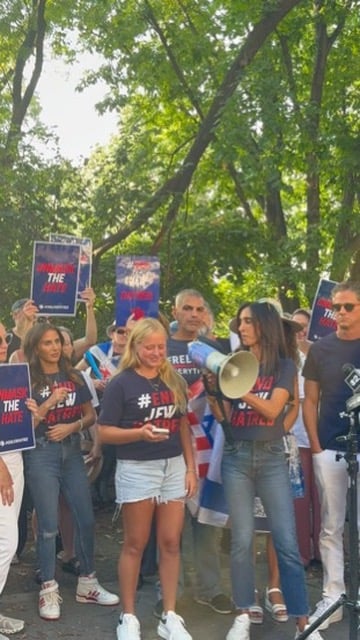
Photo credit: Gerard Filitti. #EndJewHatred civil rights movement rallies at Columbia University, demanding social justice for Jewish students and faculty and a ban on concealment during protests.
What’s being floated as a “deal” between Columbia University and the federal government is not just premature—it’s a profound mistake. It rewards evasion, ignores failure, and sends the dangerous message that elite institutions are above accountability when it comes to civil rights, antisemitism, and the rule of law.
In March, the Trump administration laid out nine clear preconditions for even beginning discussions to restore Columbia’s access to federal funding. These weren’t political demands—they were legal, reasonable, and long overdue steps to protect Jewish students and restore order to a campus plagued by chaos and hate.
To date, Columbia has failed to meet the vast majority of those conditions. Media reports suggesting otherwise—suggesting that Columbia actually agreed to the Trump Administration’s preconditions—are at best wrong, and at worst, deceptive. Columbia shouldn’t even be in a position to negotiate a deal, let alone agree to one in which those conditions are still not met:
- It refuses to abolish the University Judicial Board, the same body that repeatedly protected pro-Hamas agitators while Jewish students were harassed and threatened.
- Its so-called “time, place, and manner” rules are riddled with vague legalese and leave the door open for more building takeovers, more encampments, and more disruption.
- It declines to implement a straightforward mask ban, allowing masked agitators to continue intimidating others on campus.
- It fails to adopt the IHRA definition of antisemitism and makes no commitment to address anti-Zionist discrimination, despite this being a cornerstone of the federal government’s civil rights framework.
- It provides no meaningful plan to hold unrecognized student groups accountable, such as CUAD, whose actions repeatedly violated university policy.
- It offers a bureaucratic reshuffling instead of placing the MESAAS department—the intellectual hub of anti-American radicalism—into receivership, as the government demanded.
- It refuses to reform its admissions policies and absurdly claims current practices already comply with federal law—despite extensive evidence to the contrary.
And yet, Columbia expects to be rewarded with continued taxpayer support. Worse, that reward is within sight, and the long-suffering Jewish students and faculty at Columbia will not be any better off for it—and nor will thousands of students who want to experience college without anti-American terror.
Even the points Columbia has touted as “compliance” fall far short. Hiring 36 “special officers” with undefined authority to remove or arrest disruptive individuals is meaningless without a clear mandate. “Clarifying” that protests in some buildings are “generally not acceptable” is not a policy—it’s a loophole.
Let’s be very clear: putting lipstick on a pig doesn’t make it kosher. Cosmetic changes are not reform. Legalese is not accountability. A Tel Aviv outpost, or feel-good promises to develop K–12 curricula on “dialogue,” are not substitutes for dismantling the structures that enabled Jew-hatred to flourish at Columbia since long before October 7.
The lack of transparency surrounding this supposed “deal” is equally troubling. There has been no public release of the proposed agreement, no meaningful consultation with impacted students (I work with many of them), and no plan to ensure that foreign gifts—especially from hostile regimes—are not used to fund departments or programs that propagate antisemitic or anti-American ideologies. The Administration’s requirement for foreign gift reporting has no provision requiring disclosure of how those funds are actually spent—rendering it toothless.
Worse still, this deal sets a catastrophic precedent.
If Columbia can dodge meaningful reform and still walk away with its funding intact, what incentive remains for other universities to take civil rights enforcement seriously? This would embolden every institution that has tolerated antisemitism, foreign influence, and radical campus activism to double down—and wait out scrutiny with promises, not action.
The Trump Administration must hold the line.
There can be no federal funding until Columbia fully and unconditionally complies with every single demand laid out on March 13. No negotiations should proceed until the university:
- Disbands the UJB and centralizes disciplinary authority in the Office of the President;
- Bans identity-concealing masks during protests;
- Institutes clear, enforceable restrictions on disruptive activism;
- Holds both recognized and unrecognized student groups accountable;
- Places the MESAAS department under outside receivership;
- Adopts the IHRA definition of antisemitism;
- Reforms its admissions and international recruiting practices;
- Empowers campus security with real law enforcement authority.
Anything less is not a compromise—it’s capitulation.
The stakes are clear. What happens at Columbia will reverberate across the country. If we are serious about fighting Jew-hatred, restoring civil rights, and ending foreign-funded radicalization in our universities, we cannot afford to get this wrong. Our students deserve better.
Related Topics
Related Posts