


Coming soon: ‘Basic Law: Modesty’
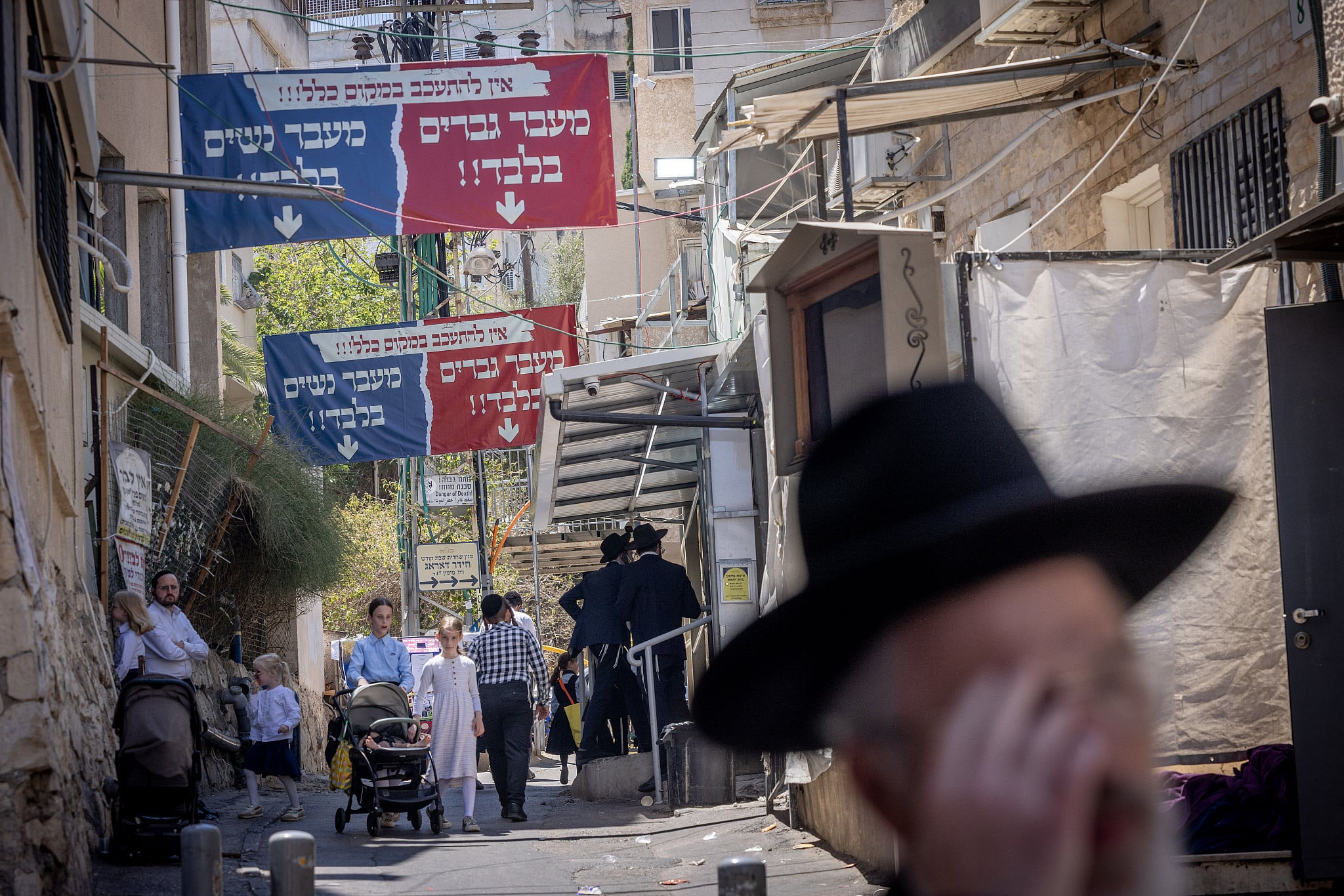
The Knesset has passed a law permitting gender segregation in Israeli academic institutions. At the same time, the city of Bnei Brak announced it will introduce gender-segregated sidewalks. Anyone who sees these as two separate developments is missing the larger picture. The Haredim, joined by the Haredi-nationalist wing of Religious Zionism, seek to remake the public sphere according to norms that have no origin or place in Jewish law. And if the High Court tries to stop them? Just as the coalition sought to shield Haredi draft exemptions through a Basic Law, it could one day enact yet more religious Basic Laws. Basic Law: Modesty, for example.
Partitions in synagogues, segregated weddings and celebrations, and separate beaches are nothing new. But until about three decades ago, there was no trace of gender segregation in other public spaces – even in the most extreme Haredi communities. The practice gathered force as the Haredi community grew, and especially as its political power and ability to impose religiously extreme norms on the public sphere expanded.
The shift began in the 1990s, when the Jerusalem-based Haredi Edah HaChareidis community council called for gender segregation on bus lines. Since then, segregation has spread into ever more areas of Israeli life. Today, gender segregation reaches almost every sphere of Haredi life – for now, chiefly in Haredi cities. But the downward spiral of excluding women from every public space and pushing them behind partitions, physical or conceptual, is only a matter of time.
Today, the situation is alarming. Beyond the near-total segregation in religious education and other religious settings, it is spreading to universities, workplaces, buses, shops in Haredi neighborhoods, clinics, cemeteries, billboards and advertisements, radio stations and newspapers, state ceremonies, performances and public events – and now, of course, sidewalks.
As far as the Haredi extremists who now set the standard are concerned, women are best kept out of sight in public. Anyone who thinks this will stop at Bnei Brak’s sidewalks has learned nothing from the past decade. It will spill into cities with large Haredi communities and workplaces employing Haredim. Then it will spread across the rest of Israel.
Israel is a Jewish state, and Jews must be free to live according to their beliefs. Jewish law
does prescribe standards of modesty governing relations between men and women, and in settings such as synagogues and beaches, gender separation is widely accepted within Orthodox practice.
But extending segregation to every sphere of public life is altogether different. It is neither an inevitable consequence of Halacha nor a longstanding Jewish tradition. It is a contemporary ideological project.
More fundamentally, Israel is not a religious state. Alongside its Jewish character, it is a democracy. Excluding women from ever more spaces violates the foundational ideals on which Israel was built. In each of these settings, it gravely threatens women’s equality and, in practice, enables their exclusion and erasure from communal life.
Haredi women bear the immediate cost. Whether or not they personally support such arrangements, separation inevitably deprives them of influence within their community. But as the practice spreads, women throughout Israeli society will pay the price. Sidewalks that are off-limits to Haredi women are off-limits to all women and no mechanism assures that the exclusionary rules will not spread beyond B’nai Brak in keeping with changing neighborhoods and political influence.
Certainly, these arrangements are subject to judicial review. For years, it was the High Court that curbed and challenged this phenomenon. But as Haredi political power grows, there is a danger that they will bypass the Court as well.
Basic Law: Torah Study, passed by the Knesset last week to legitimize draft-dodging, will serve as the model. To legitimize gender segregation, they will enact Basic Law: Modesty as soon as they can. That would sound the death knell for life in Israel as we know it.
Israelis often warn that “Tehran is here.” But unless we halt this headlong charge into the abyss of extremism and exclusion, the hardliners of Tehran’s regime will come to envy the religious standards imposed upon Israel’s public sphere.
Preventing that outcome requires clear constitutional limits and robust protection of individual rights – even, and especially, when majorities are willing to compromise them.