
Middle East Analyst
Concerns About the U.S.–Israel Defense Technology Cooperation Initiative
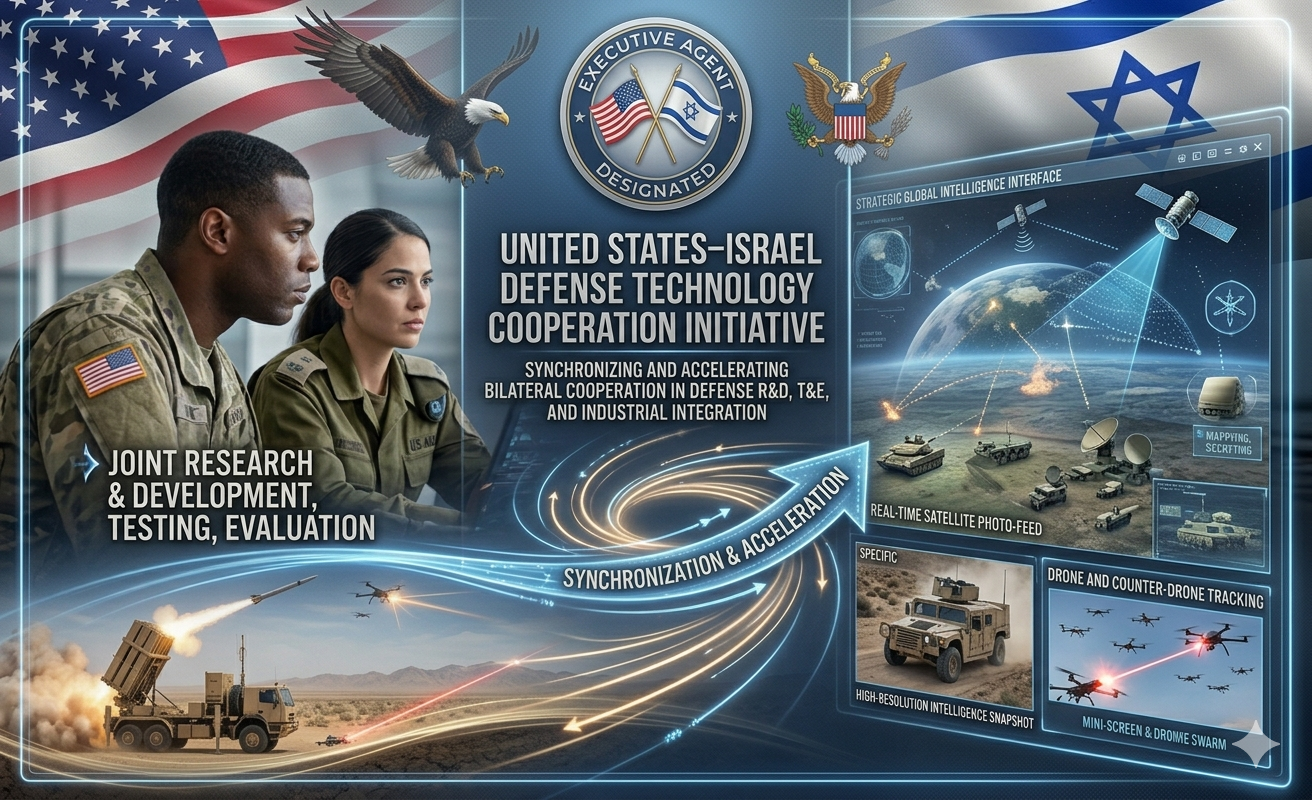
by author (AI)
What Is Section 224
Section 224, included in the House Armed Services Committee’s chairman’s mark of the FY2027 National Defense Authorization Act, would establish the United States–Israel Defense Technology Cooperation Initiative. The provision directs the Secretary of Defense to designate an executive agent responsible for synchronizing and accelerating bilateral cooperation between the U.S. and Israel across defense technology research, development, testing, evaluation, and industrial integration. Specified domains include counter-unmanned aerial systems, missile and air defense, subterranean and anti-tunneling technologies, artificial intelligence and autonomous systems, directed energy, advanced sensing, cyber and electronic warfare, and certain medical and biotechnology defenses. Supporters describe it as a coordination mechanism that formalizes and builds on existing programs and emphasize that it is investment rather than aid; critics frame it as a statutory architecture for deep, durable fusion of two militaries’ technology and industrial ecosystems—one specifically designed to be difficult to reverse.
The Legislative Mechanism and Its Timing
Embedding the initiative in the NDAA is consequential, and the timing is not incidental. The NDAA is an annual, generally must-pass defense policy bill; a provision placed there acquires statutory weight rather than remaining a pilot program or interagency memorandum. The designated executive agent would operate under the Secretary of Defense’s authority without requiring Senate confirmation. Supporters argue the statutory route creates predictable, durable pathways for joint programs and reduces bureaucratic friction.
The choice of vehicle and moment invites a harder look. A 2026 Pew Research Center survey found that 60 percent of American adults now hold an unfavorable view of Israel—a figure that has grown sharply since 2022. Among Democrats and Democratic-leaning independents the figure reaches 80 percent. Critically, the shift is not confined to one party: majorities of Republicans under 50 now also report unfavorable views, suggesting the generational erosion of support is crossing partisan lines. A New York Times/Siena poll found that roughly three-quarters of Democratic-aligned voters oppose U.S. military and economic aid to Israel outright. These are not activist numbers. They are mainstream survey findings that describe a public that has moved, in the span of a few years, from majority support to majority opposition.
That shift is finding legislative expression. The Iran War—initiated in circumstances substantially bound up with Israeli strategic interests—is generating real political costs. This week the House voted 215 to 208, as four Republicans voted with Democrats in favor of the war powers resolution, which directs Trump to withdraw U.S. troops from Iran unless Congress declares war or authorizes the use of military force. November midterms are approaching in an environment where Republicans are currently trending to lose control of at least the House, an outcome that would place military aid to Israel under considerably greater congressional scrutiny from a Democratic majority far more responsive to where public opinion now sits.
Against that backdrop, locking in a statutory framework for deep U.S.-Israeli military-industrial integration through a must-pass bill in the current Congress looks less like routine modernization of alliance cooperation and more like an effort to cement an institutional architecture before the political window closes. Critics argue explicitly that this is the provision’s purpose: to create facts on the ground—executive agents, coordination mechanisms, integrated data environments, co-production arrangements—that would be operationally and politically difficult to unwind regardless of what subsequent elections produce. That interpretation is contested by the provision’s authors and by committee leadership, but it is not implausible given the legislative context, and it is the interpretation that will drive the most serious opposition on the floor and in the Senate.
What the Provision Actually Does—And Why That Is Disputed
There is a genuine interpretive disagreement about the statutory text itself. The provision’s bipartisan authors, Reps. Ronny Jackson (R-Fla.) and Don Davis (D-N.C.), along with ranking member Adam Smith (D-Wash.), describe Section 224 as relatively modest: it directs the Pentagon to designate a single official to oversee existing cooperative programs, formalizing coordination that already occurs in narrower forms. Smith said at markup that critics were “simply not accurate” in how they characterized the legislation. Critics at the Quincy Institute and elsewhere read the same language as laying groundwork for bilateral R&D, co-production of weapons, joint ventures, and licensing arrangements at a scale constituting an unprecedented level of integration. Both readings draw from the same text. What a statutory mandate to “synchronize” cooperation across that range of domains will produce over time—given the provision’s designed durability and the bureaucratic momentum that follows from institutionalization—is genuinely uncertain, and that uncertainty is itself part of what makes the stakes consequential.
The Committee Vote and Its Limits
When Rep. Ro Khanna (D-Calif.) offered an amendment to strike Section 224 at markup, the House Armed Services Committee rejected it by a bipartisan voice vote. Only Khanna and Rep. Sara Jacobs (D-Calif.) spoke in favor. The full NDAA advanced 44–12, with Democratic opposition driven primarily by objections to the overall spending topline. That outcome reflects the current alignment of institutional power and should not be minimized.
But committee votes on the NDAA are a poor guide to floor dynamics when the underlying issue is politically charged and moving. The same members who voted to advance the bill in committee represent constituents who, in substantial and growing numbers, oppose unconditional U.S. military entanglement with Israel. A recorded floor vote—which Rep. Thomas Massie (R-Ky.) is expected to force—is a different political calculation than a voice vote in committee, particularly for members in competitive districts heading into a midterm cycle in which the Administration’s Middle East policy is highly unpopular, and the electoral environment is already unfavorable for Republicans.
Prospects
The most defensible assessment holds two things simultaneously without collapsing the tension between them. Section 224 has genuine strategic rationale. The U.S.-Israel technology partnership has produced real and demonstrable benefits across missile defense, intelligence, counter-drone systems, and cyber over decades, and the institutional and industrial interests sustaining that relationship are substantial. The provision’s proponents are not manufacturing a justification.
At the same time, the decision to use the current NDAA to lock in a durable statutory framework for deeper integration—at a moment when a clear majority of Americans holds an unfavorable view of Israel, when three-quarters of Democratic-aligned voters oppose military aid, when a war tied to Israeli strategic interests is generating Republican crossover votes, and when an adverse midterm election could shift control of the House—raises questions that are not resolved by pointing to the merits of the underlying cooperation. Whether Section 224 survives intact, is modified through floor amendments or Senate negotiation, or becomes an electoral liability for members forced onto the record before November is genuinely uncertain. What is less uncertain is that its authors understood the window they were working with, and that their opponents understand it too.
Bottom Line
The Iran war has exposed the strategic risks associated with joint U.S.-Israeli military planning that fails to adequately take into account the will of the American public. Accelerated tactical maneuvers to circumvent the public often lead to costly long-term strategic failures. The United States–Israel Defense Technology Cooperation Initiative risks repeating that pattern.
Related Topics
Related Posts