


Confronting the normalization of hate across worldwide digital platforms
Jewish advocacy groups have spent the last few years focused on antisemitism and antizionism in the academic world, as they should. At the same time, they have failed to acknowledge and confront the crisis of online antisemitism and antizionism accessible to everyone in the world with a computer or cell phone.
With 15-year-old grandchildren who will soon be applying to college, I remain alarmed at the antisemitism and antizionism on full display on university campuses around the country. The Jewish community places great value on higher education and remains justifiably alarmed at the hostile environments our young students continue to face in spaces they have a right to feel safe in. Further, I understand that this nation’s future leaders will have much of their world view formed in these unwelcoming and often hostile college settings. This will remain a fierce battle, likely for years to come. Nonetheless, campus antisemitism has at least been publicly exposed, widely criticized, and addressed to some degree by university officials under pressure by the federal government. However flawed, at least an oversight process has begun. In addition, lawyers are actively litigating civil rights violations on behalf of Jewish students and faculty around the country.
That fire is still burning, but this war has many battlefronts. And the wildfire raging out of control today is the catastrophic phenomenon of digital platform hate. And this is where the belief systems of most Americans are being formed. The leaders of our major Jewish institutions are surely aware of the ongoing slander currently mainstreaming across major social media platforms like X/Twitter, Facebook, TikTok, Instagram, and Telegram. Unfortunately, they have failed to effectively explain to the vast majority of American Jews the ubiquitous nature and extent of this cyberattack on our community.
Scholar Adam Louis-Klein has written:
“The central strategy of modern antizionism is the Flood. [Antisemites]…flood the internet with Palestinian flags, antisemitic “laugh reacts,” false claims, slogans, fabricated casualty numbers, and emotionally charged images — some AI-generated, others cynically misappropriated from unrelated conflicts like Syria or Yemen — all falsely presented to inflame outrage against Israel. This is not mere propaganda; it is emotional blackmail: the deliberate exploitation of suffering, especially of children, to bypass reason and trigger a brute-force emotional reaction, weaponizing grief and pain into hatred.
“The Flood is driven by overwhelming demographic asymmetry: fewer than 16 million Jews stand against a global Muslim population of over 1.6 billion and more than 22 Arab states, many of which have historically refused to accept Jewish sovereignty. But numbers alone are only part of the weapon. Demographic mass is now fused with recursive algorithmic propagation: slogans, lies, and fabricated imagery are endlessly amplified through social media ecosystems that reward outrage, mob behavior, and emotional escalation. The Flood saturates information spaces not through persuasion, but through viral incitement.”
X allegedly has the highest volume of antisemitic content, while Facebook reputedly has the highest volume of user-reported incidents. YouTube is a rising offender as are platforms like Reddit, and various messaging apps. (Just randomly browse the volume of hateful posts and comments.) We now also have to deal with horrors never previously imagined, like AI and creation of bot “Rabbis” who are programmed to “admit” to evil acts, conspiracies and greed.
I recently read the following statement by Holly Huffnagle, Director of Antisemitism for the American Jewish Committee: “The number one reason that we have the antisemitism levels that we do today in the United States and around the world is because of the digital space.” Huffnagle has also written:
“On every major digital platform, at least 50% of Jewish users who did not report antisemitism said they lacked confidence their complaint would make a difference. And significant numbers simply did not know how to report incidents in the first place.
“In 2025, 39% of American Jews said they avoided posting content online that would identify them as a Jew or reveal their views on Jewish issues. Among young Jews ages 18-29, exposure to antisemitism online and on social media is even more pervasive—85% say they saw or heard antisemitic content in the past year.”
Here is a summary of what appears to be the most prominent antisemitic platforms:
X/Twitter: Research shows that about 63% of online antisemitic content is found there, with recent reports pointing to an almost 1,000% increase in antisemitic posts during headlines about Israel – which is now daily.
Facebook: Frequently identified as a major platform for antisemitic content, with over half of Jewish adults reporting encountering antisemitism there. I am one of those victims, often attacked in non-political contexts, simply based on my surname Katz.
TikTok: Weill known for high levels of Holocaust denial and lies, with research indicating it has become the favorite go-to for the antisemites.
Instagram: Used for spreading antisemitic conspiracy theories, memes, and emoji-laden hatred.
Telegram: Frequently cited for hosting a high percentage of Holocaust-denial, often because there is almost no content moderation.
Reddit and other similar platforms: Specific subreddits and forums, including 4chan and various blogs, host daily extremist or hateful content.
Holocaust denial, distorted conspiracy theories, such as QAnon, and the delegitimization of Israel are given free rein, as these platforms rarely act on complaints about the hateful content or algorithms that amplify it.
Warren Kinsella’s new book, “The Hidden Hand: The Information War and the Rise of Antisemitic Propaganda,” released this past April, argues that the antisemitism and antizionism that swept across the internet in the aftermath of October 7 was not spontaneous, but rather a sophisticated operation conceived and carried out by Hamas. Nevertheless, even minimal engagement with social media will expose a user to real-world toxicity carried out by real-world people, and they are not just Middle Easterners.
We as Jews are few in number, so most of these haters don’t even know us. That’s not an excuse to hate an entire group of already oppressed people, but it’s still a fact. But what’s the explanation for our failure to recognize and develop a plan to counter hate in the virtual world? Yes, our community is aware of Tucker Carlson, Candace Owens, Kanye West, Steve Bannon, and often Nick Fuentes, Megyn Kelly, and perhaps Alex Jones. However, it is astounding how few Jews have the slightest familiarity about most influencers or what they do. The list includes Ana Kasparian and Cenk Uygur of The Young Turks TV channel, Hassan Piker, Dave Smith, Dan Bilzerian, Jackson Hickle, Stew Peters, Sneako (Nicolas Kenn De Balinthazy), Myron Gaines (Amrou Fudl), Lucas Gage (Harrison Sullivan), Jake Shields, Jon Minadeo II, Mia Khalifa, Guy Christiansen, Daniel Javanmard and Ismael Puga, Ian Carroll, Jake Lang, Tyler Oliviera, the Hodge Twins, the Groypers (Fuentes followers), to name just a few of the growing number of cyberbullies. There are countless other podcasters with massive numbers of followers – often numbering in the tens of millions. Most Jews have probably heard the name Joe Rogan, but they don’t know much about his antisemitic beliefs or the guests he regularly platforms on his podcast without pushing back on their hate.
When I mention Canary Mission, a website that is a great source of information and an effective resource in the fight against the haters in our midst, our fellow Jews often have never heard of it and usually haven’t looked at it. And when they do see the online ugliness, they are often afraid to respond or they hide their identities, maybe because they simply feel exhausted by all the noise.
One major hurdle is what has been described as platform indifference. Social media companies are currently unwilling to invest the resources necessary to filter false and malicious automation. As long as they fail to do so, they are effectively allowing this hatred to be amplified, normalized, and rewarded.
Do we need to confront this painful truth, especially when facing this crisis seems futile? Yes, because this phenomenon poses the biggest threat to our future in the diaspora since the 1930s and we have a 3,000-year-old history of facing and overcoming threats to our existence.
For the time being – especially with summer approaching and the end of the school year – we don’t need to invest resources on another program about the legal fight against campus demonstrations and BDS resolutions. What we need right now are a deep understanding of the dark antisemitic messaging that is spreading across the virtual globe and investments in effective tools to combat it. In other words, we are long past the need for generalized discussions about the phenomenon of antisemitism. Most of our existing resources should be redirected to identifying the systems enabling the mainstreaming of antisemitism; identifying the loudest voices; the platforms being used to normalize and mainstream this hate; and creating innovative ways to confront and defeat them. Currently, there is virtually no pushback against this brand of systemic Jew hatred because this menace is being largely ignored.
We can also familiarize ourselves with and support pro-Jewish and Zionist activists like Jacob Smith (“The Moderate Case,” who focuses on Gen Z and millennials), Nicholas Matau (“Nicholas the Zionist”), Douglas Murray, and Mosab Hassan Yousef (“Son of Hamas”). These relatively few allies, however, have to tangle with not only the likes of the influencers mentioned above but of a soaring number of antisemitic and antizionist podcasts appearing regularly on You Tube. Examples include “comedians” telling vile jokes about Jews and Israel – almost benign compared to much of the content popping up everywhere every day. These people now have permission to come out of the shadows, unashamed to show their friends and families who they really are.
This hate speech, whether carefully calculated or recklessly uttered, is enabled by constitutional protection and free market capitalism, which we cannot and should not want to curtail. But it is driven by people and groups making a living – often a lucrative one – for influencing and promoting agendas dangerous to the wellbeing of our community. And it is fueled by algorithms that enable them, in a world of followers, subscribers and viewers who rarely or never read anything offline, let alone a history book.
Reddit’s environment is just as toxic as X. In some ways Reddit is actually worse. Even mainstream subreddits that should be neutral, like r/pics and r/ThatsInsane, are filled with antisemitic posts and comments. These are two of the most-visited forums on the internet.
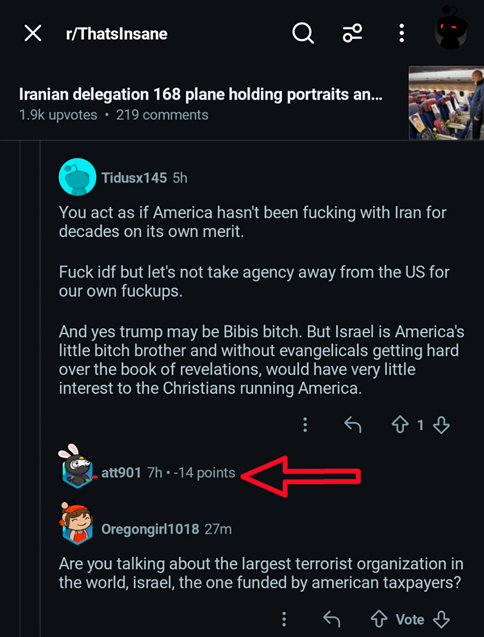
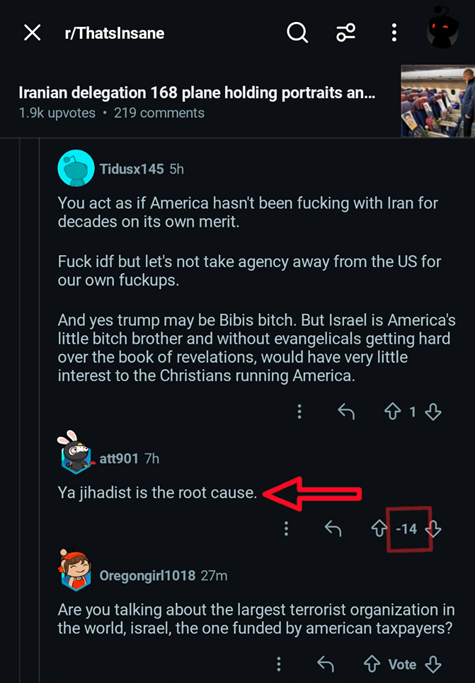
What is especially troubling is that many people who speak up for Jews and Israel, and who try to challenge or rebut the hatred, are quickly buried. Reddit’s “downvoting” system creates a unique censorship tool. If enough users or bots downvote a comment, it collapses and becomes far less visible. This functions as a form of silencing, and it happens regularly to comments defending Jews and Israel. I also strongly suspect that bot activity plays a major role in shaping what people see and how they react. Downvoting bots and coordinated inauthentic accounts can manipulate visibility, suppress opposing viewpoints, and create a kind of herd effect that encourages real users to pile on. I have no way of knowing the exact percentage, but I suspect a significant percentage of the antisemitic and antizionist activity by the bad actors across social media is indeed amplified by bots or coordinated networks, like Kinsella describes in his book, rather than arising organically.
Here’s an example of how downvotes hide comments:
So this is a complicated predicament. Solutions will require major investments in both technical and human resources.
All of our advocacy groups, including the Anti-Defamation League (ADL), Zionist Organization of America (ZOA), Jewish Federations of North America, the Conference of Presidents of Major Jewish Organizations, as well as the AJC, must step up now, on a coordinated basis, and do better in keeping up with the times, perhaps redirecting more resources out of echo chambers and conferences into research on how to fight this growing threat? If legislation cannot be drafted that would survive First Amendment challenges, then conceivably the litigators who have been so effective in the battle to end college antisemitism might turn their attention to defamation actions against certain platforms and individuals. Perhaps the recent verdict against Meta and YouTube for platforms that are addictive and harmful to young users might open the door to liability for antisemitic content. If not, perhaps other strategies might be workable, fighting fire with fire, or with the creative use of technology.
The AJC has at least made some effort to raise awareness of the way this hate is spreading to anyone with a computer or cellphone and has asked Congress to enact legislation to address it. It has also created Cyberwell, a database of online antisemitism and encouraged the victims of online hate to report those incidents. With a little bit of effort, those victims can locate a resource for doing so at “Reporting Antisemitism to Federal Agencies, Law Enforcement, and Social Media and AI Companies.” Once again, when I ask random members of our community about these tools, I get mostly shrugs.
So far, nothing has stemmed, or even slowed, the tsunami of digital hate coming at us. And the solutions to it won’t be found solely within our advocacy groups. They must also be found within ourselves.
Although conducted in the shadows, this new campaign of internet hate is a primary source of real-world hate and violence, more angry and pervasive than at any time in history. And it grows by the day. I don’t have any easy answers, but I do know a crisis when I see one. The old ways won’t work anymore. Things need to change and there’s not a lot of time left before Jew hatred becomes irreversibly normalized and ingrained in American culture.
Special thanks to my son, Mitchel J. Katz, CyberMBA, CCE, for his expert technical contributions to this article.