

Mathematics Teaching Professor, Author
Congregation Emanu-El, Victoria, BC: Canada’s oldest synagogue in continuous use
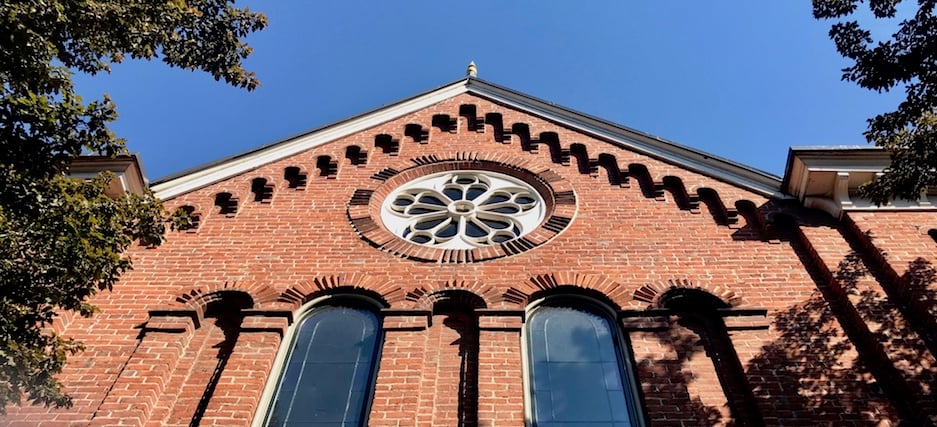
Emanu-El, Victoria, B.C. (Source: Amber Woods)
Standing in the heart of Victoria, British Columbia, Congregation Emanu-El is more than a historic landmark. Built in 1863, it is the oldest synagogue building in continuous use in Canada, a distinction that reflects more than 160 years of uninterrupted Jewish life on the West Coast. Its heritage sanctuary has witnessed generations of worship, celebration, and community, preserving a remarkable legacy while remaining an active center of Jewish life.
Today, Congregation Emanu-El is a progressive, egalitarian congregation that balances tradition with a forward-looking vision. Rooted in Torah and Jewish values, it is a welcoming community committed to diversity, lifelong learning, spiritual exploration, and Tikkun Olam, repairing the world through acts of loving kindness, social action, and justice. As both guardian of a nationally significant historic site and a contemporary congregation, Emanu-El continues to build community while honoring the generations who came before.
I would like to thank the esteemed Amber Woods, for her guidance and support.
Synagogue
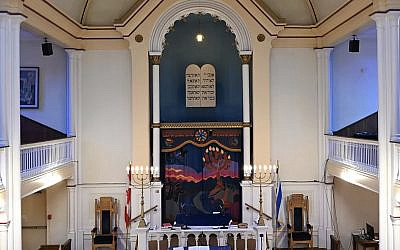
Congregation Emanu-El in Victoria, British Columbia, is one of the country’s most significant Jewish heritage sites. Designed in the Romanesque Revival style, the synagogue reflects a popular architectural choice among German Jewish congregations throughout the diaspora during the second half of the nineteenth century. It features rounded arches, decorative brickwork, recessed entrances, intricately carved column capitals, and a rosette window. The interior is built in the Orthodox tradition. The building also holds the distinction of being Victoria’s first brick house of worship.
The congregation remains the steward of a remarkable heritage sanctuary whose walls have witnessed generations of prayer, celebration, and community life. The interior echoes the building’s Romanesque design, with successive rounded arches framing the Holy Ark that houses the Torah scrolls. One of the synagogue’s most distinctive architectural features is its original five-petal rosette window which is a defining characteristic of the Romanesque Revival style of architecture. Unlike the geometric designs commonly found in North American synagogues, its five petals are often understood to symbolize the Five Books of Moses and, in Jewish mystical tradition, the Shekhinah, the Divine Feminine Presence. The sanctuary originally featured a circular skylight, or oculus, which was removed during renovations in 1948. During the building’s restoration in the late 1970s and early 1980s, a new oculus was designed and installed based on the original feature, preserving this distinctive element of the sanctuary.
While carefully preserving its nineteenth-century character, Congregation Emanu-El has continued to evolve to meet the needs of a growing community. In 1893 the Hebrew Ladies, in conjunction with the board of Directors of the synagogue, built a building in order to provide space for social activities, a Hebrew School and offices. The Hebrew Ladies Hall stood until 1970.
Torah Scrolls
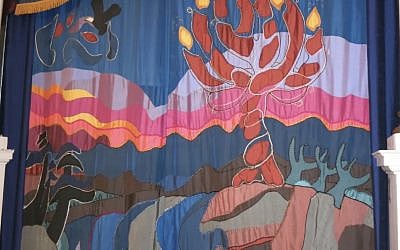
The parochet, the curtain that covers the Ark, has become one of Congregation Emanu-El’s most recognizable treasures. Created in 1980 by textile artist Celia Brauer as her contribution to the synagogue’s restoration campaign, the work reflects both Jewish tradition and the landscape of Victoria, British Columbia. Inspired by her experiences working with First Nations communities in northern British Columbia and by her own heritage as the daughter of Holocaust survivors, Brauer sought to express the idea that Jewish communities in the diaspora could develop a profound sense of place.
Using richly colored Shantung silk purchased with a Canada Council grant, she combined the menorah, the native arbutus tree, and the Tree of Life into a central image, while incorporating stylistic influences from Emily Carr, the colors of sunsets over the Olympic Mountains, the waters surrounding Vancouver Island, the synagogue’s historic brickwork and distinctive rosette window, and a Hebrew inscription urging worshippers to be “bold as a leopard, light as an eagle, swift as a deer and strong as a lion” in the service of God. Recognizing that neither lions nor leopards inhabit Vancouver Island, Brauer substituted a reclining cougar, grounding the work in its West Coast setting. The inscription comes from Pirkei Avot (Sayings of Our Fathers.)
Education
Education has long been at the heart of Congregation Emanu-El’s mission to nurture Jewish identity and lifelong learning. The congregation’s programs begin with Toddler Time, an engaging parent and child experience for children from birth to age four that introduces Hebrew through songs, stories, and play.
From preschool through Grade 5, the egalitarian Hebrew School offers a welcoming environment where students explore Jewish traditions, Hebrew language, prayers, music, and biblical stories through an interactive curriculum that blends contemporary educational methods with Jewish values.
Learning continues through the congregation’s B’nei Mitzvah Program for students in Grades 6 and 7. As they prepare to become Jewish adults, students deepen their understanding of Jewish tradition while developing the Hebrew, liturgical, and Torah-reading skills needed to lead worship and celebrate their B’nei Mitzvah. Individual tutoring and personal guidance ensure that each student is well prepared for this important milestone.
Jewish Cemetery Of Victoria, B.C.
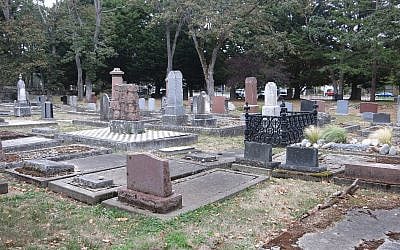
The Jewish Cemetery in Victoria, British Columbia, owned and maintained by historic Congregation Emanu-El, was established in 1860 and continues to serve the Jewish communities of Victoria, Vancouver Island, and the surrounding islands. As Canada’s oldest synagogue in continuous use, Congregation Emanu-El, designated a National Historic Site in 1979, has long been committed to preserving Jewish heritage, including the cemetery’s history, beauty, and sacred character.
The cemetery is also home to a Holocaust Memorial created through the efforts of survivors William and Helen Jacobs, who felt a responsibility to ensure that the memory of those who perished would never be forgotten. Because many victims of the Holocaust have no known graves, memorials such as this provide a place for remembrance and reflection. The memorial’s incorporation of a smokestack serves as a powerful symbol: while countless Jews were murdered and burned during the Holocaust, Jewish identity, culture, and faith endured and were not destroyed.
Historical Backgrounds
In the 1760s, Canada transitioned from French to British rule following Britain’s victory at the Battle of the Plains of Abraham in 1759 and the 1763 Treaty of Paris The first documented European contact on the Pacific Northwest coast did not occur until the late 1770s. At the end of the 1750s, Jews first arrived in what is now Canada with the British army, during its conquest of New France. Descendants of these early arrivals are members of Emanu-El today, demonstrating the continuity of Jewish life in Canada for over 250 years.
During this decade, the 1760s, what is now British Columbia was entirely untouched by Europeans. It was an exclusive Indigenous landscape characterized by highly developed societies, complex economies, and rich artistic cultures.
Which bring us to 1858.
In 1858, Canada was not yet a unified country, but rather a collection of separate British North American colonies. Central Canada was an agricultural and industrial hub, while out West, the mainland of British Columbia was transformed overnight by the Fraser River Gold Rush, bringing thousands of fortune seekers to the region.
It was in this year, 1858, that that Jews first arrived in Victoria in the Colony of Vancouver Island (now part of British Columbia) drawn from San Francisco by the Fraser Gold Rush. Rather than mining, most early pioneers established themselves as merchants in Victoria.
Victoria’s Jewish community was established in 1858 when a small group of Jewish men arrived into the region. Most had first gone to California during the Gold Rush, where they became merchants, traders, and wholesalers before moving north to seize the business opportunities created by the Fraser River Gold Rush.
European settlement of Victoria began in 1843 when Governor James Douglas relocated the headquarters of the British-owned Hudson’s Bay Company from Fort Vancouver on the Columbia River to Fort Victoria, ensuring the company remained on British territory as the US was creating a boundary between themselves and British settlements.
When gold was discovered on the British Columbia mainland in 1858, Victoria became the first port of call for thousands of people arriving from California. That summer, about 30,000 miners, merchants, and entrepreneurs passed through and arrived in the city, including a small number of Jews. While a few Jews went to the goldfields, most established businesses, opening stores and branches of successful San Francisco firms to serve the rapidly growing population. These pioneers came from California rather than directly from Europe. They arrived with English-language skills, North American business experience, and established commercial networks, making an important contribution to Victoria’s early commercial development.
Among the early pioneers were the Franklin brothers: Lumley Franklin, Victoria’s second mayor and the first Jewish mayor in British North America, and Selim Franklin, the first Jew elected to the provincial legislature. In 1859, community members formed the Hebrew Benevolent Society, leading to the establishment of a Jewish cemetery in 1860 and the foundations of organized Jewish life in Victoria.
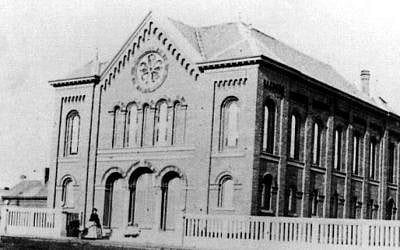
Congregation Emanu-El’s early history reflects the dedication of Victoria’s Jewish pioneers. Victoria’s economy rose and fell with successive gold rushes, creating periods of prosperity followed by financial hardship. These fluctuations affected Congregation Emanu-El. The congregation had its first full-time rabbi in 1863 with the appointment of Dr. Morris R. Cohen in 1863, He served until 1866. There was no full-time rabbi until 1891 when Rabbi Dr. Solomon Philo was installed. He served until 1894.
As Victoria’s Jewish population rose and fell with the fortunes of the gold rush economy, Congregation Emanu-El endured, sustained by a small but dedicated community. By 1948, growth allowed the congregation to modernize the synagogue, addressing structural issues and modernizing its appearance.
In the late 1970s, plans to sell the downtown building were reconsidered after Rabbi Shlomo Carlebach reminded members that there were “too many prayers in the walls.” A restoration campaign followed, returning the synagogue to its historic character and earning local, national, and international awards.
The congregation celebrated its 150th anniversary in 2013 with a recreation of the original cornerstone ceremony and the dedication of a new chuppah. The original silk chuppah, after more than a century of use, was entrusted to the Royal British Columbia Museum for preservation and was displayed at the synagogue as part of the anniversary.
Today, Congregation Emanu-El continues its legacy as an egalitarian Conservative congregation, preserving its historic heritage while nurturing a vibrant and engaged Jewish community on Vancouver Island.
Contact Information:
Congregation Emanu-El, 1461 Blanshard Street, Victoria, B.C. V8W 2J3
Phone: 250-382-0615
Email: info@congregationemanuel.ca
Website: https://www.congregationemanuel.ca/
Cemetery: https://jewishcemeteryofvictoriabc.ca/
History: https://jewishvictoria.wordpress.com/