


Mathematics Teaching Professor, Author
Congregation Temple Sinai of New Orleans: Faith, History, Stained-Glass Beauty
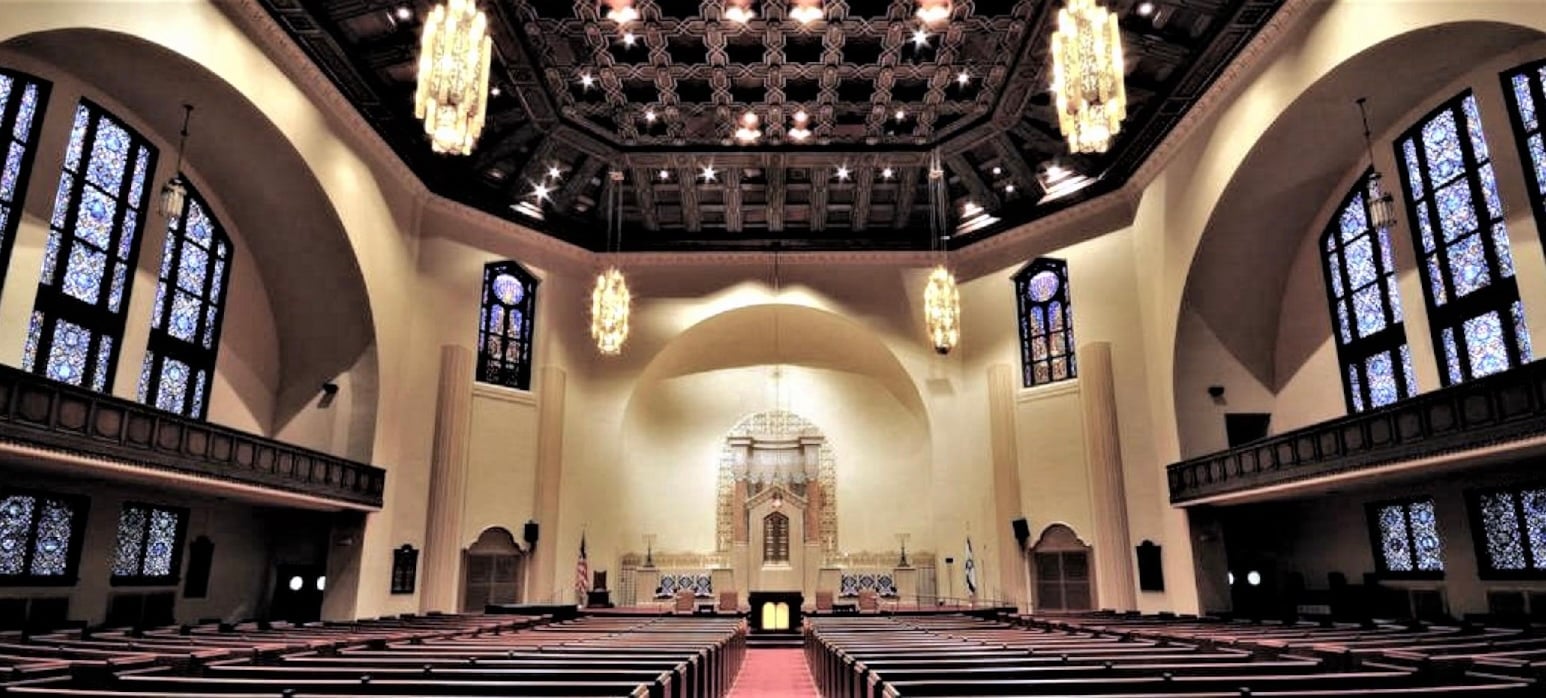
Sanctuary, Temple Sinai of New Orleans (Source: Dr. Clifford H. Kern, III)
Founded in 1870, Congregation Temple Sinai is the oldest Reform Jewish congregation in Louisiana, with more than 150 years of history rooted in Jewish tradition, inclusivity, and Tikkun Olam, the Jewish principle of repairing the world. Since 1928, the congregation has occupied its historic home on St. Charles Avenue in New Orleans. It’s magnificent stained-glass windows, fabricated by the Emil Frei Studio in 1927, remain a treasured feature of the Sanctuary.
Throughout its history, Temple Sinai has served as a spiritual home for Jews of all backgrounds, bringing together faith, music, culture, education, and community. Today, Temple Sinai continues to meet the spiritual, cultural, and educational needs of its members through programs and activities for all generations.
I would like to thank the esteemed Jennifer Daley, Executive Director of Temple Sinai New Orleans, for her guidance.
Synagogue
Founded in 1870, Temple Sinai of New Orleans, Louisiana, has been located on historic St. Charles Avenue since 1928. Among the most beautiful and treasured features of its historic Sanctuary are the magnificent stained-glass windows, fabricated by the Emil Frei Studio of St. Louis and Munich in 1927.
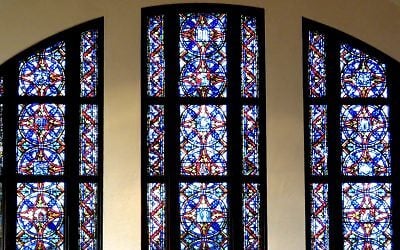
Nearly a century after their creation, the windows continue to illuminate the Sanctuary with their extraordinary colors, intricate details, and meaningful representations of Jewish history and tradition. Following damage sustained during Hurricane Ida, the windows were repaired and restored in 2023 in a project led by Nicholas Frei of Frei & Associates, the great-great-grandson of their original creator, Emil Frei.
Much of the history and symbolism of the windows has been documented by Dr. Clifford H. Kern III, Ph.D., Temple Sinai’s stained-glass window historian.
According to Dr. Kern, the weekend of November 3, 1928, marked three days of congregational, public, and regional celebrations and dedication of the “new” Temple Sinai. Although the windows are known to have been fabricated by the Emil Frei Studio, the identities of those who worked with Mr. Frei and Rabbi Maximilian Heller to design the windows, select and arrange the images, and choose the corresponding symbols on the Ark doors remain unknown.
Dr. Kern also has a personal family connection to Temple Sinai’s history. His grandfather served on one of the committees associated with the congregation, and his father was president of the first confirmation class held at the historic location.
The stained-glass windows are composed of thousands of pieces of mouth-blown French, and German crystal, some measuring only one-eighth of an inch thick. Their beauty comes not only from the extraordinary variety of colors but also from the many different textures and finishes.
The glass ranges from delicate pastels to rich jewel tones. Some pieces are smooth, while others are wavy or contain tiny bubbles. Certain pieces have shaded images fused onto them with metal oxides, while others retain their natural colors.
Here are a few particularly interesting details found within the stain glass windows.
Some of the images in Temple Sinai’s stained-glass windows represent stories from Jewish tradition, although they do not follow a particular chronological order, as is often found in church windows.
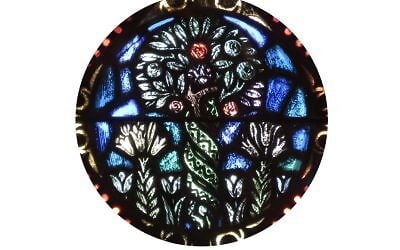
The image of the Garden of Eden is unmistakable. The tree, apple, and serpent clearly identify the biblical story. However, Adam and Eve are not visible. Dr. Kern suggests that the two smaller plants on either side of the central tree may represent them. Another interpretation proposes that the spaces between the smaller plants and the central tree could suggest human figures.
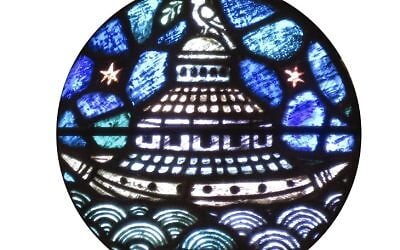
The Noah’s Ark window contains a particularly charming detail: a dove holding an olive branch and sitting atop the ark after returning from its scouting mission. The image recalls the biblical account of the dove’s return with evidence that the floodwaters were receding.
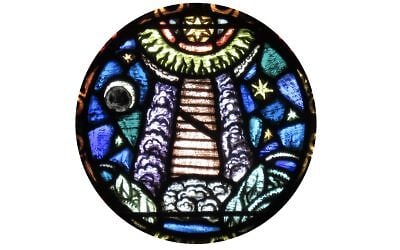
The unmistakable ladder identifies the story of Jacob’s dream. Once again, the biblical story is represented without depicting the central person. The image reflects the tradition of avoiding even the appearance of graven images.
For nearly a century, Temple Sinai’s stained-glass windows have been a source of beauty and inspiration for its congregation and visitors. Their colors, textures, and biblical imagery invite those who enter the Sanctuary to look closely and appreciate the artistry and stories preserved within each piece of glass.
Hebrew Rest Cemetery Association
Although Hebrew Rest Cemetery was formally established in 1959, Touro Synagogue and Temple Sinai have jointly owned and operated Hebrew Rest 1, 2, 3 and Dispersed of Judah since 1872. The two congregations jointly own and operate Dispersed of Judah Cemetery, located at 4937 Canal Street, and Hebrew Rest Cemeteries 1, 2, and 3, located at Pelopidas and Elysian Fields. The cemeteries are open for visitation daily, except Saturdays and major Jewish holidays, from 8:30 a.m. until approximately 5:00 p.m.
Historical Backgrounds
Jews first arrived in Louisiana in 1757, when Isaac Rodriguez Monsanto, a Dutch Sephardic Jewish merchant, arrived in New Orleans. Under French and Spanish rule, including the Code Noir, open settlement by non-Catholics was technically restricted. However, early Sephardic and Dutch Jewish merchants such as Monsanto lived and traded in the city by the mid-1700s.
Following the Louisiana Purchase in 1803, the Jewish population grew significantly as greater religious freedom allowed Jewish communities to establish deeper roots. During the early to mid 1800s, New Orleans developed a vibrant Jewish community made up of German and Sephardic immigrants who contributed significantly to the city’s commerce and culture. By 1861, around 8,000 Jews lived in Louisiana, with established communities and congregations in New Orleans, Donaldsonville, Shreveport, Baton Rouge, Monroe, and Alexandria.
Which brings us to 1870.
In 1870, when Temple Sinai was founded in New Orleans, Ulysses S. Grant was President of the United States, and the nation consisted of 37 states. The country was experiencing Reconstruction and a period of significant industrialization and expansion following the Civil War. That year marked important milestones in American history, including the ratification of the Fifteenth Amendment on February 3, guaranteeing African American men the constitutional right to vote. On February 25, Hiram Rhodes Revels of Mississippi became the first African American to serve in the United States Congress when he was sworn into the U.S. Senate. Also in 1870, Utah Territory granted women the right to vote, and on February 14, Seraph Young Ford became the first woman to cast a ballot under a U.S. equal suffrage law in Salt Lake City.
In 1870, Louisiana was experiencing the Reconstruction era following the Civil War. The state had been formally readmitted to the Union in July 1868 and was adjusting to a new social and economic order following the abolition of slavery. Free labor, sharecropping, and tenant farming became part of Louisiana’s changing agricultural economy. During this period, African American men actively participated in the political process, voting and serving in local, state, and government offices.
It was in that year, 1870, that Temple Sinai was founded. A group of 37 New Orleanians, primarily Western European immigrants, dedicated the congregation on July 3, 1870. Among its founding members were local business leaders and community figures Isidore Newman and Leon Godchaux. The congregation’s original temple building was completed in 1872 and located on Carondelet Street, between Delord and Calliope Streets.
Rabbi Maximilian Heller served as Temple Sinai’s spiritual leader from 1887 until his retirement in 1927. In 1928, the congregation moved Uptown to its present historic location at St. Charles Avenue and Calhoun Street, where a new temple was completed. The original building on Carondelet Street was sold to the Knights of Pythias. During the 1930s, the Motion Picture Advertising Company purchased the former temple and remodeled it for use as its headquarters.
Temple Sinai also played an important role in the history of civil rights in New Orleans. In 1949, the congregation hosted what was described as the first integrated public meeting of its size in the city. In cooperation with the Interracial Committee of New Orleans, the synagogue welcomed Dr. Ralph Bunche, United Nations Arab-Israeli mediator and future Nobel Peace Prize recipient. Approximately 2,000 Black and white attendees filled the Sanctuary and adjacent space for his address, marking a significant moment in the congregation’s history and its involvement in the broader New Orleans community.
For more than 150 years, Temple Sinai has been an important part of the religious, cultural, and civic life of New Orleans. From its founding in 1870 to its historic home on St. Charles Avenue, the congregation has preserved its Jewish traditions while embracing education, fellowship, community service, and social responsibility. Its historic Sanctuary, magnificent stained-glass windows, religious programs, and commitment to future generations reflect a legacy built by those who came before. Through changing times and generations, Temple Sinai remains a place of worship, learning, friendship, and community, a lasting testament to the enduring spirit of Jewish life in New Orleans.
Contact Information:
Temple Sinai of New Orleans, 6227 St. Charles Avenue, New Orleans, LA. 70118
Phone: 504-861-3693
Email: info@templesinaino.org
Website: https://templesinainola.com/