Connecting
“To care for those who once cared for us is one of the highest honors.” (Tia Walker) While many of us who work with older adults fully embrace those words, we know that this philosophy, of reverence for our elders, is neither common nor widespread.
Too often we hear, read or experience a negative attitude towards older adults as well as towards those who care for them. “Why would you want to work with old people?” “Isn’t that so sad, just waiting for them to pass?” These and other questions have been, and often are, directed at those who have chosen elder care as a profession.
Caring for the elderly is not a “one size fits all” proposition. Just as younger people are all different, older adults are diverse in every way. Abilities may be fully retained or they may be compromised. Health issues may exist, but they also may not. Each person, regardless of age, remains an individual with individual concerns and needs and expectations.
Everyone has a right to be treated and respected as a person. And when that respect is demonstrated with sincerity, the results can be powerful.
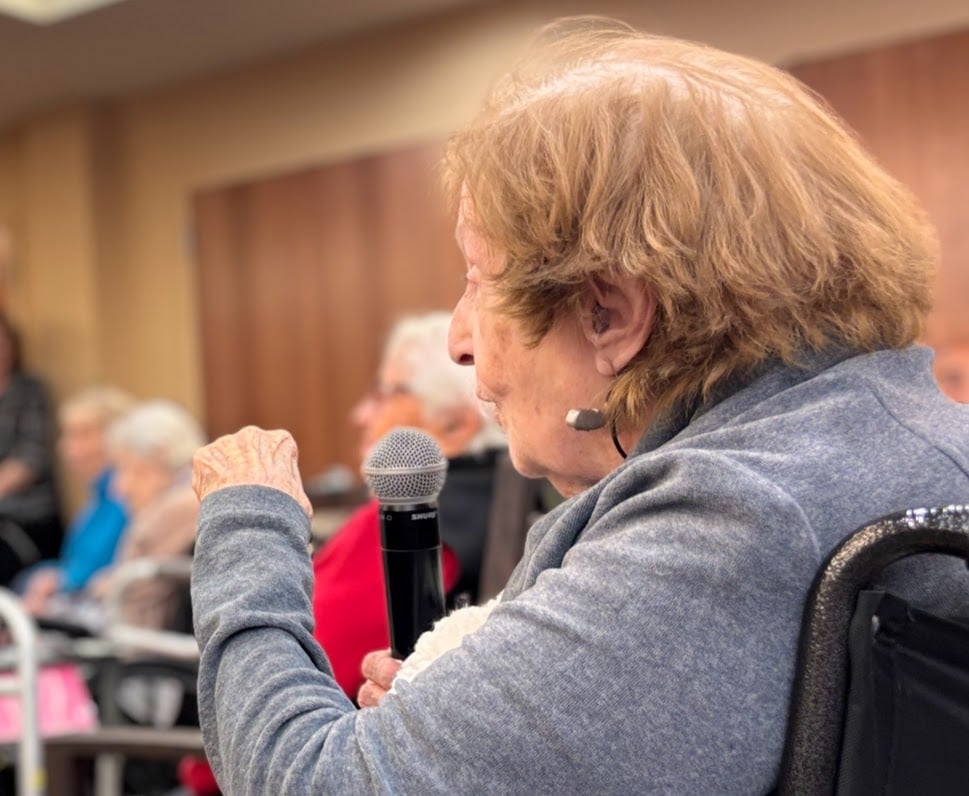
Yesterday I watched as a volunteer led a program with individuals who live in a nursing home. In a room full of people, many of them had physical challenges and many also had cognitive impairments. Our volunteer began by sharing a bit about herself, where she grew up and her parents’ backgrounds. She told the story of visiting her grandparents, hugging her grandma at the door and then looking down the long hallway of the apartment behind where her grandmother stood. At the end of the hall was her great-grandmother, arms opened wide, and she would run into these arms. It was a happy memory and there were many smiles in the room.
Then she asked the elders to share a happy memory. Initially, this sharing was slow in coming. But as each person raised their hand, she walked to them with the microphone, shook their hands and introduced herself. And, little by little, nearly every elder in the room participated, some of them individuals who rarely speak, others for whom speech is difficult.
She didn’t passively listen to the memories either. She engaged with the speaker and then got the whole room involved. When someone mentioned a memory of jumping rope, she asked the room how many remembered doing that too. When someone shared that their daughter is a graduate of the Police Academy and now a police officer, she led the applause in honor of those who “protect and serve.”
This was a room of people that others would have “talked at,” a room of people who require significant care every day and a room full of people who demonstrated, once again, that they have so much to offer.
It is easy to “do for” or “do to” someone. But how much better it is to “do with,” adding meaning not just to the elder’s life but to our own as well.