
Convenient Blindness: Enabling Regime Hijacking
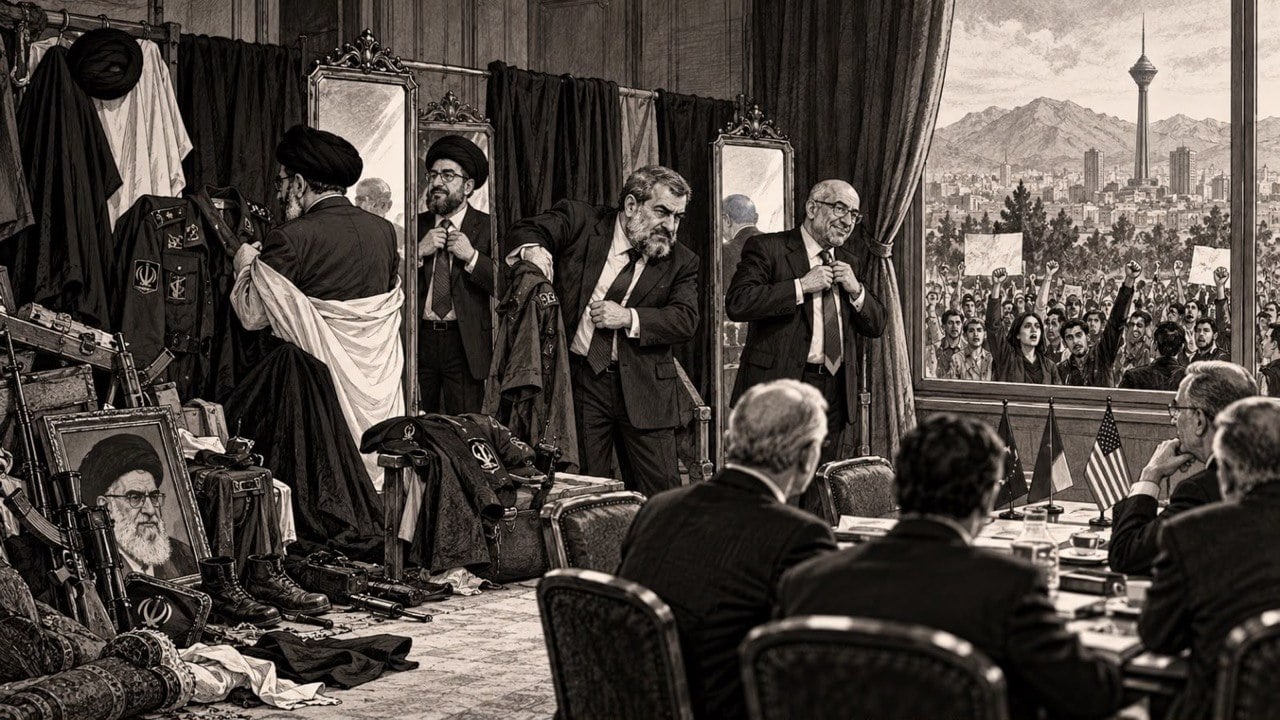
One of the gravest strategic errors the United States and its democratic allies could commit in confronting the Islamic Republic regime is to disregard the explicit will of the Iranian people in favour of familiar “strongman” model that have repeatedly failed elsewhere. The recent experiences of Syria offer cautionary tale: external powers often prioritise short-term transactional arrangements with residual power brokers over the sustained, bottom-up demands of populations that have already paid an extraordinary price for change. Iranians have made their preferences unmistakably clear both in what they reject and in what they demand. On the streets, in repeated waves of protests, and through sustained civil resistance, they have rejected the Islamic Regime and any continuation of theocratic rule. They have also articulated a positive vision centred on territorial integrity, secular governance, individual freedom and equality and free elections to determine their fate without any ideological export, and a transition that restores institutional continuity with Iran’s pre-1979 traditions rather than inventing a new revolutionary rupture.
U.S. assessments, including statements associated with President Trump and later government confirmations, have cited figures exceeding 72,000 lives lost in the course of the “Lion and Sun” revolution during January 2026 uprising. Regardless of the precise accounting as some estimating over 100,000, the scale of sacrifice is not in dispute among serious observers: tens of thousands of Iranians have been killed, imprisoned, and executed during the Lion and Sun Revolution. That cost has purchased clarity of purpose. The demand is not for a managed reform within the existing system or for the elevation of any single strongman; it is for the decisive removal of the Islamic Republic and the installation of a credible transitional authority that Iranians themselves identify as legitimate.
A parallel danger lies in the regime’s sophisticated efforts to divert any external aid, whether from the United States or Israel, intended to arm and empower the population. IRGC intelligence has long cultivated armed proxies and criminal networks inside Iran, particularly in Sistan and Baluchestan and in Kurdish areas. The overwhelming majority of Baluch and Kurdish Iranians are long-rooted, politically astute communities that have suffered the same systematic discrimination, economic exclusion, and security-state violence as the rest of the country. They are not natural recruits for the regime’s intelligence apparatus. A small, but armed minority, however, has for years collaborated with the IRGC Intelligence facilitating narcotics trafficking, cross-border logistics into Iraq, Afghan and Pakistan, and localised intimidation. These groups do not speak for their ethnic communities any more than the regime’s state media speaks for the Iranian nation. Treating them as representative interlocutors, or channeling material support through them, would simply reproduce the pattern of co-optation the Islamic Republic has practiced for decades. We have observed how Starlink terminals that were sent by the US to empower Iranian people did not reach the right hands.
The regime’s endgame, now that its survival is visibly threatened, is not difficult to anticipate. Having accumulated vast sums of laundered wealth in Canada, Europe, Australia, UK, and North America over four decades, residual networks, many of them tied to the Revolutionary Guards, intend to re-enter any post-collapse environment. Their model is already on display in Iraq, where Iranian-linked actors and their local partners captured state institutions, security forces, and resource flows after formal regime change was done by the US. Similar efforts are underway in Venezuela. In Iran, the mechanism would be familiar: the sudden reappearance of “Clean-Shaven” or nominally reformist figures with access to foreign capital, the purchase of media and political influence, and the systematic obstruction of genuine democratic sequencing. The objective is not restoration of the Islamic Republic as such, but the capture of whatever replaces it by the same oligarchic networks that have enriched themselves under clerical rule and suddenly appear as “technocrats.” Such efforts were visible during the failed summer negotiations post ceasefire, where a group of the regime affiliates, especially “Reformists,” advertised themselves as a replacement for The Islamic Republic.
This is precisely why large numbers of Iranians have coalesced around Crown Prince Reza Pahlavi as the only widely recognised alternative capable of blocking such a capture. Pahlavi is not an aristocratic claimant in the classical sense; his political base lies predominantly among wage-earners, small-business owners, teachers, students, and the urban middle and working classes, the very strata that communist and Islamist propaganda have historically claimed as their own. That demographic reality has rendered older leftist attacks on “monarchy” largely ineffective inside Iran. Supporters view him as the only trustworthy transitional figure, he is not entangled with the current power structure, and his public commitments emphasise a constituent process rather than personal rule. The absence of other figures with comparable name recognition and cross-class acceptance has produced a practical consensus: any alternative “face” that emerges under external sponsorship risks being a vehicle for residual IRGC interests.
American, Israeli, and broader Western and democratic policymakers therefore face a binary choice. Respecting the repeatedly expressed preference of Iranians reduces the probability that the next Iranian government will be an oligarchic successor state. Ignoring that preference in the name of tactical flexibility or alliance management with local armed actors raises the opposite risk: the Islamic Republic falls, yet its security and financial networks reconstitute themselves under a new label. For Israel, the consequences would be more severe. A transition perceived inside Iran as externally managed against popular will would extinguish residual goodwill toward Jerusalem and supply the IRGC’s information apparatus post Islamic Republic with a durable narrative:” that the United States and Israel ultimately sacrificed Iranian aspirations for their own strategic convenience.” The resulting alienation would not be abstract; it would shape the security environment facing Israel for a generation.
The practical implication is straightforward. External support must be calibrated to strengthen the capacity of ordinary Iranians to determine their own post-regime arrangements, not to empower the residue or expatriate financial networks that the regime itself has cultivated. The Iranian people require support and enablement so that they can fight at equal levels to that of IRGC! That requires listening to the signal already sent from Iranian streets and diaspora communities rather than substituting the judgment of outside capitals or the residual assets of the collapsing system. History in Iraq, Afghanistan and Syria demonstrates the cost of the alternative.