

Conversational dominance
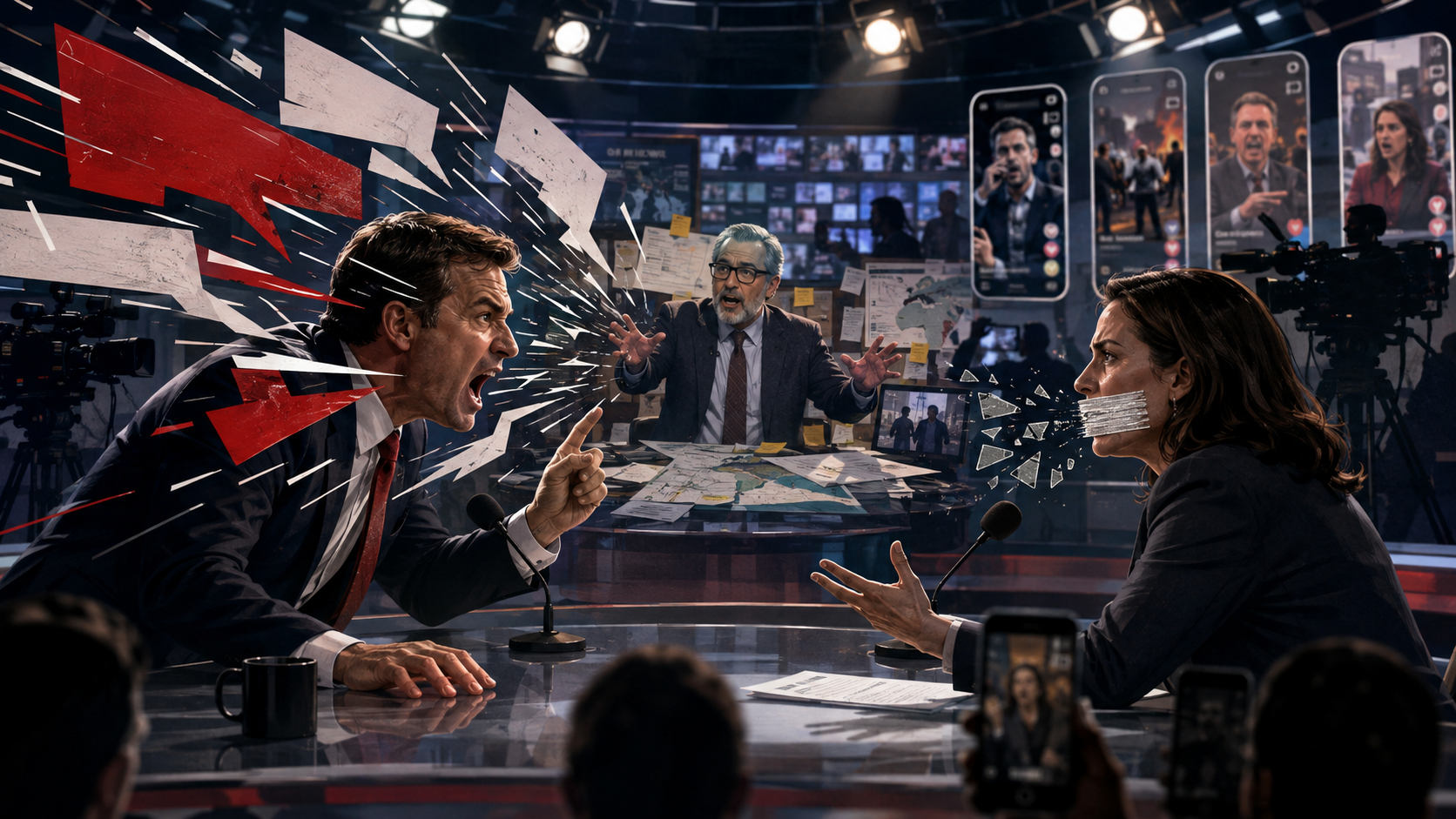
For some time now, but especially with international geopolitical events, the same scene has been repeated on television sets in many countries. People are invited to debate. But very quickly, the debate disappears. One interrupts, raises her voice, refuses to let the other person finish and turns each objection into a personal attack. The goal no longer seems to be to explain, let alone convince. It is about occupying the space, imposing one’s own rhythm and giving the audience the impression that the one who speaks loudest is also right.
This method is not entirely new; politics has always been characterized by invective, provocation and confrontation. But what seems new is their systematization. Aggression is no longer just an overflow; it is becoming a technique. Interruption is no longer an accident. It becomes a strategy. The debate is no longer conceived as a confrontation of ideas, but as a show of strength.
We could call this “conversational domination”. The one who uses it does not necessarily seek to respond to his opponent. He seeks to prevent him from building a reasoning. He cuts sentences, imposes new topics, multiplies accusations, and forces the other to defend himself constantly. Speaking time is monopolized, not to provide more arguments, but to prevent any contradiction from arising.
This tactic works particularly well on TV. Complex reasoning takes time. A spectacular accusation can be made in a few seconds. A cautious analysis requires distinguishing between facts, interpretations, and scenarios. An aggressive formula, it can circulate immediately on social networks. The debate is therefore no longer just for viewers in front of their screens. It is also designed to produce a short sequence, a shock phrase or a humiliation that will then be shared thousands of times.
The political leader then no longer speaks to his opponent. He speaks to his own camp. He does not seek to convince the undecided, but to reassure his followers about his fighting spirit. He must show that he gives nothing, that he never doubts and that he knows how to dominate the opponent. In this logic, recognizing a nuance becomes a weakness. Admitting uncertainty becomes almost a mistake. Apparent strength replaces the soundness of reasoning.
This way of communicating has been particularly developed by certain populist or protest movements, which readily present politics as a clash between the people and the elites, patriots and traitors, honest people and the corrupt. But it no longer belongs to them. It has spread to almost all political families. Everyone accuses the other of having started, then adopts the same methods in the name of the need to respond. Aggressiveness thus becomes contagious.
The phenomenon no longer concerns only political leaders. It also affects those who are invited to help us understand crises: security specialists, former military personnel, intelligence experts, diplomats, researchers or strategic analysts. Their presence should, in principle, help elevate the debate. Their role should be to recall what is known, what is assumed and what remains impossible to verify.
A military expert should be able to explain that a tactical victory does not guarantee a political one. A security specialist should distinguish between an actor’s real capabilities and his supposed intentions. A former intelligence official should remind people that the information available is often incomplete. Expertise begins precisely where certainty ends.
Now, on some boards, this caution disappears. The expert no longer presents hypotheses: he pronounces verdicts. He no longer describes several scenarios: he announces what will inevitably happen. He no longer separates the analysis from his personal preference. He approves, condemns, dramatizes or moralizes. Gradually, the specialist becomes an editorialist.
The problem is not that a former soldier, a researcher or an expert has an opinion; he naturally has the right to do so. The problem arises when this opinion is presented as the unquestionable conclusion drawn from his expertise. The past grade, the position held or the academic title then give to a personal judgment the appearance of a technical truth. The public no longer knows whether it is listening to a professional analysis or a political conviction supported by a particular authority.
Television sometimes favors this transformation. A cautious expert is less spectacular. He says that several scenarios remain possible, that the data are partial and that an adversary’s intentions cannot always be known. Yet this caution is a sign of serious analysis. But it produces less audience than a forcefully proclaimed certainty: the regime will fall, the war will be short, the offensive will be successful, the opponent is already defeated.
We are thus witnessing a double evolution. On one hand, some politicians replace the argument with verbal domination. On the other hand, some experts replace analysis with an editorial. The first seek to prevent the opponent from speaking. The latter sometimes use their authority to make the contradiction almost illegitimate. In both cases, the debate loses its essential function: to help us understand before judging.
This development is dangerous because it also changes our perception of opposition. In a democracy, an opponent can be wrong without being an enemy. One can fight his ideas while recognizing his right to defend them. But when interruption, contempt and permanent accusation become the norm, the other side is no longer just presented as being in error. He becomes morally suspect, dangerous, sometimes even unworthy to speak up.
In the short term, this method is effective. It creates visibility, mobilizes an electorate, and gives an impression of power. But in the long term, it impoverishes democracy. Because when everyone shouts, no one listens anymore. When each expert becomes a prosecutor, the analysis disappears. And when the contradiction is perceived as an aggression, compromise becomes impossible.
The real issue is therefore not only to find more politeness on sets. The aim is to restore a clear distinction between debating, commenting and campaigning. The politician must be able to defend his position without preventing the other from speaking. The expert must be able to express an opinion, but clearly indicating when he leaves the field of analysis. The media, finally, must choose whether they want to organize a useful confrontation or simply produce a confrontational spectacle.
Democracy does not always die in silence. It can also be weakened by noise. Not because there are too many opinions, but because each one now seeks to make the other’s inaudible. So the question is no longer just who won the debate. It’s whether there was still a debate.