
Could a Victory at Pickaxe Mountain Change the 2026 Midterms?
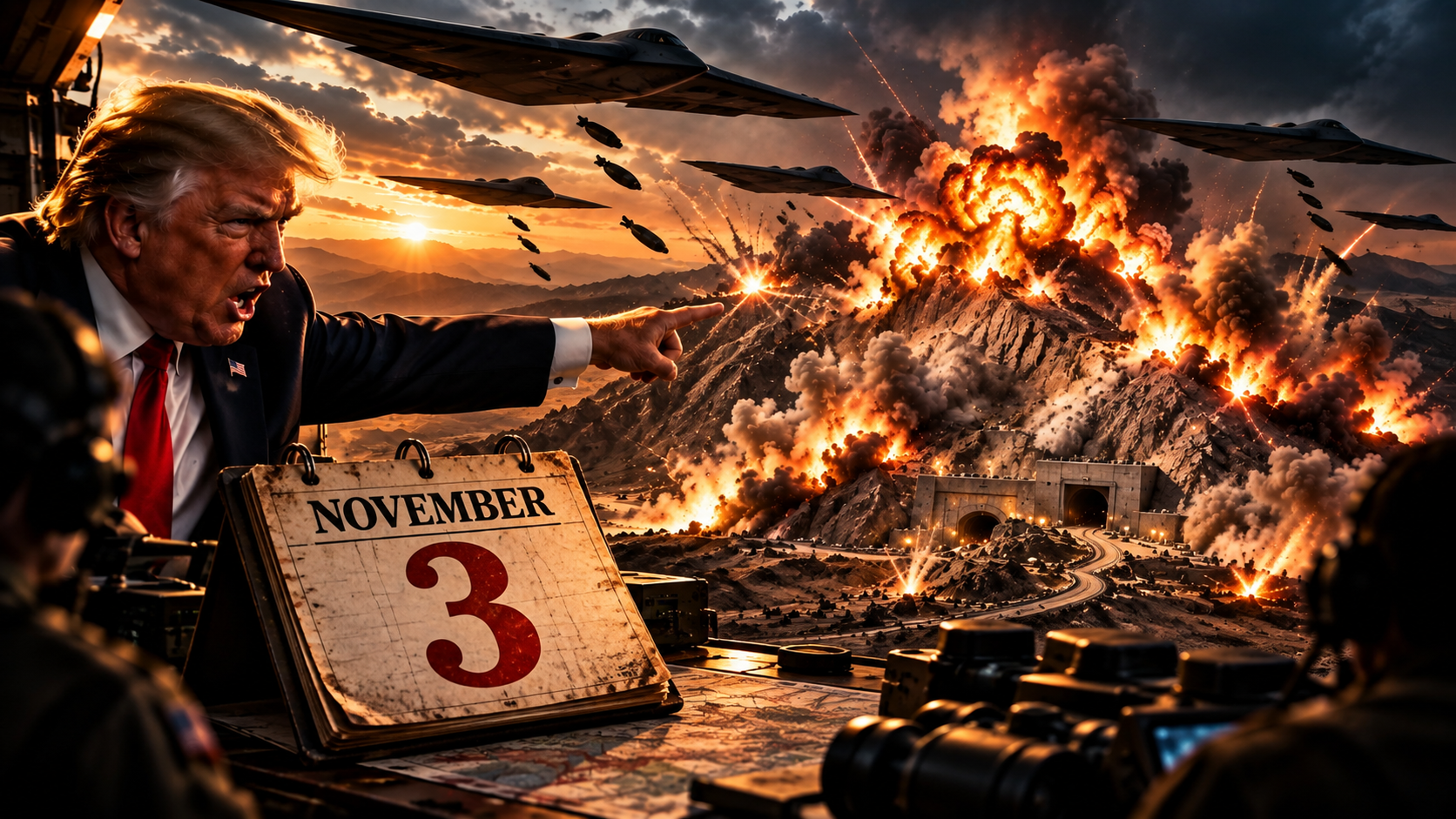
Donald Trump’s problem with Iran extends well beyond the battlefield. The war he has defended as necessary to keep Iran from acquiring a nuclear weapon is being fought while Americans prepare to vote in the November 3 midterm elections, with the economy and the cost of living at the top of their concerns. A poll released on September 22 found that only 26 percent of Americans approve of his handling of Iran, down from 33 percent in March, and that 78 percent believe he is not doing enough to end the war. Reuters/Ipsos measured his overall approval at 32 percent the day before, the lowest of his political career. Beneath a mountain in central Iran sits one event that could change the political conversation: Pickaxe Mountain.
What would happen if the United States neutralized it before Election Day?
Pickaxe is not another site of the kind already struck. In June 2025, the United States struck Fordow, Natanz and Isfahan. Pickaxe Mountain was not attacked. Considerable uncertainty persists about what Iran subsequently placed there. Israeli intelligence has reportedly assessed that thousands of centrifuges were moved to the complex, along with part of Iran’s stockpile of 60 percent enriched uranium.
The Institute for Science and International Security (ISIS), which has closely monitored Pickaxe through commercial satellite imagery, offers a more cautious picture. Its September analysis found that Iran had blocked access to the tunnel portals and added earth over some entrances, apparently hardening them against attack. The Institute assessed that the facility was not currently being used for operations, while also concluding that it likely contains valuable equipment or materials. What exactly lies beneath the mountain remains unknown.
Trump has nevertheless drawn attention to Pickaxe again and again, most recently on September 4, when he said the United States could hit it “very soon.” After seven months of war, Pickaxe has become the piece of Iran’s nuclear program that everyone can still point to.
It is unfinished business.
An attack by itself would do little to sustain a victory narrative. A cratered mountainside accompanied by competing claims from Washington and Tehran would offer little basis for declaring the problem solved. The result would have to be convincing: evidence that the facility had been neutralized and that something Iran needed to rebuild its program had gone with it.
With that in hand, Trump could recast the argument about the war. Most Americans have experienced the conflict through gasoline and grocery prices rather than through centrifuges. A demonstrable success at Pickaxe would let the administration turn the question from what the war has cost to what it accomplished: Iran had a nuclear infrastructure that successive administrations feared, the United States struck its major facilities, and even the hardest remaining complex was reached in the end.
Whether voters would accept that argument is another matter. Trump would at least have what he now lacks: an ending to the story he has been telling.
He himself has tied that ending to the calendar. On September 9, Trump said he expected the war to end “immediately after” the midterms and accused Iran of holding out to hurt Republicans in November. A verified success at Pickaxe could give him the option of trying to move that ending forward, to before the vote.
Neutralizing Pickaxe would not lower grocery prices the next morning. It would not automatically bring down gasoline prices, undo the economic effects of the conflict or persuade voters unhappy with Trump’s domestic record to reconsider. Nor would one underground complex necessarily end the war. Iran could retaliate. Fighting could intensify. Intelligence agencies could dispute the extent of the damage. Evidence could surface that equipment or nuclear material had been moved before the strike.
Elections are also contests over narratives, and narratives can change faster than economic fundamentals. If a verified success at Pickaxe were followed by de-escalation, Trump could present the sequence as the fulfillment of the objective he has invoked from the start: preventing the Islamic Republic from obtaining a nuclear weapon. The political question would then be whether that accomplishment could compete with the economic grievances already shaping the election.
The hardest variable is timing.
Iran may understand that as well as Trump does. The US naval blockade is inflicting mounting pressure on an economy increasingly deprived of oil revenue and foreign currency. Iranian crude loadings fell from roughly two million barrels per day in March to about 220,000–255,000 barrels per day in August, according to industry estimates cited by Reuters. Yet Tehran has not capitulated. Trump himself has accused Iran of trying to hold out until the midterms in the hope of hurting Republicans before November 3. Whether that is actually Tehran’s strategy cannot be known from the outside. But Iran does not need to defeat the United States militarily for the calendar to work in its favor.
It may only need to endure.
Endurance has a cost on the other side. There has been no catastrophic explosion in oil prices, and there does not need to be one. Brent has traded around or above $100 a barrel this month, while US retail diesel has surpassed $6 per gallon for the first time. Months of elevated transportation and energy costs can reach American households gradually: at the gas station, through freight costs and eventually in the price of everyday goods. The political pressure is already visible. Reuters/Ipsos found that only 17 percent of Americans approved of Trump’s handling of the cost of living, the issue respondents most often said would determine their midterm vote.
Washington is trying to make the economic cost of waiting unbearable for Tehran. Tehran, intentionally or otherwise, is surviving long enough for the economic and political cost of the war to accumulate in the United States.
And unlike Iran, Trump has November 3.
If economic pressure alone cannot force an Iranian concession before the election, while allowing the present situation to continue means allowing the calendar to keep running, Trump eventually confronts a choice: continue waiting, reach an agreement, or attempt to produce the decisive event that the war has so far failed to provide.
Suppose, hypothetically, that the United States could neutralize Pickaxe and prove it. When would that event have to happen to matter politically?
Too early, and the victory would have time to decay. Iran could retaliate. Oil markets could react. New operations could follow. Questions about what survived underground could replace the first headlines, and what looked like the culmination of the war could become another episode in it.
Too late, and the problem reverses. Voting before Election Day began in some states in mid-September. Millions of Americans will have voted before November 3, and a narrative needs time to settle. A military achievement arriving when much of the electorate has already made its choice would find far less of the campaign left to alter.
Three separate timelines would therefore have to coincide. The first is military: when an operation could succeed. The second is informational: how long it would take to establish and demonstrate what happened beneath the mountain. The third is electoral: how much time would remain for that information to reach a campaign already dominated by the cost of living.
None of this means that neutralizing Pickaxe would deliver Congress to the Republicans. Hundreds of House and Senate races cannot be reduced to one military event, however dramatic, and no one can know how Americans would respond to something that has not happened.
Iran can measure endurance in economic survival and military resilience. Trump must also measure it in days.
The political significance of Pickaxe therefore lies not simply in the mountain itself, but in what a verified success there could allow Trump to argue in the weeks before the midterms: that an expensive and unpopular conflict had achieved something he could call a victory. The blockade may continue tightening around Iran. The economic pressure may continue tightening around American households. And between them, the electoral clock will continue running.
The mountain may hide more than whatever Iran built beneath it. It may also hold one of Trump’s remaining opportunities to change the story of this war before Americans vote.
At Pickaxe Mountain, the hardest target may not be buried beneath the rock.
It may be the calendar.