Stephen J Stern PhD
Cowboys and Communists: America’s Ghost Story of Freedom and Fear
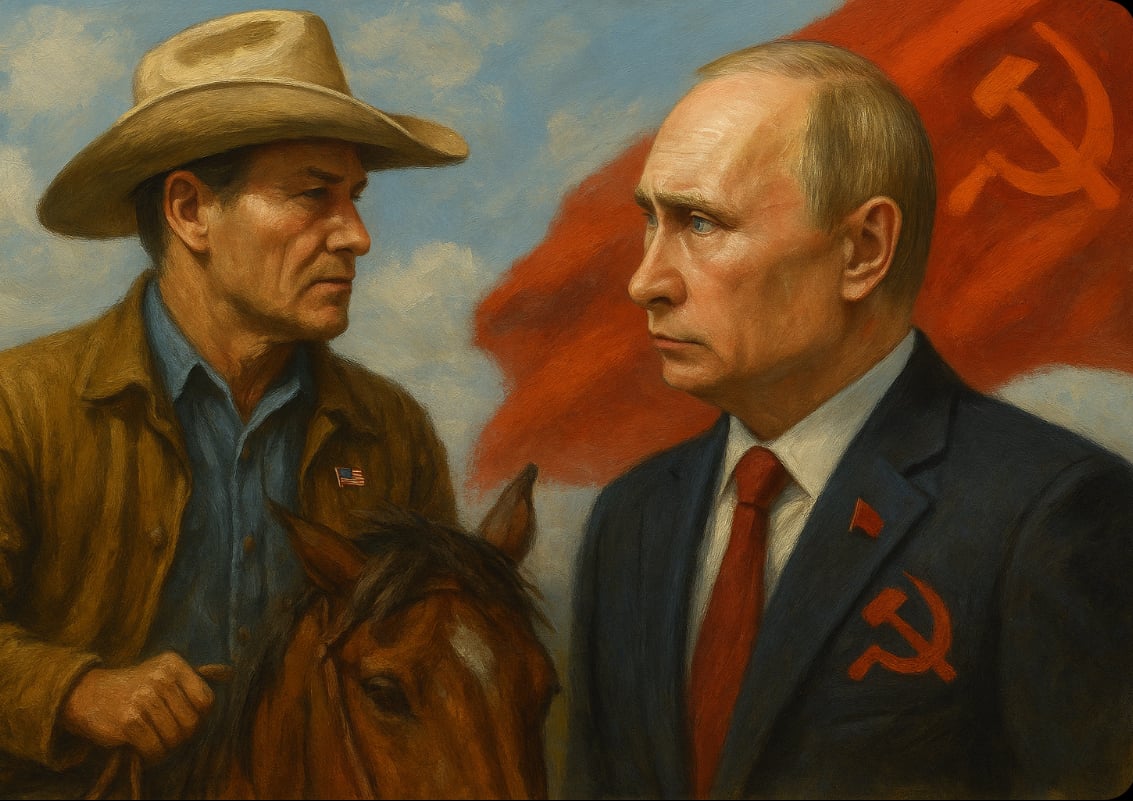
AI image created by Stephen Stern
Elsewhere.
America is always rediscovering its never-ending terror of “communism.” The word keeps getting repackaged. These days it is “woke,” “globalist,” “DEI,” “cultural Marxism,” or “socialist,” but the melody is the same. Long before Republicans accused Democrats of being Marxists, Democrats accused Republicans of being communists. America’s mirror has always been good at reflecting its own fears.
What we keep calling “communism” is rarely about Karl Marx or the Soviet Union, Russia. It is about morality, about who counts as a virtuous American. The fear is older than Lenin, older than Stalin, and older than Palmer and McCarthy. It is a moral panic that flares up whenever someone challenges the idea that success equals goodness. The reflex, branding empathy as dangerous, has been with us from the start.
Utopians and Heretics
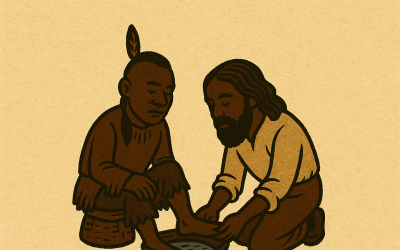
In the 1820s and 1830s, reformers like Robert Owen and Frances Wright built small communities based on equality. They shared land, labor, and reward. Admirers called them “moral laboratories.” Critics called them “blasphemy.” Ministers thundered from pulpits that communal living was an assault on the home and on God. America’s first anti-communism was not about economics, it was about sin.
By 1848, when Marx and Engels published The Communist Manifesto, the U.S. press had already learned to equate “socialist” with “immoral.” The irony is that few Americans read Marx, who interchangeably used socialist and communist. “Communist” became a caricature, a foreigner with bad manners and maybe a suspicious accent. Anti-radicalism was as much about cultural anxiety as political theory, a moral panic dressed up as patriotism.
The Paris Commune Meets the Freedmen’s Bureau
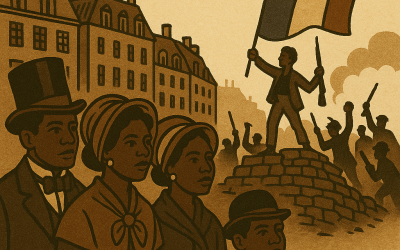
After the Civil War, America faced a test of equality. The Freedmen’s Bureau was created to help formerly enslaved people build new lives. It fed the hungry, distributed clothing, built hospitals, provided medical care, opened schools, and founded colleges and universities. It reunited families, offered legal protection, and gave newly freed people the tools of independence. For a moment, it even distributed small parcels of land under the promise of “forty acres and a mule.”
But equality makes people nervous. President Andrew Johnson vetoed the Bureau’s renewal in 1866, warning that it created “a system of guardianship inconsistent with free government.” He called it unconstitutional, claiming it gave too much power to Washington. Translation, helping the poor, such as recently enslaved people, looked too much like socialism. Congress overrode his veto, but the damage was done. Reconstruction itself was branded a radical experiment.
Then came the Paris Commune of 1871, when Marxist inspired young people took over and ruled a city for seventy-two days, trying to govern without masters. In Europe, it terrified the powerful. In America, still raw from the Civil War, white Southerners and many white Northerners wrapped their fear of freed Black citizens in the same language, describing Reconstruction as a communist uprising in disguise. The Richmond Examiner called the Freedmen’s Bureau “an engine of corruption and communism.” The New York Herald claimed it “subverted property rights by teaching idleness and dependence.” This was a time when democrats identified reconstruction republicans as communists.
The fear was never about Marx or Paris. It was about control. Historian Heather Cox Richardson notes that postwar politics “turned moral questions of justice into questions of loyalty.” To want equality was not only radical, it was un-American. That logic helped end Reconstruction, paving the way for Jim Crow.
The Anti-Communist Cowboy Rides In
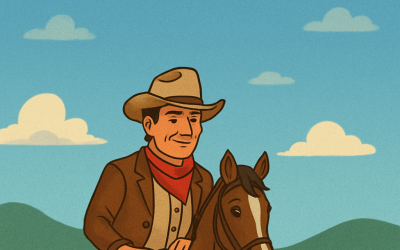
With Reconstruction ruined and equality tainted as socialism, a new hero was invented in the 1870’s, someone who needed nothing and no one. Enter the cowboy. Publishers saw the opportunity and flooded the market with tales of rugged independence. He was everything the Freedmen’s Bureau was not, resistant to collectivism, government oversight, social and morally pure because he answered only to himself. Cowboys did not suffer neighbors.
Owen Wister’s 1902 novel The Virginian gave us the prototype, the solitary man of honor, free from rules, skeptical of institutions, quick to shoot when “justice” required it. By the time John Wayne put on a Stetson, that man was not just a character, he was the country itself. Historian Richard Slotkin called the cowboy “the symbolic antithesis of collectivism,” a protest against anything that smelled like regulation. Cultural critic Jane Tompkins saw the same pattern, writing that “The Western is not about the frontier, it is about the fear of civilization.” Every gallop into the sunset was an argument that the truest American was the one who did not need anyone else. The cowboy myth was anti-communism on horseback. It turned isolation into virtue and contempt for all government into a moral creed. Cowboy capitalists still ride through our politics today, just with different hats.
From Mobs to McCarthy
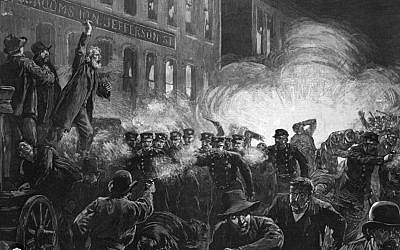
By the 1870s and 1880s, “communist” meant not only the Paris worker or the freedman with land, but also the immigrant with a union card. During the Great Railroad Strike of 1877, the Chicago Tribune warned that “the Communist anywhere is a lazy, dissolute, sneaking, dangerous vagabond.” A decade later, May 4th, 1886, the Chicago Haymarket bombing (during a labor protest) sealed the stereotype. Anarchists, socialists, and communists all became one monster, foreign and disloyal.
Industrialists preached that inequality was good for the soul. Andrew Carnegie wrote that “the price which society pays for the law of competition is great, but the advantages are greater still.” Translation, if you are poor, it is probably your fault. If you try to change it, you are a communist.
By 1901, when an anarchist killed President William McKinley, Congress had already begun tightening immigration against “subversives.” The dragnet caught Jews (Eastern Europeans), Italians, Russians, and anyone from lands where revolution was rumored to live. By 1919, the Palmer Raids made arresting radicals sound like patriotism. Henry Ford’s ‘Dearborn Independent’ newspaper perpetually warned that Jewish “Bolshevism” threatened America from within. You can hear the loud whisper beneath it all, they are coming for your home, faith, and freedom. I’m reminded of SNL parodying Mel Gibson’s Jewhatred: https://youtu.be/l5F5q_wAxHg?si=4e3klcNQ6QHBf4og
McCarthy, HUAC, and the Eternal Sermon
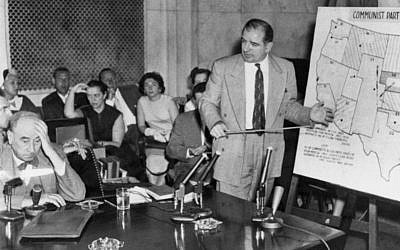
Photo is from Wikipedia.
By the 1950s, anti-communism had become a kind of national religion. Senator Joseph McCarthy, aided by legal counsel Roy Cohn, turned paranoia into theater. (I have seen Cohn’s doppelgänger.) President Dwight Eisenhower, no fan of McCarthy, believed “our form of government has no sense unless it is founded in a deeply felt religious faith.” Evangelist Billy Graham called communism “a godless creed.”
The House Un-American Activities Committee (HUAC) followed suit, dragging artists, educators, and public servants before its panels. It destroyed careers on suspicion alone. Jewish writers, directors, and performers were disproportionately targeted in Hollywood, not for espionage, but for “un-American” ideas. Producer Dore Schary put it simply, “They were not accused of betraying secrets, but of thinking the wrong thoughts.” Every accusation turned into a loyalty ritual, every denunciation a confession. “Godless communism” became the moral language of the Cold War, teaching generations to see dissent as sin.* (See comment below on federalist paper 10 by founding American James Madison.)
Culture Wars and Recycled Fears
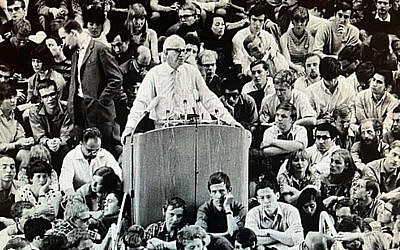
The Cold War ended, but not the sermon. “Cultural Marxism” replaced Bolshevism as the bogeyman. The villains were no longer factory agitators but professors and writers, many of them intellectuals like the Jewish German philosopher Herbert Marcuse, who fled Hitler for the U.S., where he found himself blamed by the right for corrupting American youth. He’s still blamed.
https://www.dissentmagazine.org/article/refusing-marcuse-fifty-years-after-one-dimensional-man/
At the 1992 Republican National Convention, Pat Buchanan warned of “a culture war for the soul of America.” The crowd roared because they had heard the line before, it was just “godless communism” with better lighting. Today, the code words have shifted again, globalists (e.g. Jews, George Soros), elites, DEI, woke mobs, (Jew hating) ‘Great Replacement’ theory … The melody has not changed, it just found a new beat.
The Real Tradition
Across two centuries, American anti-communism has had less to do with Marx than with manners. It protects a self-image, Protestant, property-owning, self-made, righteous. It worships the independent man and mistrusts the collective. Historian Heather Cox Richardson reminds us that “for all our focus on fighting socialism and communism, right-wing authoritarianism is actually quite an old threat in our country.” The labels change, the fear does not.
Every generation of so-called “communists,” from the utopians of the 1820s to the freedmen of Reconstruction to the protesters of the 1960s to today’s identification of democrats as Marxists and socialists has asked the same question: what if the measure of democracy and democratic capitalism is sympathy, equality under the law, and equal opportunity, not betrayal? It is the question America still has not answered, because too many of us are still busy labeling whoever asks it.
Adam Smith, the 18th century Scottish, moral philosopher and founder of capitalism, would not be happy with the cowboy capitalist label of betrayal against those asking the question. He wrote: “Concern for our own happiness recommends to us the virtue of prudence; concern for that of other people, the virtues of justice and beneficence—of which the one restrains us from hurting, the other prompts us to promote that happiness.”
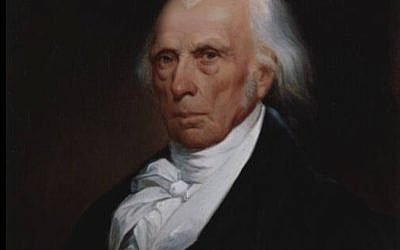
*The 1950’s emphasis on religion and God (like today’s ethno-white Christian nationalist faithfulness to the antebellum South ) as foundational to government was once a great worry for founding father, James Madison, fourth president of the United States, architect of the American Constitution, and enslaver of black people. (Only one of America’s first four Presidents wasn’t an enslaver, nor a Southerner, John Adams, the 2nd President.) Factional wars, e.g. the religious wars in Europe, weren’t desired. Madison expressed this in federalist paper 10, where he took a jack hammer to factional foundations. Taking Adam Smith’s (the founder capitalism) understanding of a free market economy, Madison argued for a free market of factions, where never ending competition keeps factions in check from taking over anything, such as the government. Madison felt this was achievable with a central republican government in a big country as opposed to a small country where a group’s interest may take control. Link to Madison’s Federalist 10: https://constitutioncenter.org/the-constitution/historic-document-library/detail/james-madison-federalist-10-178