Torah for the Age of Awakening
Creation & the 25th of Elul
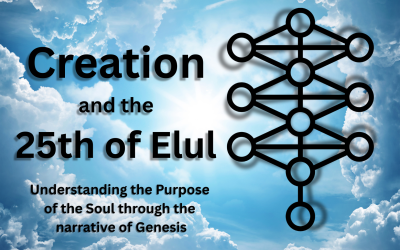 The profound wisdom embedded in the creation narrative reveals layers far deeper than chronological history. When the sages teach that the 25th of Elul marks creation’s beginning with the divine utterance “Yehi Or: Let there be light,” they point toward a spiritual architecture that culminates with Adam’s formation on Rosh Hashanah. Yet Kabbalah unveils an even more sublime teaching: Genesis 1 is not history but mashal—a parable describing the structuring of consciousness itself.
The Torah’s opening, “Bereishit bara Elohim” (“In the beginning, God created”), conceals profound mysteries. Reishit itself is code for Chochmah, primordial Wisdom emerging from Keter, the concealed crown of the Infinite. This “beginning” follows an even more primordial act: the tzimtzum (divine contraction) and the emanation of the first ray of light (kav) from absolute nothingness (ayin) into being (yesh).
What Genesis describes is not the absolute creatio ex nihilo, but rather the ordering and rectification (tikkun) that follows the shattering of vessels (shevirat ha-kelim) in the world of Tohu. The tohu vavohu (formless chaos) represents the collapse of primordial structures, and the six days narrate their careful reconstruction as divine light descends through successive spiritual levels. Let’s look at the following seven archetypal stages of this creation narrative:
Day One: The Primordial Light of Chesed
“Yehi Or: Let there be light”
The first divine utterance releases the Ohr HaGanuz (hidden primordial light) pure Chesed overflowing as unbounded beneficence. This is not physical luminescence but consciousness-light itself, the illumination of infinite possibility. The immediate separation of light from darkness introduces Gevurah, the principle of boundary and distinction, tempering pure flow with necessary limitation.
In the human soul, this corresponds to the awakening spark that distinguishes reality from illusion, establishing the fundamental discernment upon which all spiritual development depends.
Day Two: The Firmament of Gevurah
“Let there be a firmament… dividing the waters”
Here separation deepens through the sefirah of Gevurah. The rakia (firmament) creates sacred boundary between “upper waters” (supernal consciousness, mochin d’gadlut) and “lower waters” (unconscious potentialities). This is Din (judgment), where divine constriction prevents the overwhelming dissolution that unbounded light might cause.
Spiritually, this represents discipline and discernment, the soul’s capacity to create sacred space between transcendent and immanent, establishing the framework for conscious evolution.
Day Three: Harmony in Tiferet
“Let the waters be gathered… and let the dry land appear”
Balance emerges through Tiferet as waters gather (limitation) allowing land to emerge (stable form). Vegetation sprouts, the first expression of sustainable life and growth. Tiferet, the sefirah of beauty and compassion, achieves synthesis between Chesed and Gevurah.
Like plants drawing life from water while rooted in earth, human consciousness begins bridging heaven and earth, establishing the potential for sustained spiritual development.
Day Four: The Rhythm of Netzach and Hod
“Let there be lights… for signs, for festivals, for days and years”
Sun and moon, greater and lesser luminaries, establish sacred temporality through Netzach (eternal endurance) and Hod (reflective glory). The sun embodies steady radiance; the moon reflects light in phases. Together they anchor time, enabling consciousness to experience history, growth, and cyclical return.
This stage establishes the rhythm of spiritual life; the dynamic interplay of expansion and reflection, action and contemplation, that marks sacred time.
Day Five: The Generative Power of Yesod
“Let the waters swarm with living beings, and let birds fly”
Through Yesod (foundation, connectivity), creation overflows with movement and fertility. The blessing “Be fruitful and multiply” first appears here, linking this stage directly to transmission and union. Swarming sea life and soaring birds represent the soul’s imagination, creativity, and relationality—the energies connecting beings to one another and linking heaven with the depths.
Day Six: The Microcosm of Malkhut
“Let us make man in our image, after our likeness”
In Malkhut (sovereignty, manifestation), terrestrial creatures appear, culminating in Adam. Humanity integrates all prior stages as both earthly creature and heavenly image, the microcosm containing all ten Sefirot. Adam possesses intellect from Chochmah and Binah, heart from Chesed through Tiferet, body from Netzach through Yesod, and kingship from Malkhut.
In Adam, consciousness becomes self-aware, recognizing itself as the conscious integrator of all cosmic levels. Rosh Hashanah thus marks not merely humanity’s formation but the annual re-enthronement of the human soul as partner in divine creation.
Day Seven: The Return to Keter
“And God completed… and He rested”
Shabbat is not cessation but revelation of the inner source. While six days manifest multiplicity, the seventh returns all to unity through Keter, the crown where all opposites dissolve into their root. Shabbat offers the taste of redemption, the realization that beyond striving lies simple being, union with the Infinite.
This kabbalistic vision reveals Genesis 1 not as material origins but as the allegorical descent of divine light into ordered vessels. What emerges is not creation itself, but a spiritual seder, an ordered environment, an inner cosmos designed specifically for human consciousness to awaken, struggle, and ascend.
Creation becomes the beit midrash of the soul, the cosmic study hall where conscious evolution unfolds. This is an arena within the greater expanse of existence, a theater wherein the human soul is positioned at the center of cosmic evolution, called to harmonize heaven and earth.
The six archetypal days fashion the environment for the seventh, the human “sabbath consciousness” that recognizes its role as conscious integrator. Rosh Hashanah annually renews this recognition, reminding the soul of its cosmic purpose: to serve as the point of conscious reflection through which the divine creation beholds and perfects itself.
In this light, the ultimate destiny is the realization of Adam Kadmon’s archetype, the perfected human as mirror of the Infinite, in whom all levels of creation achieve their conscious integration and return to their source. The creation narrative thus becomes a map of consciousness itself, charting the descent and ascent of awareness through the cosmic architecture designed for its awakening.
Related Topics
Related Posts