
Culture Under Siege: The TIFF Controversy
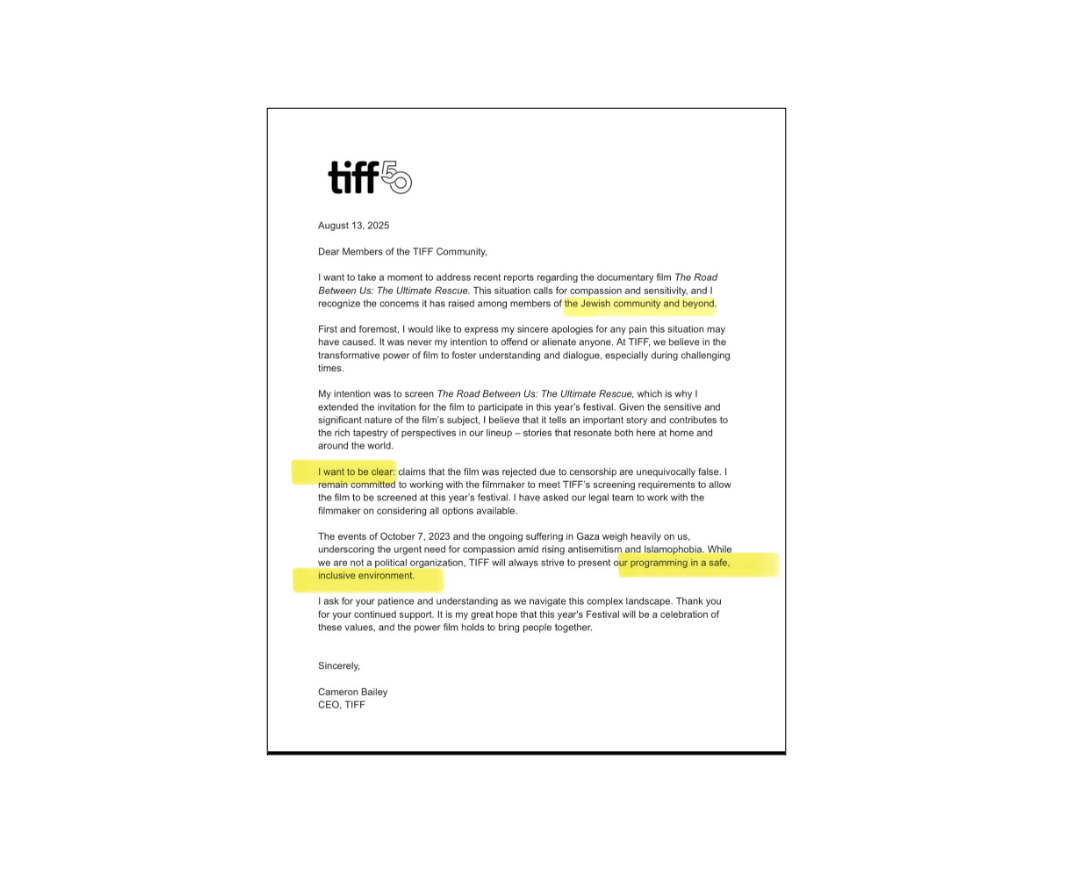
On August 13, 2025, Cameron Bailey, CEO of the Toronto International Film Festival (TIFF), issued a letter addressing the cancellation of The Road Between Us: The Ultimate Rescue. The documentary, which recounts a grandfather’s heroic mission to save his granddaughters, has ignited outrage over perceived censorship and a troubling disregard for Jewish voices. Bailey’s response, though framed as conciliatory, reveals a deeper and more insidious trend: the weaponization of culture to serve ideological ends.
Echoes of a Sinister Playbook
History offers chilling precedents. In 1933, Joseph Goebbels founded the Reich Ministry of Public Enlightenment and Propaganda, seizing control of arts, media, and culture to glorify the Nazi regime and vilify Jews. His infamous observation still resonates:
“Propaganda works best when those who are being manipulated are confident they are acting on their own free will.”
This strategy is reemerging, not in the shadows, but in broad daylight. On university campuses, in political discourse, and within cultural institutions, emotional manipulation and threats of violence are steering narratives. TIFF’s decision is not an isolated misstep; it’s part of a broader pattern of cultural submission to ideological pressure.
TIFF’s Hollow Defense
Bailey insists the film’s rejection wasn’t censorship, citing a commitment to “safe” and “inclusive” programming. But these terms have become ideological shields. “Safe” now implies a threat, real or imagined, of violence or unrest. “Inclusive” is often code for excluding narratives deemed politically inconvenient, particularly those involving Israel.
This linguistic sleight of hand reflects the dual pressures shaping cultural decisions in Canada and across the West: the growing extremist population and its threat and use of violence and terror, and the economic coercion of the BDS movement. TIFF’s decision to cancel the film under these pressures is a disservice not only to the Jewish community but to the integrity of storytelling itself.
A Call for Courage
In any negotiation, a threat’s power lies in its credibility and the willingness to act on it. The rise of radical Islam in the West and backers in organizations such as the Muslim Brotherhood and the Iranian Regime, have demonstrated both. Cultural institutions, once bastions of free expression, now bend to intimidation. TIFF’s cancellation of The Road Between Us is emblematic of this trend, where “safety” and “inclusivity” are invoked not to protect, but to suppress.
Leadership demands more than platitudes. It requires moral clarity and the courage to resist manipulation. Film festivals should be arenas for truth, not battlegrounds for propaganda. It is the difference between Chamberlain and Churchill.
Turning Points
We are living through a series of moments that beg the question: Have we reached a turning point? I would argue that the seeds have already taken root. Consider the UK, where a 2024 survey by the Henry Jackson Society revealed stark realities of an extremist worldview embedded within significant segments of the population. Only 24% of British Muslims acknowledged Hamas’s atrocities of rape and murder on October 7, 2023; only 24% affirmed Israel’s right to exist; and just 23% found the prospect of Sharia law in the UK undesirable.
This is not a future threat, it is a present reality. The creation of a radicalized and concentrated minority population in urban Britain is no longer hypothetical; it is historical fact.
As Amjad Taha, an Emirati strategic affairs expert, stated in a CBS News interview:
“You can’t be more Muslim than we are in the UAE or even in Mecca. We ban ‘Islamic Relief org.,’ while you open offices for it in London and New York. The EU and Democrats complain about tariffs, yet turn a blind eye to Muslim Brotherhood-linked terrorists funneling their citizens’ money to extremists in Yemen and Gaza, or to those displacing Christians by force in Syria and Iraq.”
Like Taha, I have no issue whatseoever with people of Islamic faith – my issue like Taha’s remarks reflect growing frustration in the Gulf over Western permissiveness toward Islamist organizations that are banned across much of the Arab world. His warning is clear: the West is not just tolerating extremism, it is enabling it.
These are not just statistics or soundbites, they are signals. They suggest that the erosion of Western values is not a distant possibility but a present crisis. Cultural institutions must decide whether to stand firm or be swept away.