Critiquing Ireland's "anti-Zionist" mindset
“Dad, I’ve just invested in Israel State Bonds!”

“Israel has been selling diaspora bonds for almost as long as the country has existed ...Ukraine is the most recent country to have attempted to do this, and failed. “(1)
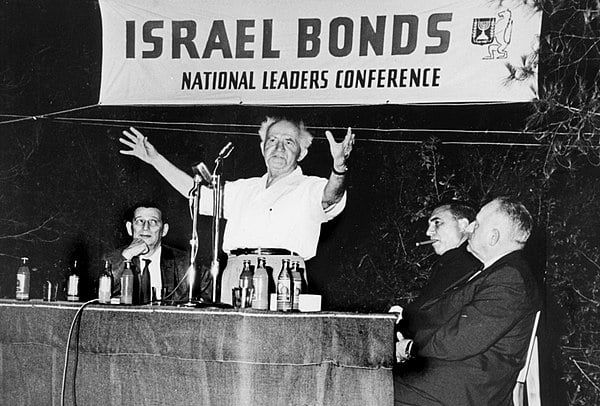
Israel Bonds, Ethical Investing, and the Politics of Finance
For as long as Israel has existed, it has raised money from its global diaspora through bonds.
These so-called “diaspora bonds” are hardly unique to Israel: Pakistan, India, Ethiopia, and Greece have attempted similar offerings, with mixed success. Ukraine, more recently, tried and failed.
Qatar, Kuwait, Iran, and the United Arab Emirates – all theocratic Islamic countries – tap international debt markets without comparable outcry. They have problematic politics and human rights issues. Yet when it comes to Israel, financial debates reliably escalate into political battlegrounds.
In principle, government bonds are blind, abstract financial levers. In practice, the politics of who issues them can be anything but blind. Democracies, dictatorships, and theocracies alike borrow beyond taxation to fund infrastructure, relieve humanitarian crises, pay down debt—or, sometimes, to arm themselves.
Since Hamas’s October 7 attack, the Development Corporation for Israel has raised $1 billion from U.S. investors, including $250 million from individuals.
Critics present Israel Bonds as uniquely suspect
Meanwhile, in Ireland, Sinn Féin’s attempt to ban the sale of Israeli bonds was narrowly defeated in the Dáil, 87–75. Had it passed, the Restrictive Financial Measures (State of Israel) Bill would have barred the Central Bank from facilitating their sale across the EU.
Sinn Fein, hard-left political parties and trade unions have led countless protest demonstrations outside Ireland’s Central Bank. They hope to convince the bank, the government and corporate investors to ban the sale of Israel Bonds through the supposed “will-of-the-people”.
Critics present Israel Bonds as uniquely suspect, while ignoring the operational “sins” of other states – whose debt instruments continue to circulate unquestioned. The selective outrage reveals more about politics than finance.
A binned newspaper lead to an unusual investment.
My own path into this world of investing was almost accidental. Back in 2008, after the Celtic Tiger years, I tentatively tried my hand at trading shares, guided by the Financial Times, Motley Fool, and other investment advice publications.
Then, in 2009, I spotted a newspaper sticking out of a shopping centre bin. It was the broadsheet business section, seemingly unread and certainly clean. Being a typical “waste not, want not” Protestant, I placed that supplement in my knapsack.
That serendipitous find detailed the growth of Israel’s tech sector. When I followed up, the minimum entry into the fund was far beyond my spare capital. The kind-minded fund secretary suggested that I consider getting in touch with the Israel embassy for more modest investments. This in turn led me toward my first-ever government bond purchase, Israel State Bonds.
I am a nuanced evangelical Anglican Christian, and sympathetic to that small, scrappy start-up country. My investment wasn’t just about returns. It was a gesture of moral support for a small democratic nation-state. Israel has survived against many odds, in a hostile, despotic geopolitical environment.
The Good, the Bad and The Guardian.
Counter-narrative readers are alert to the many malevolent, politically paranoid Protocol conspiracies about Israel. These have their negative nadir in The Guardian. Ironically, their mission statement claims: “.. .We embrace diversity, champion inclusivity and treat everyone with respect…”
My late father—an otherwise liberal man—often mailed me clippings of sectarian Guardian op-eds, critical of Israel. This repetitive ideological “underlining” was quite wearying.
After my first Israel Bond purchase, I wrote to my dad after yet another conspiracy-theory news clipping: “Thanks for sending me yet another anti-Israel article. I’ve just invested in State of Israel Bonds.”
Curiously, the clippings then stopped arriving.
There is no such thing as a “neutral” bond. Whether it is China funding economic revival, or Israel seeking resilience under attack, the capital raised can serve noble ends—or troubling ones. Ethical investing is rarely clear-cut. But if investors are going to scrutinize Israel, consistency demands they apply the same standards to every sovereign issuer.
At the end of the day, whether my investments are wise or not, I believe all money ultimately belongs to God: stewardship and not ownership. Where to place it, however—into bonds, equities, or elsewhere—remains both a financial calculation and a reflection of conscience.
Deuteronomy 8:17–18 (NIV):
“You may say to yourself, ‘My power and the strength of my hands have produced this wealth for me.’ But remember the LORD your God, for it is he who gives you the ability to produce wealth, and so confirms his covenant, which he swore to your ancestors, as it is today.”
Sources:
-
- The Puzzle of Diaspora Bonds: A Case Study of Israel’s Program https://www.creditslips.org/creditslips/2023/06/the-puzzle-of-diaspora-bonds-a-case-study-of-israels-program.html
- Massive surge in the buying of Israel Bonds from the United States
https://www.cnbc.com/2023/11/08/massive-surge-in-the-buying-of-israel-bonds-from-the-united-states.html - Sinn Féin bill sought to prevent sale of Israeli ‘war bonds’ defeated by 87 votes to 75
https://www.thejournal.ie/sinn-fein-israeli-war-bonds-bill-voted-down-dail-6717476-May2025/ - ‘It’s Not Just Money; You Are Investing in Your Identity’: Israel, the Jewish Diaspora, and the Israel Bonds Program https://papers.ssrn.com/sol3/papers.cfm?abstract_id=4479132
- When the Guardian was a Zionist newspaper
https://www.thejc.com/opinion/analysis/when-the-guardian-was-a-zionist-newspaper-bdd3426t - https://en.wikipedia.org/wiki/Israel_Bonds Israel Bonds on Wikipedia