

Dante’s Labyrinth Film
I am writing this for people interested in politics, anthropology, the Middle East, Iran, political prisoners, human rights, journalism, and the strange ways history enters an ordinary life.
Before I met David De Hannay—Dante to those who know him—I had no clear image of what a political prisoner looked like.
Perhaps, somewhere in my imagination, there was Alexandros Panagoulis, the Greek resistance fighter Oriana Fallaci wrote about in A Man. But that belonged to literature and history. It was distant from me.
Iran was distant too.
Like many people in the West, I knew embarrassingly little. I knew the headlines. I knew the Islamic Republic. I did not understand the complexity of Iranian history or its culture. Many of us casually confuse Iranians with Arabs, forget that their language is Persian, and imagine an entire civilization through the image of its present government.
Then I met Dante.
And even then, I understood almost nothing.
He did not present himself to me as a political man. He spoke about art, cinema, France, Italy, books, photography. He identified deeply with European culture. He was charismatic, contradictory, difficult at times, extremely funny, and completely independent. He was the founder of NYC Art Movement and had organized exhibitions around political and social questions. I participated in one of the exhibitions he organized in support of Ukraine.
At first, this was the man I knew: an artist.
It took me almost four years to understand that there was another life underneath the one I could see.
I began discovering photographs and films that were not on Instagram, works almost nobody around us had seen. I learned about his imprisonment in Iran, his photography, his political history, his activism, and his later life as an American citizen. I also learned about his Christian faith, something that became part of his identity after the experiences that shaped him.
But documents tell only part of a life.
What affected me more was what I saw myself.
I have known David for four years, and in all that time I had never seen him cry.
Not once.
Even when he spoke about painful things in his private life, he often laughed. Even when a former girlfriend betrayed him, he laughed about it. That was his way. He could turn humiliation, pain, loss, and absurdity into humor.
Then, in 2026, when the killing in Iran intensified, I saw something completely different.
He was working with underground photographs and videos from Iran. One day I walked into the room while he was editing images.
He was crying.
I had never seen that man cry.
That moment changed something for me.
It made me understand that exile does not necessarily mean escape. Sometimes a country follows you. Sometimes history follows you. Sometimes the prison survives after the prison doors have opened.
He later made the short film Silent Slaughter and created a performance in New York connected to the Iranian victims.
Over the years, I also watched conflicts gather around him. I watched people who had once been close to him turn against him. I experienced harassment myself. Hard drives containing years of his work disappeared. Parts of an enormous artistic archive were damaged or lost. There were moments when it seemed that what was disappearing was not simply data but evidence that a person had existed and created.
People even asked me why I continued showing his photographs.
That question stayed with me.
Why should an artist disappear because his life is inconvenient?
By then I had traveled with him for other artistic projects. He had also made a film about me and my painting, which later became a finalist at a festival in Berlin. During those travels I kept asking questions. I kept looking at the archive. And slowly I understood that the person beside me was carrying several lives at once: artist, filmmaker, photographer, former political prisoner, Christian, immigrant, American citizen, activist, organizer, provocateur, and witness.
He is also one of the most complicated people I have ever met.
That complication is precisely why I wanted to film him.
I am not a filmmaker by training.
I am a witness who made a film.
I am not a writer either, but I want to share what I know and what I saw.
I did not want to make propaganda. I did not want to make a saint. Saints are not interesting to me.
I wanted to document a man.
David De Hannay is a Christian, an American citizen, and a former political prisoner in Iran who has spent more than twenty years fighting through art, photography, filmmaking, activism, and personal resistance.
Whatever people think of him, that life deserves to be seen.
A man who refused to kneel before a political system he opposed. A man whose work repeatedly returned to freedom. A man who could be surrounded by people and somehow remain entirely alone. A man whose archive seemed to be disappearing faster than I could understand it.
That became Dante’s Labyrinth.
It is a short documentary, and therefore necessarily incomplete. I combined fragments of his archive with material I filmed across New York, Colombia, Paris, London, and elsewhere. What you see is only a small part of what exists—and a small part of what has already been lost.
I made the film because eventually I felt that remaining silent would also be a decision.
I am especially interested in sharing it with journalists, researchers, historians, anthropologists, people working in human rights, members of Iranian and Middle Eastern communities, and members of New York’s Jewish community who want to understand Iran beyond headlines and slogans.
Whether people agree with David on every question is not the point.
The point is to look.
To listen.
To examine what survives.
Today his health has made this project feel even more urgent to me. He may not even be able to attend the screening of a film about his own life.
There is something painful about that.
A film about a man fighting disappearance, shown perhaps in his absence.
I hope Dante’s Labyrinth is only the beginning. There is enough material—and enough unanswered questions—for a much longer film. I want to preserve what remains of the archive, speak with people who knew different chapters of his life, and understand what happened rather than simply repeat what anyone says happened.
I need support for that work.
Not support for an ideology.
Support for the act of documenting.
Because history is not always preserved by governments, universities, museums, or newspapers. Sometimes it survives on a damaged hard drive. Sometimes in an old photograph. Sometimes in the memory of one person who happened to be standing in the room.
And sometimes you realize that if you do not record what you saw, one day someone may say it never happened.
I am sharing the invitation to the screening and the trailer below.
If politics, Iran, human rights, art, exile, memory, religion, or the psychology of political resistance interests you, I hope you will come and see the film for yourself.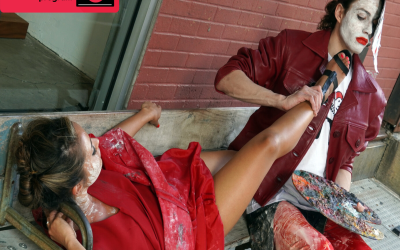
From Iran to NYC — independent thought, artistic freedom, intellectual courage, and the belief that art can elevate society.
This Friday, Oct. 2, at 5 PM in NYC, join me for Dante’s Labyrinth, the film I directed and wrote about David De Hannay — an American artist born in
Iran, founder of NYC Art Movement, one of the most consequential conceptual artists of our times.
I combined endangered archival material from Iran beginning in 1999, including BBC World News footage, with new material I filmed across the U.S., Paris, London, and Colombia.
Trailer: https://lnkd.in/g9pfpV_B
More about the film: https://lnkd.in/e9a5nmrX
Previous post: https://lnkd.in/p/eQppKrsp