

Featured Post
Daring to be holy in the Holy Land
The best gift I can bring to my friends abroad is not an item from the Jerusalem shuk but an awareness of God and an identity rooted in the wondrous place I call home
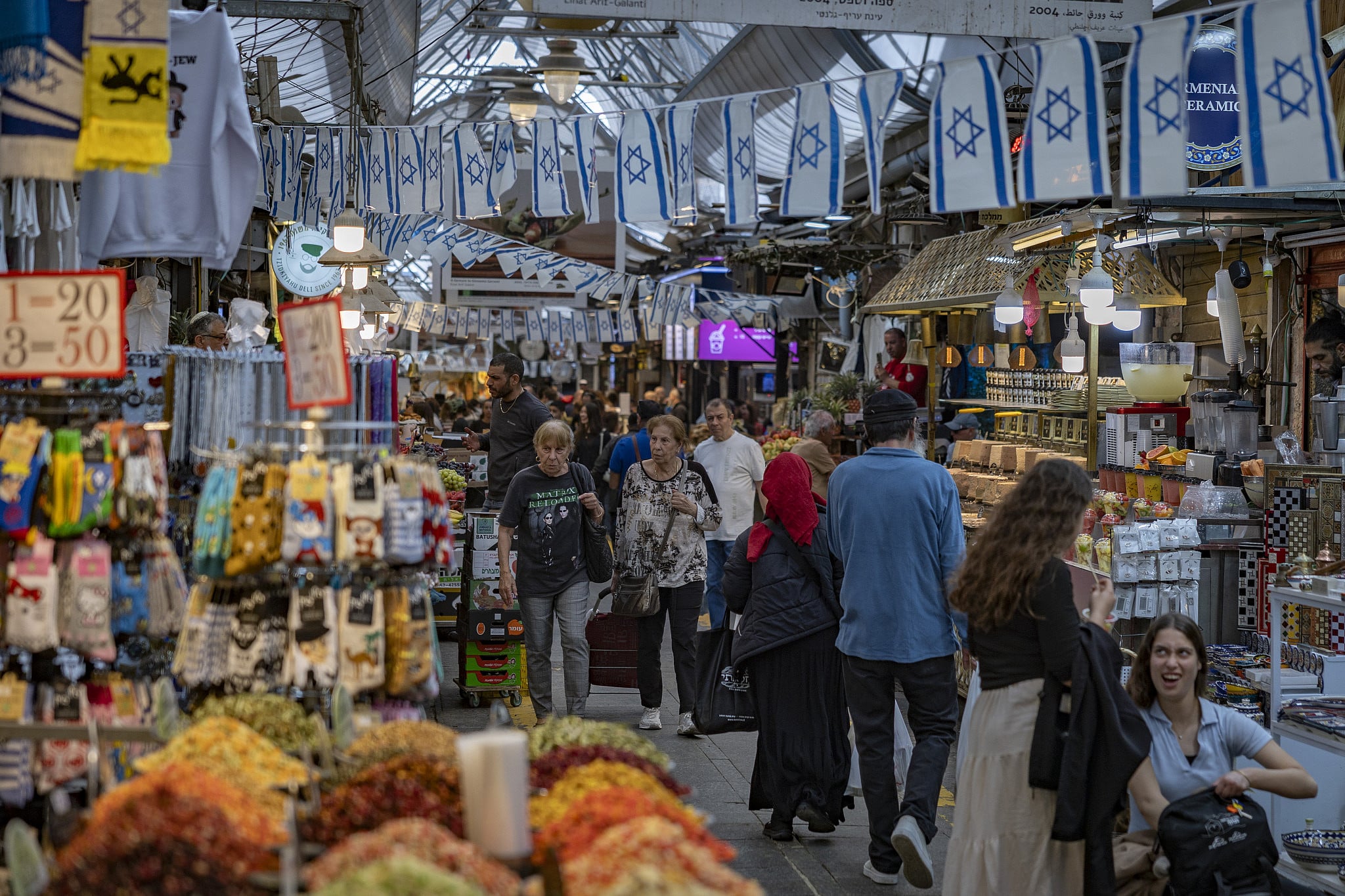
People shop at the Mahane Yehuda Market in Jerusalem on April 15, 2026. (Photo by Yonatan Sindel/Flash90)
More than 60 years ago, at a seminar held at the Jewish Public Library of Montreal in June 1964, the celebrated singer/songwriter Leonard Cohen cried out, “We no longer believe we are holy. This is the declaration I wait to hear going out from the synagogues and from the lips of cultural Jews and ethical Jews. This is the confession without which we cannot begin to raise our eyes — the absence of God in our midst.”
Of all Cohen’s prescient, immortal words, these reverberate most strongly for me at the present moment – his rebuke of his fellow Jews for their abandonment of God. Like all prophets, Cohen needed the passage of time in order for humanity to fully realize the potency of his message.
Here we stand at this critical moment for Israel and world Jewry, when the legitimacy of our homeland is challenged, our heritage demeaned and libeled, our very existence the catalyst for protests worldwide, the pretext for moral purity tests.
The Jews are famous, but not for a good reason.
Against this backdrop, I find myself deep in contemplation of the best and most useful gift I can bring my American family and friends when I visit next month for a teaching tour.
I ponder specialty Israeli food items, Judaica, jewelry, crafts. I walk leisurely through Machane Yehuda and along Emek Refaim in Jerusalem looking for inspiration, only to realize that the gift I can bring, as an Israel-dwelling Jew, is that which is intangible.
Yes, I will stuff my suitcase with all of the above, but my best “made in Israel” house-gift is my God-consciousness and authentic Jewish identity forged in the daily reality of life in this beautiful and wondrous place I call home.
Despite alarming headlines, I maintain that if ever there was a time to appreciate living in Israel, it is now. Despite the missiles that rained down upon our heads for weeks. Despite everything.
You see, we who live in the imperfect perfection of Zion have something that our galut —diaspora — counterparts do not have: an unambiguous, unapologetic Jewish sense of self. We choose to live in Israel because we are Jews. We may have wildly divergent politics and practices, but to quote that 1970’s musical Kazablan: “Kulanu Yehudim.” We are all Jews.
As an educator of spiritual texts, I spend significant time pondering the mysteries and dimensions of Jewish identity, and it is my distinct impression that the discourse over Jewish identity in North America is so polluted by the debate of Zionism versus anti-Zionism that the core principles of what it means to be Jewish have been buried beneath a mountain of accusations and apologies.
Living in Jerusalem, I can access a lost truth: that Judaism expresses compassion, kindness, joy, confidence, unapologetic integrity, spiritual sensitivity, familiarity with the Jewish story, honoring our past and dedication to creating a new path into our future — with pride and dignity.
This truth enables me to feel less threatened and afraid in response to news that rattles my American Jewish friends and family, including the latest libel against Israel in no less a publication than the New York Times. But there is nothing new under the sun. What we are seeing now is simply the newest version of an old affliction.
It is not that I am impervious to the rampaging Jew-hatred around the world; it is that I am observing it within the grand privilege of being home, not living in an insecure diaspora, which is the very nature of all diasporas.
Here, in Israel, we anticipate a direct encounter with God or at least reach for a life that highlights a God consciousness. This presence was with me from the first sound of the sirens last month all the way to my bomb shelter, but it is also with me as the Jerusalem sun beams down upon me as I walk through this ancient and beautiful city.
I sadly observe that for many across the globe, the status quo — the assumed and the expected — has undergone a rupture of sorts. As human beings living with the uncertainty, anxiety, pain, despair and fear of the present moment, it behooves us to reframe our reality by asking, “What is being asked of us now?” “How are we to respond?”
Certainly, Jews might feel overwhelmed by these new questions, which are actually age-old, but shocking for many because we never thought that our Golden Age would come to an end, as all golden eras must.
Each of us will answer in our own unique way. However, what we all share might very well be the recognition of the need to change, heeding Leonard Cohen’s directive that it is time to acknowledge the absence of God in our lives.
We are clearly standing at a tipping point. We have gone through the crisis of October 7 and live in its critical immediate aftermath. As we try to cope, it may be hard to see, but history has proven that periods of crisis birth innovation and renewal.
History is a cycle. Life as we knew it has tilted in an unexpected way at an unexpected time.
As I consider the future of the People of Israel, I perceive the opportunity to create an innovative path moving forward, one that contributes to a thriving and unified Jewish people. Of course, the road will present its challenges, and much will be asked of us, but I am certain that persevering and interrogating the meaning of this moment will catapult us to a new and important chapter in our history. What an opportune time to bring God back into the conversation! Such a move supports our basic human need to feel more connected with our deeper selves — our souls — and with each other.
As I allow myself to quietly contemplate this loud and turbulent moment, I realize that the nation of Israel is called upon to return to a God-centered Judaism that fertilizes a holistic way of being Jewish. This Judaism excludes no one; every individual feels there is a place at the table for their authentic true self. We need to reclaim the truth that Jews are members of a nation — a peoplehood with its own language, values, homeland, and history — that includes but is not limited to a theology. The latter painfully limits a Jewish identity to a religious one with its dogmatic expectations and proclamations of absolutism.
Living a Godly and spiritually sensitive life achieves what so many of us yearn for: achdut – Jewish unity rooted in our awareness that to be Jewish is to be holy.
As a spiritual activist, I channel Leonard Cohen’s poignant observation sixty-two years later at a moment where the nations of the world seem to be banding together to remind us that we are indeed a people who dwell apart, different, quirky, stubborn, troublesome, God-centered, and unified when claiming membership in a holy nation.
Traveling through the US this June, my suitcase will be light, but my soul will be full unto bursting as I am transporting the knowledge of a living God in our world, crossing borders and time zones with my teaching, inspiring others to dare to be Jewish, even now, especially now.