
Where history exposes power and moral failure
DARVO from beyond the grave: Ratko Mladić and Serbia’s cult of victimhood
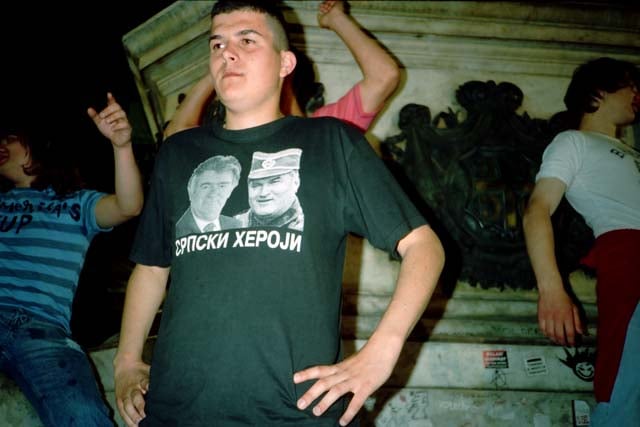
Radovan Karadžić and Ratko Mladić on t-shirt worn by Serbian youth. The caption on the t-shirt reads "Српски хероји", "Serbian heroes". By Andrej_Filev - Flickr, CC BY-SA 2.0, https://commons.wikimedia.org/w/index.php?curid=2443344
Ratko Mladić returned to Serbia on a government plane.
He had left Serbia in 2011 after his arrest and transfer to The Hague, where the former commander of the Bosnian Serb Army was eventually convicted of genocide, crimes against humanity and war crimes. He returned on September 3, 2026, six days after dying in United Nations custody while serving a life sentence. His coffin, covered with a Serbian flag, was received by relatives and government officials before being taken to a military hospital. Four days later, thousands followed him through Belgrade to his grave. Soldiers accompanied the coffin. A military band played. Patriarch Porfirije of the Serbian Orthodox Church presided over the funeral. Serbia’s defence and justice ministers attended, as did President Aleksandar Vučić’s son Danilo. Vučić himself stayed away.
Vučić’s absence did not diminish the state’s role. It refined it. By staying away while a government plane, soldiers, ministers and his own son did the honoring, he reserved the right to call the funeral a family matter after having already made it a public one. The president who accused the United Nations of “inhuman behavior” for keeping Mladić in custody did not need to stand at the grave in order to decide what the grave would mean. Vučić is not a latecomer to this mythology: as a Šešelj radical and Milošević-era information minister he once papered Belgrade with “Ratko Mladić Boulevard” signs, claimed a wartime encounter with the general, and treated Karadžić’s circle as political company. He later recast himself as Serbia’s indispensable European interlocutor – talking accession while Brussels still lists cooperation with the tribunals and respect for their victims among the political conditions of membership – skipping the graveside, notoriously waving at a dark and empty train platform, kissing the Serbian flag and wrapping himself in it before other members of the UN General Assembly, and beaming for the cameras while he presented a Hollywood actor and director with a Serbian passport after the star filmed in the country and then asking on TikTok, “Did you know Lord Voldemort is a Serb?”
That absurd and offensive double game is now much harder to play: even as Vučić weathers more than a year of student-led protest after the Novi Sad station collapse and months of demands that he resign, using his own absence from the funeral of a convicted génocidaire whose coffin the Serbian state had already flown home to keep one European option open while his ministers, soldiers and son closed the others.
The legal record Mladić brought home with him was remarkably complete. The International Criminal Tribunal for the former Yugoslavia convicted him in 2017 after a trial that had begun five years earlier. The court found him responsible for genocide at Srebrenica, where Bosnian Serb forces captured the United Nations-designated safe area in July 1995, separated Bosniak men and boys from women and children, detained and transported thousands of them to execution sites, and murdered more than 8,000. Their bodies were buried in mass graves. Bosnian Serb forces later dug up a number of those graves and moved the remains to secondary burial sites in an effort to conceal the crime, leaving some victims’ bodies divided among multiple graves. Mladić was also convicted of persecution, extermination, murder, deportation and forcible transfer elsewhere in Bosnia; the campaign of sniping and shelling used to terrorize Sarajevo; and the taking of United Nations personnel as hostages. In 2021, the appeals chamber affirmed his convictions and life sentence.
Those legal categories contain families. Mejra Djogaz lost three sons, her husband and her grandson at Srebrenica. After Mladić died, she told Reuters that he claimed to be a hero, while to her he was “nothing but a piece of dirt.” Fadila Efendić, whose husband, son and more than thirty members of her extended family were killed, was troubled by something that survived him: “his idea didn’t die with him.” Nearly thirty-one years after Srebrenica, the women whose relatives were taken away were watching the country next door prepare to receive his body.
There is very little historical uncertainty available to hide inside here. The argument over Mladić is taking place after the trials, the testimony, the military documents, the intercepted communications, the forensic evidence, the mass graves and the identification of the dead. His initial indictment dates from July 1995. His trial ran from 2012 until 2016, followed by a five-volume judgment in 2017 and an appeal decided in 2021. Anyone wishing to construct Mladić as a Serbian hero in 2026 has to do it in the presence of that record.
Psychologist Jennifer Freyd coined the acronym DARVO for a recognizable sequence: Deny, Attack, and Reverse Victim and Offender. It describes the maneuver by which responsibility is resisted and then inverted until the person accused of causing harm occupies the position of the person harmed. Applied to historical memory, the concept helps explain a peculiarity in the afterlife of Mladić. Serbia’s problem is no longer simply how to deny what he did. The conviction itself can be put to work.
Mladić was convicted at The Hague; therefore The Hague persecuted a Serbian general. He spent his final years imprisoned abroad; therefore Serbia was deprived of one of its defenders. International officials condemn his glorification; therefore foreign powers continue to humiliate Serbia. Aleksandar Vulin, a former Serbian deputy prime minister and longtime Vučić ally, dispensed with the intermediate steps at the funeral. The Hague tribunal, he said, “was created not to seek justice, but to seek revenge against the Serbs.” Republika Srpska President Siniša Karan described Mladić and other Bosnian Serb commanders as men who had “defended the Serb people from physical extermination.” When the United Nations refused requests that the gravely ill prisoner be released to spend his final days in Belgrade, Vučić accused it of “inhuman behavior.” Milorad Dodik went considerably further, describing Mladić’s death as a “contract killing.”
The dead Bosniak men and boys of Srebrenica have not changed places with Mladić in any historical record. They have changed places with him in the distribution of grievance.
Serbian civilians did suffer during the wars of Yugoslav dissolution. Serbs were murdered and expelled. NATO bombed Yugoslavia in 1999. None of those facts alters who was separated from the women and children at Srebrenica in July 1995, who controlled the troops there, where the prisoners were taken, or what happened to them when they arrived. None alters what happened in Sarajevo, where Bosnian Serb forces maintained a siege lasting nearly four years while civilians lived under sniper, artillery and mortar fire from positions around the city.
Mela Softić spent her childhood inside that siege. In 2021, as the appeals chamber prepared to deliver its final judgment against Mladić, she told Reuters, “Twenty-five years later, I feel as if the war is not over.” About 11,000 people were killed during the siege, including roughly 1,600 children. The tribunal found that the campaign was intended to spread terror among Sarajevo’s civilian population.
Yet cumulative Serbian suffering can be assembled into a national story in which Mladić’s prosecution becomes one more installment in a much older persecution. A man interviewed by Deutsche Welle in Ruma after Mladić’s death supplied the premise almost perfectly: “What was he supposed to do, let them kill all the Serbs? Thank you [Mladić], for everything.” Once the war is remembered in those terms, Srebrenica can be absorbed into a story in which Serbs were defending themselves from annihilation. The Hague becomes another foreign institution acting upon Serbia rather than the place where evidence against a named defendant was tested.
Genocide denial around Srebrenica remains politically important, but Mladić does not need an acquittal to be rehabilitated. His conviction can acquire another moral meaning. The sentence becomes evidence that he suffered for Serbia. His imprisonment abroad extends that suffering for years. His death in foreign custody supplies an ending that a nationalist account can understand without revisiting why he was imprisoned. Then the government plane brings the body home.
By the time of his funeral, very little had to be said explicitly. The ceremony supplied enough. Serbian soldiers and a military band accompanied a man whose conviction included genocide and terror against civilians. Government ministers attended his burial. Patriarch Porfirije led the service. Thousands carried his photograph and Serbian flags through Belgrade. The state never issued a document declaring Ratko Mladić an innocent man. It helped return and bury him with honors.
The football terraces were less restrained. Red Star Belgrade supporters honored Mladić immediately after his death, including chants that resulted in a €90,000 UEFA fine and an away-ticket sanction against the club. His image and name had already become fixtures in Serbian nationalist public culture; enormous displays, banners and murals have kept the general visible outside any courtroom or history book. At the funeral, Milovan Bajić called him “the greatest Serb and general” and said that “for every true Serb, Ratko Mladić is a sacred figure.” After Mladić’s son Darko denounced the courts that had turned Serbian “defenders into criminals,” men in the crowd, including many too young to remember the Bosnian war, chanted: “Hero! Hero!”
By September, a conviction that filled thousands of pages existed alongside a much simpler public proposition: General Mladić belonged to us.
That possessive relationship explains some of the durability that additional evidence has failed to disturb. The ICTY could establish where Mladić stood in the command structure, what objectives the Bosnian Serb forces pursued, what happened to Sarajevo and Srebrenica, where prisoners were transported, how they were killed, where their bodies were buried, how some of those bodies were subsequently moved, and which crimes could legally be attributed to him. It could imprison him. It had no jurisdiction over the political meaning later attached to his imprisonment. Serbian nationalists could take the punishment imposed for his crimes and add it to his credentials as a Serbian sufferer.
The reaction from Brussels has now entered the same account. European Commissioner for Enlargement Marta Kos cancelled a planned September visit to Serbia, saying that the glorification surrounding Mladić’s death was incompatible with the values required on Serbia’s path toward European Union membership. After the funeral, European Commission President Ursula von der Leyen called the images from Belgrade “shocking.” European Council President António Costa joined the criticism. Bosnia expelled two Serbian diplomats and withdrew most of its embassy staff from Belgrade.
Serbia is an EU candidate state whose soldiers accompanied the coffin of a man judicially established to be responsible for genocide at Srebrenica. Reconciliation, acceptance of the judgments concerning the Yugoslav wars and respect for their victims have long formed part of the political conditions surrounding Serbia’s European integration. Brussels could hardly ignore the funeral while continuing to insist upon those conditions.
Every European rebuke, however, can be fed straight back into the Serbian grievance account. Marta Kos cancels her trip: Europe punishes Serbia. Von der Leyen condemns the funeral: Europe insults Serbia. The EU warns that Mladić glorification threatens accession: Europe dictates Serbian memory. Conduct that produces an international response then supplies fresh material for the claim that Serbia remains a victim of hostile foreign powers.
International criminal justice spent decades establishing individual responsibility partly because collective guilt is both unjust and historically useless. The ICTY did not convict “the Serbs” of genocide. It tried named defendants, evaluated evidence against particular people and reached individual verdicts. The precision went considerably further than nationalist memory usually permits. Mladić himself was acquitted of one genocide count concerning crimes in several Bosnian municipalities even while being convicted of genocide at Srebrenica. Judges distinguished between crimes, places, evidence and legal findings because those distinctions determine criminal responsibility.
The nationalist account reverses the scale of responsibility. An individual Serbian commander is prosecuted, and the prosecution becomes an injury to Serbia. A judgment against Mladić becomes a judgment against Serbs. His punishment can consequently be mourned as theirs. The tribunal spent years separating individual criminal responsibility from collective ethnicity. Mladić’s rehabilitation depends upon putting them back together.
Mladić lost almost everything that could be decided in a courtroom. He was arrested. He was transferred to The Hague. Prosecutors proved the case against him. Thousands of pages of judgments recorded what his forces had done. He was convicted, lost his appeal, received a life sentence and died in custody.
Then Serbia flew his body home.
On September 7, soldiers walked beside his coffin while thousands came to mourn the general. At Potočari, the work of identifying his victims continues because the effort to conceal the Srebrenica killings left some families waiting decades to recover enough of a body to bury.
The more than 8,000 Bosniak men and boys murdered at Srebrenica already have graves of their own. Serbia’s cult of victimhood has spent thirty years constructing one more victim of the massacre: Ratko Mladić.
Related Posts