


Daryoush Ashouri, Friedrich Nietzsche and the Crisis of Modernity IV
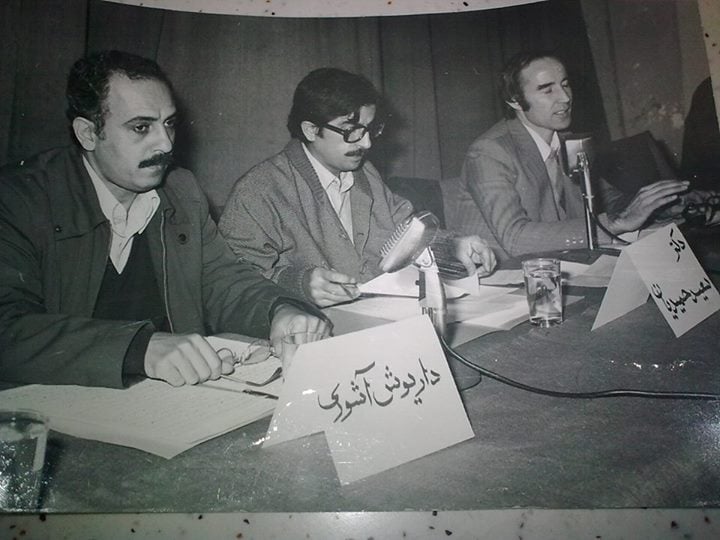
Daryoush Ashouri (Persian: داریوش آشوری), born in Tehran on August 2, 1938, is one of the most influential Iranian intellectuals of the last half-century — and one of the least easily categorized. Trained at the University of Tehran’s Faculty of Law, Political Science, and Economics, he went on to hold visiting positions at Yale University, the University of Oxford’s Oriental Institute, and Tokyo University of Foreign Studies, while also lecturing on political philosophy and political sociology at the University of Tehran. From 1970 to 1978 he served as a member of Iran’s Academy of Persian Language. Since the 1980s he has lived in Paris.
Ashouri’s career resists a single label: he is at once an essayist, encyclopedist, lexicologist, literary critic, and translator. His most lasting contribution to Persian intellectual life may be linguistic rather than doctrinal — he has coined and adapted a substantial part of the modern Persian vocabulary used in the humanities and social sciences, work compiled in his Farhang-e ‘Olum-e Ensani (Dictionary of the Human Sciences). His book-length study of Hafez, ‘Erfān o Rendi dar She’r-e Hafez, is considered a landmark in modern Persian literary hermeneutics, and his essays on modernity — collected in Mā va Moderniyat (We and Modernity) — have shaped decades of Iranian debate about how a non-Western society absorbs, resists, or reinvents Western categories of thought.
It is precisely this long engagement with the problem of cultural translation that makes Ashouri’s second major legacy so significant: he is the principal Persian translator of Friedrich Nietzsche, having rendered Beyond Good and Evil, On the Genealogy of Morality, Twilight of the Idols, and, most consequentially, Also Sprach Zarathustra (Thus Spoke Zarathustra) into Persian. Translating Nietzsche’s Zarathustra into the very language whose ancient ancestor, Avestan, was spoken by the historical prophet Zarathustra/Zoroaster placed Ashouri in a uniquely charged position — one he used not simply to render Nietzsche’s German into Persian, but to correct a long-standing Iranian misunderstanding of what Nietzsche had actually done with the name.
The Misreading Ashouri Set Out to Correct
In his article “Nietzsche and Persia,” written for the Encyclopaedia Iranica, Ashouri identifies a recurring and, in his view, naive tendency among Iranian readers: the wish to treat Nietzsche’s Zarathustra as a faithful revival of the historical Zoroastrian prophet, and to receive Nietzsche’s choice of name as an act of homage to Persian civilizational greatness. Ashouri notes that this reaction has old roots — Nietzsche’s sister Elisabeth reported that Persian visitors to her Weimar salon regularly thanked her brother for having chosen a Persian sage as the herald of a new and superior humanity. The same impulse survives among what Ashouri calls “uncritical admirers of pre-Islamic Iranian history and culture,” particularly compatriots eager to find in Nietzsche’s masterpiece a mirror of their own ancient prophet’s teaching.
Ashouri’s rebuttal is philological and philosophical at once. He shows that Nietzsche’s acquaintance with actual Zoroastrian sources was thin — there is no firm evidence he ever read Anquetil-Duperron’s pioneering translation of the Avesta, despite his philological training and his awareness of the emerging European scholarship on Old Iranian religion. Nietzsche’s borrowings from Zoroastrianism are, on Ashouri’s reading, few and largely structural: the name itself; the image of the prophet withdrawing to a mountain at age thirty and descending ten years later to teach humanity; and the Persian word hazār (a thousand), which Nietzsche uses for the millennial cycles of his own doctrine of cosmic recurrence. Beyond these borrowed motifs, the text of Zarathustra is saturated not with Avestan material but with the Bible — Nietzsche’s real interlocutor throughout is Judeo-Christian morality, not Mazdean theology.
The Deliberate Inversion at the Heart of the Choice
Where Ashouri’s analysis becomes genuinely incisive is in his account of why Nietzsche chose this name at all, given how little substantive use he made of Zoroastrian doctrine. The answer, Ashouri argues, lies not in imitation but in calculated reversal — and Nietzsche said so himself. In Ecce Homo, Nietzsche explains that he places his philosophy “in the mouth of the first immoralist” precisely because the historical uniqueness of the Persian prophet consists in the opposite: Zarathustra, on Nietzsche’s account, was the first to make the struggle between good and evil into the very axle of the cosmic machine — the first to project morality onto the metaphysical structure of reality itself. Having been the one to invent this “most calamitous error,” Nietzsche’s Zarathustra must also be the one to outgrow it. The self-overcoming of morality, achieved through radical truthfulness, is thus staged as the self-overcoming of the moralist — turned into his opposite, into Nietzsche.
Ashouri’s point, distilled, is this: Nietzsche did not borrow Zoroaster’s teaching, he inverted it, and he inverted it knowingly and publicly. The two Zarathustras share a biography (mountain, solitude, descent, revelation) but preach opposite gospels. The historical prophet, on this reading, moralizes the cosmos into a battlefield of Ahura Mazda’s truth against Angra Mainyu’s falsehood; Nietzsche’s poetic prophet arrives at the end of that same history to announce the death of God and the consequent impossibility of any moralistic reading of existence whatsoever. The relationship between the two figures is not resemblance but antipodal structure — same shape, opposite content. For Ashouri, then, the Iranian nationalist celebration of Nietzsche’s choice rests on missing exactly this: Nietzsche did not exalt the Persian prophet, he recruited his name in order to stage that prophet’s philosophical defeat.
What Ashouri Leaves Untouched
It is worth being precise about the limits of Ashouri’s intervention, because they mark the boundary of a debate that has not, on the whole, been carried further. Ashouri corrects a reception error — the sentimental, nationalist conflation of Nietzsche’s literary figure with the historical prophet — largely by explaining and defending Nietzsche’s own stated intentions. What he does not do is interrogate the accuracy of the premise Nietzsche builds the inversion on: namely, that the historical Zarathustra really was “the first moralist” in the sense Nietzsche needs him to be — the inventor of a metaphysical, quasi-fatalistic dualism between good and evil as opposing cosmic forces.
This is a non-trivial gap, because specialists in Gathic and Avestan ethics have long emphasized that the innovation most securely attributable to the historical Zarathustra is not dualism as fatality but the introduction of individual moral choice — the demand that each person actively choose between Asha (truth, order) and Druj (falsehood) rather than passively inherit a cosmic verdict. If that emphasis on freedom and responsibility is closer to the historical core of Zoroastrian ethics than the rigid, externally-imposed dualism Nietzsche attributes to “the first moralist,” then Nietzsche’s caricature of his source may be doing more rhetorical work than philosophical justice — and the antipodal relationship Ashouri describes so lucidly might be less clean than either Nietzsche or his Iranian critic-defender suggests. Ashouri, writing primarily as a corrective philologist and defender of Nietzsche’s coherence, does not pursue this further question, and it remains, as far as the available literature shows, largely unexplored from within Iranian Nietzsche scholarship itself.
Contemporary Western Scholarship on the Same Terrain
Ashouri’s essay does not stand alone; it intersects with a body of Western scholarship that has approached Nietzsche’s use of Zarathustra from adjacent but distinct angles — historical-philological, postcolonial, and genealogical.
Jenny Rose’s study The Image of Zoroaster: The Persian Mage Through European Eyes (2000) traces the long European fascination with Zoroaster from antiquity through the nineteenth century, situating Nietzsche’s appropriation within a much older Western habit of refashioning the Persian prophet to fit contemporary intellectual needs — magus, monotheist, proto-scientist, or, in Nietzsche’s case, anti-moralist.
Duncan Large’s essay “Nietzsche’s Orientalism” argues that although Edward Said’s foundational study of Orientalism largely bypassed the German tradition, Nietzsche’s treatment of “Asia” and “the Orient” fits the pattern in a distinctive way: his stereotypes are generally admiring rather than denigrating, deployed to critique European decadence, yet no less generalized or under-examined for that inversion of value.
More recently, an essay published on the Journal of the History of Ideas blog, “Nietzsche’s Debt to Zoroastrianism: How a Cultural Collision Contributed to Also Sprach Zarathustra,” has pushed the genealogical question further than Ashouri does, arguing that Nietzsche’s reading of philologists such as Georg Friedrich Creuzer gave him a deeper and more sustained engagement with Zoroastrian material than is commonly assumed, and that recognizing this debt complicates the standard image of Nietzsche as a purely “Western” or self-generated genius.
Conclusion
Finally, scholarship on the postcolonial afterlife of Nietzschean concepts — including work tracing how ressentiment travels from Nietzsche through Frantz Fanon, Edward Said, and Achille Mbembe — situates the Zarathustra episode within a wider and still-active argument about how non-Western figures, texts, and concepts get absorbed into European philosophy’s self-image, often in service of arguments those figures never made and might well have contested.
Taken together, these strands suggest that the fullest reckoning with Nietzsche’s Zarathustra — one that would test Nietzsche’s caricature of “the first moralist” against the actual ethical content of the Gathas, rather than simply defending or historicizing his choice of name — has yet to be written, sitting at the unclaimed intersection of Ashouri’s philological correction and the postcolonial critique of European appropriation. (“Ressentiment in the Postcolony: A Nietzschean Analysis of Self and Otherness.” Scholarly article on the deployment of Nietzschean ressentiment by Frantz Fanon, Edward Said, and Achille Mbembe.)