Working it out in organisations across the world
Dear Colleagues – Our 20 are Home!
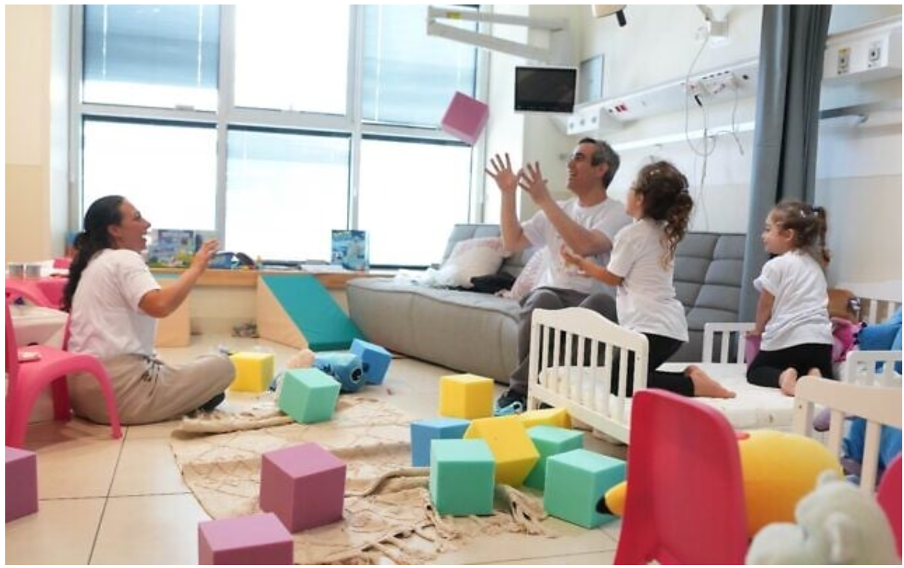
Released hostage Omri Miran is reunited with his daughters Roni, 4, and Alma, 2, and wife Lishay Miran-Lavi, at Ichilov Hospital after he was released from Hamas captivity in Gaza on October 13, 2025 (GPO)
If you bump into a Jewish colleague this week and ask them how they are feeling, you will likely get a big smile wrapped up in a deep sense of joy. It will be tinged with the sadness and tragedy that we have felt for two years and that is still ongoing for many, especially those who have not yet been able to bury their loved ones.
On Monday, 13th October 2025, our remaining twenty living hostages came home to Israel. So many of us, including even the most optimistic reporters and the most seasoned negotiators, had stopped imagining this was a possibility. Potential deals were framed in terms of ‘half the hostages’; thoughts went through our minds that were too horrendous to express. We knew these men were being held in underground tunnels, we knew they had been tortured, starved and some were being held in isolation. We knew six hostages (Alexander, Almog, Carmel, Eden, Hersch and Ori) had been executed in September 2024. And we understood that these twenty men were the final bargaining chip of a desperate terror organisation.
And yet, here we are.
The picture above is of Omri Miran and his wife, Lishay, playing with their two daughters, Roni and Alma. There were so many photos I could have selected, each one showing hugs and tears and real time love between parents and children, siblings, partners, husbands and wives and friends reunited. This one was simply the first one that popped up on my Instagram feed. It captures the joyfulness of a family, it brings relief that Roni and Alma will not be added to the over one thousand children orphaned on October 7th 2023, and it shows the spirit of play. As I write this, I send love to Yarden Bibas, whose wife, Shiri, and children Ariel (Batman) and Kfir, had such different and heartbreaking endings. Containing both realities is our current task.
Some of you are reporting cognitive dissonance. You want to be happy and yet there is nothing that Trump has ever done or said that you have supported. On a recent Call Me Back podcast, the question was posed as to whether history is shaped by moments or leaders. All three commentators, covering the spectrum of political leanings, acknowledged that in this moment there has been something of the man. Something of a leader who decided that the way things have been done until now is no longer working, who was willing to create a new reality through sheer force of will.
I am no rabbi, but the way I have made sense of it is simple. We are often surprised when amazing individuals do bad or foolish things. Why can’t the opposite be true? If G-d is trying to teach us anything, it is that humans are complex, unpredictable and more nuanced than any of our algorithms. If anything has been proven, it is that ultimately none of us can be that certain about anything. That does not mean we cannot hold our views or voice our opinions or believe what we believe. But we should remember to do so with just a touch more humility. On all sides. As a friend of mine posted, “I don’t know him personally and I have a complicated relationship with him, but I want to thank Donald Trump for bringing the hostages back home.’ I can say Amen to that.
Each of us will find our new way into the future. What I am deeply confident about, is that Israel will be fine. It will flourish, reinvent itself yet again, likely have a baby boom (many of whom will be called Donald!), and continue to produce miracles. Israel is not what I worry about. Israel will not be the scary place to be in the world.
The scary places are those where the chanting continues and where the silence resounds. The next time your child tells you that they are going on a march, take a moment to check whether they understand what they are chanting, whom they are supporting and what it really means. When thousands of people marched on Sydney’s Harbour Bridge in August this year, many explained to me that they were neither anti-semitic nor against the existence of the state of Israel, they were merely supporting the end of a war. From where I sit, that is not good enough. We cannot have people screaming, ‘From the river to the sea’, saying they want peace. We cannot have people marching under an Iranian flag while claiming that they do not support the destruction of Israel. We cannot have people wearing keffiyehs, long symbolising terror for Israelis, and brushing it off as a way of demonstrating care for people in Gaza. If your children truly care for the people of Gaza, encourage them to find those Palestinian leaders with a vision for deradicalisation, who genuinely want to build a flourishing Palestinian society and then encourage them to support them with all their heart.
Slowly details will emerge. While the hostages looked skinny but relatively well, let us not be naïve about what they have been through. And while Israelis are still celebrating on the streets, thousands are struggling with the aftermath of trauma. Only a few days ago, Roei Shalev, 30, was unable to continue living as a witness to his best friend and girlfriend being murdered at the Nova festival and took his own life. He is not the first, and we know he will not be the last. While the deal demanded that twenty-eight hostage bodies be returned on Monday as a condition of the ceasefire, Hamas returned only four. They have already broken the rules. The body of our last female slain hostage, Inbar Hayman, remains somewhere in Gaza. Families continue to wait for the dignity of a burial.
But let us also hold onto this miracle: our twenty living hostages came home!
This week at Friday night dinners across the world, an additional prayer, Shehecheyanu, will be added to those said over the bread and wine. It is a blessing recited to express gratitude to G_d for having reached a particular moment. “Blessed are you, Lord our G_d, King of the Universe, who has granted us life, sustained and enabled us to reach this occasion.”
Carmel
p.s. Oh, and about Netanyahu. Sometime between now and November 2026, elections will take place. Let the people of Israel decide whom they want as their next prime minister. After all that is how democracies work.
Related Topics
Related Posts