

Deceitful Definitions Means Discourse Dies
 The two parents were respectful, but concerned. “We love Israel and aren’t afraid to say so in public – and our daughter feels the exact same. But does the course you teach have to include that word on the transcript? She’s applying to several selective colleges, and we’re worried that someone in the Admissions office, especially when behind closed doors, will react negatively.” Needless to say, the offending word was Zionism.
For decades, critics of Israel have formulated their own definition of the word. Urged on by the Arab League, in 1975 the United Nations infamously proclaimed “Zionism is Racism.” Years later, the international body rescinded the resolution, but the damage was already done. More recently, impassioned protesters upset about the war in Gaza held signs and plastered social media claiming the word means “Settler Colonialism” or “Apartheid.” Neither is accurate, but those marching have mostly been young college students who just don’t know. But a professional journalist like Lulu Garcia-Navarro from NPR should. Which makes her “reporting” even more reprehensible.
In a recent interview of Jonathan Greenblat, Head of the Anti-Defamation League, Garcia-Navarro said this: “In talking to people who are self-described anti-Zionists . . . they feel that everyone should have rights in Israel and Palestine and Palestinian territories.” It’s so clever & nefariously subtle – because who among us doesn’t believe in equal rights? But leaving aside all the facts & history this characterization fails to consider, the more critical issue is this:
The “self-described anti-Zionists” are allowed to define themselves and by extension define their opposition – meaning Zionists? In no other context would a New York Times journalist allow this. Do those protesting a given U.S. policy get to define what American nationalism is? Of course not. When it comes to Israel, however, definition & delegitimization is apparently fair game.
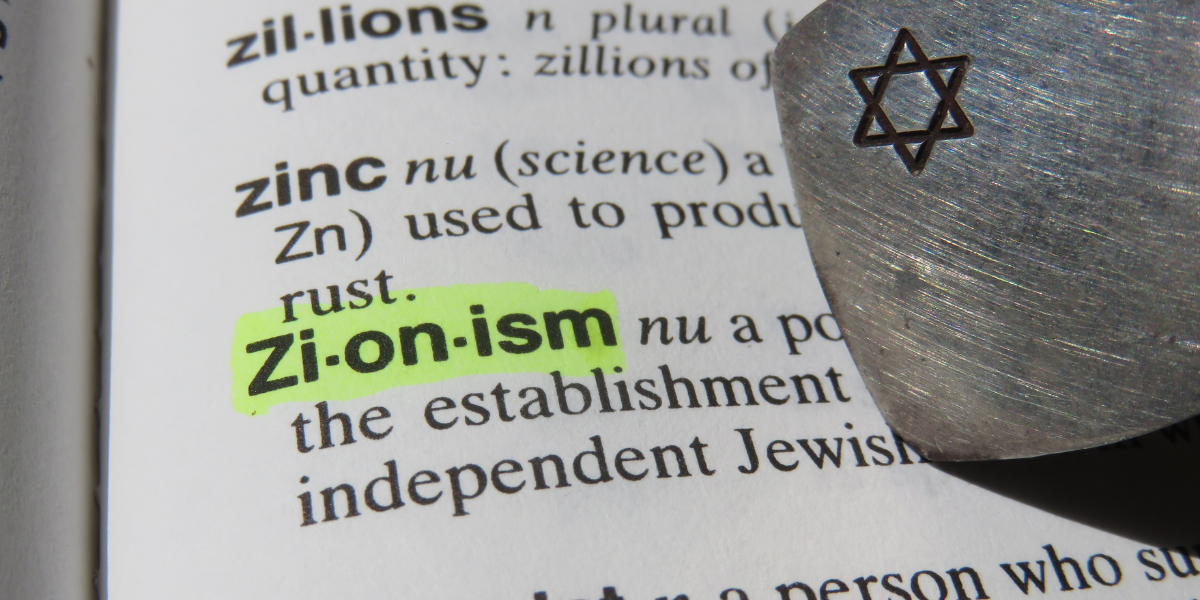
So what is “Zionism?” Simply put, it is the national liberation movement of the Jewish People. And despite claims to the contrary, it’s an ancient idea – for Jews have repeatedly dreamed of returning to and re-establishing sovereignty in our ancestral home after every expulsion from the Land of Israel, dating back to the Assyrian Conquest in the 8th century BCE. After millennia of longing, Zionism took on a modern incarnation in the 19th century, similar to other forms of nationalism across Europe. In 1948, the U.N. officially recognized the Jewish State. And yet, ours is the only nationalism on earth that is still subject to existential questioning.
* * *
That said, it’s important to acknowledge a different fallacious definition of Zionism – one that some segments of the Jewish community seek to impose on others. It’s a myopic view that “Zionist” means only those who support a right-wing view of what’s “good” for Israel. I’ve literally been lectured to by individuals from this ideological camp that NYT columnist Thomas Friedman and members of the liberal pro-Israel lobbying group J-Street aren’t Zionist – even though they clearly support Jewish self-determination. The problem with this approach should be obvious: It’s intellectually vacuous and strategically short-sighted. Zionism can, should & does include progressives. Which is why, for example, Israel hosts two gay-pride parades annually (one in Tel Aviv, the other in Jerusalem), while all of its Arab neighbors still have none. Those of us who love Israel should embrace a large tent because it’s right, smart, and consistent with the movement’s history. (Think of David Ben Gurion versus Ze’ev Jabotinsky.)
* * *
There are several other words that are knowingly mis-defined in arguments about Israel, including “Palestine” and “Intifada,” but the most pervasive & pernicious abuse of language relates to claims of genocide. To be clear, the humanitarian crisis and loss of innocent life in Gaza is heart-breaking, and there are valid criticisms of some of the Israeli government’s actions there – including about the ongoing military campaign given remaining objectives and likely harm to civilians. Israelis themselves protest about this weekly. That said, here’s some critical historical context:
The Holocaust (1941-45): The Nazis systematically murdered 6 million Jews, comprising nearly 70% of European Jewry.
Cambodia (1975-79): The Khmer Rouge murdered between 1.5 and 2 million “political enemies,” comprising nearly 25% of the population.
Ottoman Empire (1915–1916): The Turks murdered almost 1.5 million Armenians, comprising about 75% of the local population.
Rwanda (1994): Hutu militias murdered between 500,000 and 800,000 Tutu men (comprising 10-15% of the population), and raped between 250,000 and 500,000 women — in a span of 100 days.
Notwithstanding how tragic Gaza is, the notion of using the same word to describe the situation there with the notorious events above is absurd. In addition, consider the following:
- First, Israel acted only after she was attacked by a heavily armed enemy that proudly seeks her destruction – and one that intentionally hides among urban residents.
- Second, in war, innocents are killed. In World War II, for example, Allied bombing killed over 500,000 German citizens. In this war, Israel provides advanced notice of when and where it’s going to bomb and distributes food and medical aid to the hostile population. The Allies did neither.
- And finally, leaving aside the astronomical increase in Gaza’s population since Israel captured the territory in 1967 (nearly 500%), the current war has resulted in approximately 60,000 Palestinian deaths in a population of over 2 million – and half those killed have been adult men, often militants who belong to Hamas or Islamic Jihad.
The actual genocides listed above aren’t remotely similar – in scope, context, or design.
In sum, strong feelings tempt us to use strong language. But when we manipulate words in an effort to provoke and prevail emotionally, it undermines our ability to have meaningful discourse rationally. The result of which is we all lose.