

Philosophy, kabbalah, screenwriting...
Delcy, Bibi, and the Reunion of Two Nations
Venezuelan Jews never ceased to be Venezuelan, even if they occasionally felt imperiled by the geopolitical rhetoric sparked by Chávez and inherited by Maduro. This was a discourse defined by an affinity for jihadist Palestine, Iran, and Syria—nations traditionally positioned as arch-enemies of Israel.
To my recollection, there was never an official antisemitic campaign targeting Venezuelan Jews. However, the State of Israel was frequently criticized from afar—accused of “genocide” for its legitimate and fierce self-defense following the horrific attacks of October 7, 2023.
Of the 30,000 Jews once residing in Venezuela, only about 3,500 remain, according to the Israelite Federation. I do not believe their departure was driven by active persecution; rather, my impression is that they left—much like six million other Venezuelans—primarily due to the economic collapse, the erosion of institutions, and a vanishing sense of a viable future. This choice is deeply respectable: if one cannot build a life in one country and has the opportunity to move to another, they should do so. It is what the Hebrew people have done for millennia. One’s family and children will be grateful, and those left behind can be supported through remittances from Spain, Australia, Canada, or Argentina.
The severance of ties with Israel and the United States was the handiwork of Chávez. It was fueled by his obsession with restructuring the world order—viewing himself as the reincarnation of Simón Bolívar—his incurable megalomania, and an ideology inherited from Nasser’s failed pan-Arabist ambitions. His goal was to undermine Israel by forging coalitions, forcing antagonistic UN votes, and weaponizing media manipulation—all fueled by oil. It was the same playbook Chávez used with Bolivia, Cuba, and Nicaragua, squandering millions of barrels of crude on Caribbean micro-states while ruining our own nation.
Maduro inherited this framework and found himself unable to pivot. Chávez left him surrounded by “bad friends” and dangerous partners. I suspect they knew this path would lead to collapse, yet they lacked the political training, statecraft, and strategic muscle to navigate a geopolitics as complex and ruthless as the one following the war in Ukraine and the escalations in Gaza, Lebanon, and Iran. That was the reality until January 3rd, when Venezuela was pulled back toward its natural sphere of influence: the Western Hemisphere and the United States.
In a previous column, we discussed the Israeli Foreign Minister’s comments regarding the possibility of resuming bilateral relations following the events of “3E.” Similarly, we noted statements from Deputy Nicolás Maduro Guerra (son of the imprisoned former president) about a potential restoration of ties based on “mutual respect and sovereignty.” Yet, on the surface, nothing happened.
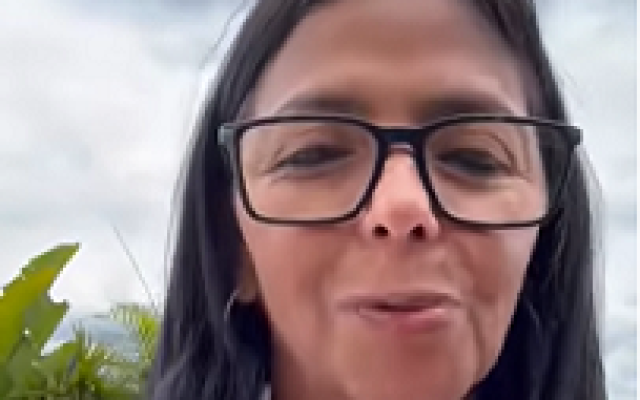
Yesterday, however, Interim President Delcy Rodríguez posted on Instagram a warm Passover greeting to the Venezuelan Jewish community and the Venezuelan Chief Rabbi Isaac Cohen, praising the Jewish people and advocating for peace and inter-cultural and inter-religion respect. She appeared smiling, though somewhat weary—likely from the exhaustion of the transition.
What does this signify?
It suggests that the distancing from radical Islamic regimes is accelerating. Official rhetoric no longer mentions Gaza, and when Iran or Lebanon is discussed, it is through sterile, perfunctory calls for peace without any real initiative. It is hard to say, but I imagine that in pectore, high-ranking officials of the current transitional government—and Delcy in particular—are quietly relieved by the strategic setbacks Israel and the U.S. are dealing to Iran in the Middle East.
In his speech yesterday, Donald Trump sent a clear message: the U.S. does not need the Strait of Hormuz; it has enough oil and gas to supply itself and its European allies. And if more is needed, they will buy it from Venezuela.
It seems we are returning to the fold. Good riddance to Hamas, the Houthis, Hezbollah, and the Ayatollahs. Likewise, a firm distance from the Cubans, Russians, and Nicaraguans. If the Chinese want our oil, they shall pay market price—not a penny less. In truth, this is what the majority of Venezuelans wanted all along—perhaps even the officials themselves in secret—though they didn’t know how to shake off that swarm of leeches.
But the Lord’s ways can be winding and unexpected. We are in the days of Passover. Who knows if, by the end of the Counting of the Omer, Delcy and Bibi will already be exchanging messages, much like the dialogue with Rubio and Trump.